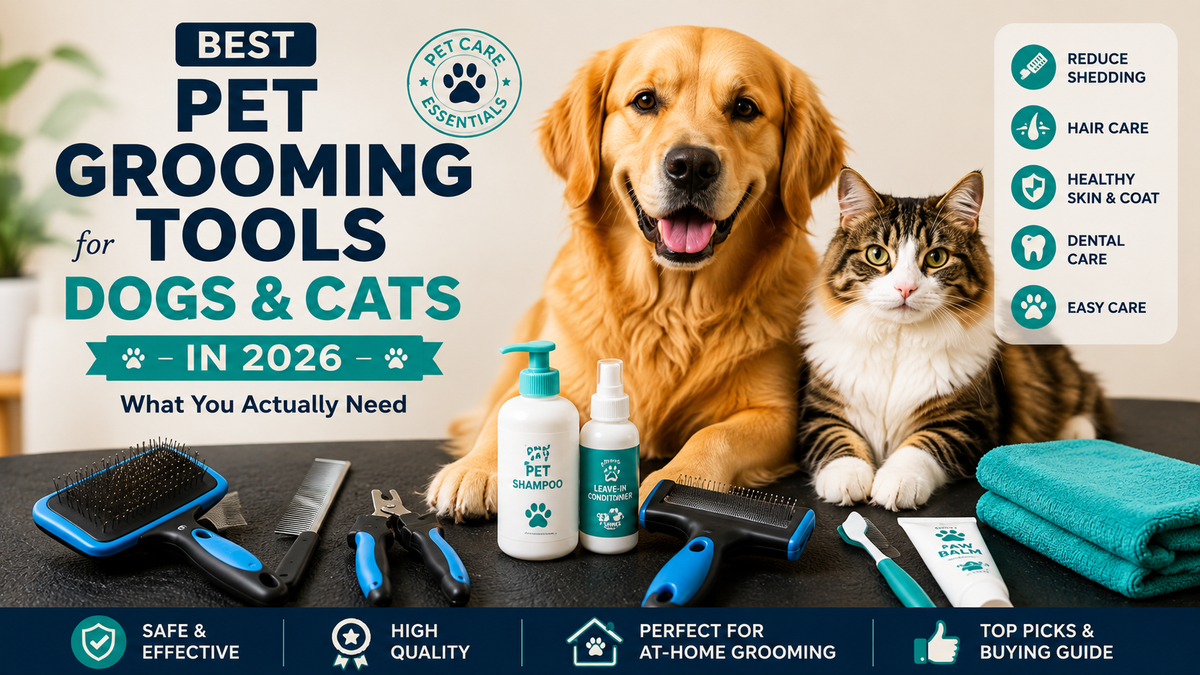
Keeping a dog or cat well-groomed is about much more than making them look good. The right grooming tools can help control shedding, reduce tangles and mats, keep nails at a healthy length, support dental and ear care, and make routine grooming easier for both you and your pet.
But there are hundreds of brushes, combs, clippers, shampoos, nail trimmers, dryers, and grooming kits available. Choosing the right ones can quickly become confusing.
The good news is that you do not need every grooming gadget you see.
You need the right tools for your pet’s coat, size, grooming needs, and temperament.
In this guide, we’ll explain the most useful pet grooming tools for dogs and cats, what each tool does, who needs it, what to look for before buying, and when professional grooming or veterinary care is the better choice.
Quick Answer: What Are the Best Pet Grooming Tools?
For most pet owners, a practical home grooming setup starts with a suitable coat brush, grooming comb, nail clippers, pet-safe shampoo, and a deshedding tool when the pet’s coat requires it.
Depending on your pet’s needs, you may also want ear-cleaning supplies, a pet toothbrush and toothpaste, grooming scissors, a pet hair dryer, or an all-in-one grooming kit.
The most important rule is simple:
Choose the tool for the job and your pet’s coat—not simply the most popular product.
A slicker brush that works beautifully for a long-haired cat may be unnecessary for a short-haired dog. Likewise, a powerful deshedding tool is useful for some double-coated pets but is not automatically the right choice for every dog or cat.
Why Choosing the Right Grooming Tools Matters
Regular grooming helps keep your pet’s coat clean and manageable, but it also gives you an opportunity to notice changes that might otherwise be hidden under fur.
Depending on the pet and coat type, grooming can help:
- Remove loose hair and reduce shedding around the home
- Prevent small tangles from becoming painful mats
- Keep the coat cleaner and easier to manage
- Support healthy-looking skin and fur
- Keep nails from becoming excessively long
- Support routine ear and dental care
- Help you notice unusual lumps, irritation, parasites, or skin changes
- Make grooming sessions faster and more comfortable
The key is choosing tools that match your pet rather than trying to use one grooming setup for every animal.
Start with the tools your pet actually needs.
10 Best Pet Grooming Tools for Dogs and Cats
1. Slicker Brush
A slicker brush is one of the most useful grooming tools for many dogs and cats, especially pets with medium or long coats.
The fine pins can help remove loose hair and work through minor tangles while keeping the coat looking neat.
Best for:
- Long-haired dogs
- Curly or dense coats
- Long-haired cats
- Removing loose fur
- Managing minor tangles
What to look for:
- Comfortable handle
- Fine but appropriately sized pins
- A design that is gentle on the skin
- Easy-to-clean bristles
- Size appropriate for your pet
Do not assume that a harder brush is a better brush. Excessive pressure can make grooming uncomfortable.
For dogs, the right brush depends heavily on coat type. For cats, long-haired breeds often benefit from regular gentle brushing to prevent tangles and mats.
2. Deshedding Tool
If your pet leaves fur on your furniture, clothing, and floors, a deshedding tool can become one of the most useful additions to your grooming routine.
Deshedding tools are designed to help remove loose undercoat hair that ordinary brushing may not capture as effectively.
Often useful for:
- Labrador Retrievers
- German Shepherds
- Golden Retrievers
- Huskies
- Other heavy-shedding dogs
- Cats with suitable coats
However, this is one area where more is not better.
A deshedding tool should be used according to the pet’s coat and the manufacturer’s instructions. Using a tool too aggressively or too frequently can irritate the skin or remove more coat than necessary.
Before buying, consider:
- Your pet’s coat length
- Whether your pet actually has a removable undercoat
- Tool tooth spacing
- Handle comfort
- Skin sensitivity
If shedding is your biggest grooming problem, this may be one of the first tools worth considering.
3. Pet Nail Clippers
Nail care is easy to overlook until your pet’s nails become noticeably long.
Pet nail clippers are designed specifically for animal claws and can give you better control than trying to improvise with unsuitable tools.
Look for:
- Sharp stainless-steel blades
- Comfortable non-slip handles
- A size suitable for your pet
- A safety feature if you are a beginner
- A design that gives you a clear view of the nail
The biggest concern when trimming nails is the quick, the sensitive tissue inside the nail.
Take small amounts off at a time and avoid rushing.
If you are uncomfortable trimming your pet’s nails, a professional groomer or veterinarian can show you the correct technique.
4. Grooming Comb
A grooming comb is a simple tool, but it can reveal tangles that a brush may miss.
A good comb is particularly useful around areas where mats commonly develop, such as:
- Behind the ears
- Around the neck
- Under the legs
- Around the tail
- Longer facial hair
For long-haired pets, a comb can also help you check whether you have brushed all the way through the coat rather than only grooming the surface.
Metal grooming combs are often durable and easy to clean.
Tip: Use the comb gently. If you encounter a stubborn mat that you cannot safely remove, do not repeatedly pull at it. Severe or tight mats may require professional help.
5. Pet Shampoo
Bathing is another part of grooming where the wrong product can cause unnecessary problems.
Always choose a shampoo formulated specifically for pets rather than assuming a human shampoo is suitable.
Depending on your pet’s needs, you may look for:
- Gentle formulas
- Oatmeal-based formulas
- Hypoallergenic options
- Moisturizing ingredients
- Puppy- or kitten-appropriate formulas
The best shampoo depends on the animal, coat, and skin needs.
If your pet has persistent itching, redness, odor, sores, or other skin problems, grooming products should not replace veterinary advice.
6. Ear Cleaning Solution
Ear care is another useful part of a complete grooming routine.
A pet-safe ear-cleaning solution can help owners maintain routine ear hygiene when appropriate for their pet.
Look for:
- A product specifically formulated for pets
- Clear usage instructions
- A gentle formula
- A product appropriate for your pet
Never force cotton swabs deep into the ear canal.
If an ear is painful, very red, swollen, producing unusual discharge, or has a strong persistent odor, it is better to have the ear checked by a veterinarian rather than trying to solve the problem with grooming products alone.
7. Pet Toothbrush and Toothpaste
Grooming should not stop at fur.
Dental care is an important part of routine pet care, and a pet-specific toothbrush and toothpaste can make home dental care easier.
A basic dental setup can include:
- Pet toothbrush
- Pet-safe toothpaste
- Finger brush for pets that tolerate it better
- Dental-care routine appropriate for the animal
Never use human toothpaste for your pet.
Start slowly and allow your pet to become comfortable with the toothbrush before expecting a full brushing session.
The goal is consistency, not forcing a long dental session on day one.
8. Grooming Scissors
Grooming scissors can be useful for carefully trimming small areas of fur, especially around places where precision matters.
They may be useful around:
- Paws
- Face
- Ears
- Tail
- Sanitary areas
For beginners, scissors with rounded or safety-oriented tips can provide an additional margin of protection, but they still need to be handled carefully.
Never use grooming scissors to cut through a tight mat sitting close to the skin.
If you cannot clearly see where the skin ends and the mat begins, professional grooming is the safer option.
9. Pet Hair Dryer
A pet hair dryer can be useful for owners who regularly bathe long-haired dogs or cats.
A good dryer can help reduce drying time and make coat maintenance easier after bathing.
Useful features include:
- Adjustable airflow
- Multiple temperature settings
- Lower-noise operation
- Comfortable controls
- A design intended for pets
Noise matters.
Some pets are frightened by loud dryers, so a quieter model may be worth considering if your pet is nervous around grooming equipment.
Always avoid excessive heat and follow the manufacturer’s instructions.
10. Grooming Kit
If you are starting from scratch, an all-in-one pet grooming kit can be convenient.
Depending on the kit, you may find combinations such as:
- Brush
- Comb
- Nail clippers
- Grooming scissors
- Clippers
- Cleaning brush
- Storage case
- Additional attachments
A grooming kit can be a good value when you genuinely need several of the included tools.
But do not buy a large kit simply because it contains more pieces.
A smaller kit containing the tools your pet actually needs may be a better purchase than a 20-piece set filled with items you will never use.
Dog Grooming Tools: What Should You Choose?
Dogs have dramatically different coat types, so their grooming requirements can vary from one breed to another.
A short-haired dog may need little more than routine brushing and nail care, while a long-haired or double-coated dog may need more frequent brushing, combing, and seasonal shedding management.
If you are shopping specifically for your dog, explore our Dog Grooming Tools collection:
You’ll be able to focus specifically on grooming products selected for dogs instead of sorting through products intended for other pets.
Regular grooming is more than keeping your dog looking neat. Brushing can help remove loose hair and give you an opportunity to notice changes in the skin or coat early. Grooming routines should also be comfortable for your dog, and if you notice unusual skin irritation, pain, lumps, or other concerning changes, it’s best to consult your veterinarian. For additional veterinary guidance on caring for companion animals, see the American Veterinary Medical Association (AVMA)
A Simple Dog Grooming Starter Setup
- Coat-appropriate brush
- Grooming comb
- Nail clippers or grinder
- Pet shampoo
- Dental-care supplies
Add a deshedding tool, scissors, dryer, or clipper when your dog’s coat and grooming routine actually call for them.
Cat Grooming Tools: What Should You Choose?
Cats are excellent self-groomers, but that does not mean they never need help.
Long-haired cats can develop tangles and mats, while many short-haired cats still shed and benefit from regular brushing.
The most important consideration is to choose tools that are appropriate for the cat’s coat and use them gently.
For cats with longer coats, a suitable brush or comb can help manage loose hair and minor tangles. Short-haired cats may need a simpler brushing routine.
If you’re shopping specifically for your cat, see our Cat Grooming Tools collection:
This gives you a more focused place to compare grooming products intended for cats.
Cats are naturally good at grooming themselves, but regular brushing can still be beneficial, especially for cats with longer coats. Cornell University’s College of Veterinary Medicine notes that brushing helps remove loose hair and can also give owners an opportunity to monitor the skin and coat. Regular nail care is another important part of routine cat grooming. For more veterinary-backed cat-care information, visit the Cornell Feline Health Center
Can You Use the Same Grooming Tools for Dogs and Cats?
Sometimes—but not automatically.
Some grooming tools, such as certain brushes and combs, can work for both dogs and cats when the tool is appropriate for their coat and used correctly.
Other products are better chosen specifically for the animal.
For example, a grooming tool designed for a large double-coated dog may be too aggressive or simply unnecessary for a small short-haired cat.
Before Buying, Ask These Questions
- What type of coat does my pet have?
- How much does my pet shed?
- Does my pet have long, medium, or short fur?
- What grooming problem am I trying to solve?
- Is the tool appropriate for my pet’s size?
- Will my pet tolerate the tool’s noise or sensation?
These questions are more useful than simply choosing the product with the highest number of reviews.
How to Choose the Best Pet Grooming Tools
Match the Tool to the Coat
Coat type should be one of your first considerations.
Long hair, short hair, curly coats, double coats, and fine coats can all respond differently to grooming tools.
A tool that works brilliantly for one pet may be unnecessary—or uncomfortable—for another.
Think About the Grooming Job
Do not start with:
“Which grooming tool is best?”
Start with:
“What do I need this tool to do?”
- Too much loose fur → consider a suitable deshedding tool
- Tangled coat → brush and comb matched to the coat
- Long nails → pet nail clippers or grinder
- Bathing → pet-safe shampoo
- Ear maintenance → appropriate pet ear cleaner
- Dental care → pet toothbrush and toothpaste
- Small fur trims → grooming scissors
- Frequent bathing and long coats → pet dryer
Once you identify the problem, choosing the right category becomes much easier.
Consider Your Pet’s Temperament
A technically excellent grooming tool is not useful if your pet refuses to tolerate it.
Noise, vibration, pulling, pressure, and unfamiliar sensations can make grooming stressful.
For nervous pets, look for tools that are:
- Gentle
- Easy to control
- Comfortable to hold
- Low-noise when possible
- Appropriate for short grooming sessions
Introduce new tools gradually rather than immediately attempting a full grooming session.
Look for Comfortable, Durable Construction
Grooming tools are used repeatedly, so construction quality matters.
Features worth considering include:
- Stainless-steel blades or teeth
- Comfortable handles
- Secure grips
- Easy cleaning
- Durable construction
- Replacement parts where applicable
- Clear manufacturer instructions
The cheapest product is not always the best value if it breaks quickly or makes grooming uncomfortable.
Common Pet Grooming Mistakes to Avoid
1. Buying the Wrong Brush for the Coat
A brush should match the pet’s coat type and grooming needs.
2. Using Too Much Pressure
Brushing harder does not necessarily mean brushing better.
3. Overusing Deshedding Tools
Deshedding should be appropriate for the coat and used according to product guidance.
4. Ignoring Small Tangles
Small tangles can become larger, tighter mats if they are repeatedly overlooked.
5. Cutting Nails Too Quickly
Rushing increases the chance of cutting the quick.
6. Using Human Shampoo or Toothpaste
Pet grooming products should be specifically formulated for animals.
7. Treating Serious Skin or Ear Problems as Grooming Problems
Persistent itching, redness, swelling, discharge, painful ears, severe mats, or other concerning changes may require veterinary attention.
8. Buying a Huge Grooming Kit Without a Plan
More tools do not automatically mean better grooming.
Buy according to your pet’s actual needs.
How to Build a Simple Home Grooming Kit
If you’re a new pet owner, you do not need to buy everything at once.
For coat care:
- One appropriate brush
- One grooming comb
For nail care:
- Nail clippers or a suitable grinder
For bathing:
- Pet-safe shampoo
For dental care:
- Pet toothbrush and pet-safe toothpaste
Then add specialized tools based on your pet’s coat and routine.
Heavy shedders may benefit from a deshedding tool.
Long-haired pets may need additional combing tools.
Pets that are regularly bathed may benefit from a dryer.
Pets that require at-home trimming may need clippers or grooming scissors.
This approach keeps your grooming kit practical instead of turning it into a drawer full of tools you never use.
When Should You See a Professional Groomer or Veterinarian?
Home grooming is useful, but it has limits.
Consider professional help when:
- Mats are tight against the skin
- You cannot safely remove a severe tangle
- Your pet becomes extremely stressed during grooming
- You are uncomfortable trimming nails
- Your pet needs a complicated haircut
- You are unsure how to use clippers or scissors safely
A veterinarian should be involved when grooming reveals possible medical problems such as painful skin, persistent itching, unusual swelling, wounds, significant ear problems, or other concerning changes.
Grooming tools are designed to support routine care—not replace professional medical advice.
Where to Find the Right Grooming Products
Once you know which grooming tools your pet actually needs, the next step is comparing products based on quality, usefulness, customer feedback, and value.
For dog owners, start with our Dog Grooming Tools collection:
For cat owners, explore our Cat Grooming Tools collection:
You can also browse our broader pet product categories to compare other pet-care essentials.
Final Thoughts
The best pet grooming tools are not necessarily the most expensive, the most popular, or the ones included in the biggest kit.
The best tools are the ones that match your pet’s coat, size, grooming needs, and comfort level.
For many pet owners, a good brush, grooming comb, nail-care tool, and pet-safe shampoo are the foundation. From there, specialized tools such as deshedders, ear cleaners, dental-care products, grooming scissors, dryers, and complete grooming kits can be added when they make sense.
Whether you have a short-haired cat, a fluffy long-haired cat, a Golden Retriever, a Husky, or another beloved companion, choosing the right grooming equipment can make routine care easier for both of you.
Take your time, choose for the job rather than the hype, and make grooming a calm, positive part of your pet’s routine.
Ready to find the right tools?
Explore our Dog Grooming Tools and Cat Grooming Tools collections to find grooming products selected for your pet’s needs.