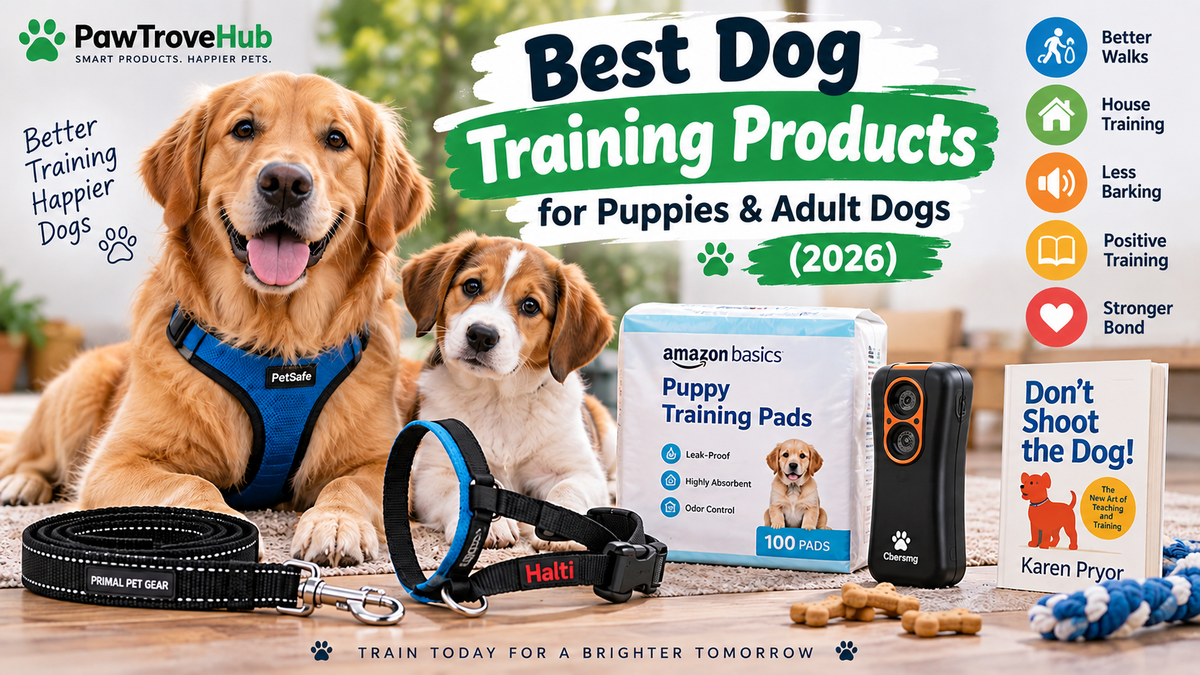
Training a dog is easier when you have the right tools for the job. Whether you are teaching a puppy to use the bathroom outside, helping an adult dog stop pulling on walks, or working on better everyday behavior, the right dog training products can make practice more manageable.
But good equipment is only part of the process. A harness, leash, training pad, or other tool cannot replace patience, consistency, positive reinforcement, and clear communication.
In this guide, we’ll look at some of the best dog training products for puppies and adult dogs in 2026, what each one is designed to help with, and how to decide which products you actually need.
Quick Answer: Best Dog Training Products
| Product | Best For |
|---|---|
| PetSafe Easy Walk No-Pull Dog Harness | Dogs that pull during walks |
| Primal Pet Gear 6-Foot Reflective Dog Leash | Everyday leash training |
| Halti Headcollar | Additional control during walks |
| Amazon Basics Puppy Training Pads | Puppy house training |
| Cbersmg 3X Ultrasonic Dog Bark Deterrent | Bark-related situations |
| Don’t Shoot the Dog! | Learning positive training principles |
You do not necessarily need all six products. The best choice depends on your dog’s age, behavior, training goals, size, and individual needs.
What to Look for in Dog Training Products
Before buying dog training supplies, think about the specific behavior you are trying to improve.
A good training product should be:
- Appropriate for your dog’s size and age
- Comfortable and properly fitted
- Durable enough for regular use
- Easy for you to use correctly
- Suitable for the particular training task
- Used alongside humane, reward-based training
Avoid buying equipment simply because it is marketed as a “training” product. A specialized tool is useful when it solves a real problem, but unnecessary equipment can make training more complicated.
If you are building your dog’s overall routine, you can also explore our Dog Food category for everyday nutrition options.
Best Dog Training Products for Puppies & Adult Dogs
1. PetSafe Easy Walk No-Pull Dog Harness
Best for: Dogs that pull on walks
Pulling is one of the most common problems dog owners encounter during walks. A no-pull harness can provide a different point of control than a traditional collar while giving you an opportunity to practice calmer walking.
The PetSafe Easy Walk No-Pull Dog Harness is designed specifically for dogs that tend to pull. Its design can help redirect the dog’s attention when combined with consistent loose-leash training.
The important thing to remember is that the harness itself does not teach a dog not to pull. Use it together with rewards, short training sessions, and consistent walking rules.
Good choice for: dogs that regularly pull toward people, smells, other animals, or interesting surroundings.
Check the PetSafe Easy Walk No-Pull Dog Harness on Amazon
Training tip
Start in a low-distraction environment. Reward your dog whenever the leash remains loose, then gradually introduce more challenging environments.
2. Primal Pet Gear 6-Foot Reflective Dog Leash
Best for: Everyday leash training
A reliable leash is one of the most basic pieces of dog training equipment you can own.
A six-foot leash provides a practical balance between freedom and control. It can be useful for everyday walks, basic leash manners, and practicing attention around gradually increasing distractions.
The reflective design can also be useful when walking in lower-light conditions.
The key is not simply having a good leash, but using it consistently. Dogs learn faster when the same expectations are reinforced during regular walks.
Good choice for: puppies learning leash manners and adult dogs that need more consistent walking practice.
Check the Primal Pet Gear 6-Foot Reflective Dog Leash on Amazon
Training tip
Reward your dog for walking beside you or maintaining a loose leash instead of waiting until pulling becomes severe.
3. Halti Headcollar for No-Pull Dog Training
Best for: Additional control during walks
Some dogs are extremely strong or become highly distracted outdoors. In those situations, a headcollar may provide additional control while the owner works on better walking behavior.
The Halti Headcollar is designed for dogs that need additional guidance during walks and training.
However, headcollars should be introduced gradually. Your dog may initially find the sensation unfamiliar, so allow time for adjustment and never use the equipment roughly.
As with a harness, the headcollar should support training rather than replace it.
Good choice for: owners who need additional walking control while teaching calmer leash behavior.
Check the Halti Headcollar on Amazon
Training tip
Let your dog become comfortable with the headcollar gradually and associate wearing it with positive experiences before starting longer walks.
4. Amazon Basics Leak-Proof Puppy Training Pads
Best for: Puppy house training
House training is one of the biggest challenges for new puppy owners.
Training pads can provide a practical temporary solution, particularly when a young puppy cannot yet reliably hold its bladder or when outdoor access is limited.
Amazon Basics Leak-Proof Puppy Training Pads are designed to provide an absorbent surface for puppies during the house-training process.
However, pads should not become an excuse to avoid teaching the desired long-term bathroom routine. If your goal is for your puppy to eliminate outdoors, gradually transition toward the routine you ultimately want.
Good choice for: young puppies, apartment living, temporary indoor training, and situations where immediate outdoor access is difficult.
Check the Amazon Basics Puppy Training Pads on Amazon
Training tip
Take your puppy to the appropriate bathroom location consistently after sleeping, eating, drinking, playing, and waking up. Reward successful behavior immediately.
5. Cbersmg 3X Ultrasonic Dog Bark Deterrent Device
Best for: Certain barking situations
Unwanted barking can have many different causes. A dog may bark because of excitement, boredom, fear, territorial behavior, attention seeking, or environmental triggers.
An ultrasonic bark-deterrent device may be useful in some situations, but it should not be treated as a universal solution.
The Cbersmg 3X Ultrasonic Dog Bark Deterrent Device is designed to discourage unwanted barking using ultrasonic sound.
Before relying on a bark-deterrent product, identify why your dog is barking. If the underlying trigger remains, simply trying to suppress the barking may not solve the behavioral problem.
Good choice for: owners looking for an additional management tool for specific barking situations.
Check the Cbersmg Ultrasonic Dog Bark Deterrent Device on Amazon
Training tip
Pay attention to what happens immediately before barking starts. Identifying the trigger can help you address the actual behavior rather than only the noise.
6. Don’t Shoot the Dog! — A Positive Dog Training Book
Best for: Learning better training principles
Not every useful dog training product is equipment.
Understanding how dogs learn can be more valuable than purchasing another physical training tool. Don’t Shoot the Dog! is a well-known book focused on behavior and reinforcement principles.
For new dog owners, learning the reasoning behind positive reinforcement can make everyday training easier. Instead of simply reacting when your dog does something wrong, you can learn to recognize and reward behaviors you want to see more often.
Good choice for: new dog owners, puppy parents, and anyone who wants to understand positive reinforcement more deeply.
Check Don’t Shoot the Dog! on Amazon
Which Dog Training Product Do You Need?
You do not need to buy every training product at once.
Start with the problem you are actually trying to solve.
If your puppy needs house training
Start with:
- Puppy training pads when appropriate
- A consistent bathroom schedule
- Positive reinforcement
- Close supervision
If your dog pulls on walks
Consider:
- A properly fitted no-pull harness
- A reliable leash
- Short, consistent walking sessions
- Rewards for loose-leash behavior
If you need additional walking control
A headcollar may be worth considering, particularly when introduced correctly and used alongside training.
If your main problem is barking
First identify the trigger. Then work on management and training. A bark-deterrent product may be an additional tool rather than the entire solution.
If you are new to dog training
Start by learning the fundamentals of positive reinforcement and then purchase only the equipment relevant to your dog’s needs.
Dog Training Products for Puppies vs. Adult Dogs
Puppies and adult dogs can benefit from many of the same training tools, but their training needs are often different.
Puppy Training Products
Puppies commonly need products that support:
- House training
- Basic leash introduction
- Safe walking
- Early obedience
- Positive reinforcement
- Consistent routines
Training pads can be useful during the early house-training stage, while a comfortable leash and harness can help introduce puppies to walking.
Keep puppy sessions short and positive. Young dogs have limited attention spans, so several short sessions can be more productive than one long session.
Adult Dog Training Products
Adult dogs may need more specialized equipment depending on their existing habits.
For example, an adult dog that has developed strong pulling habits may benefit from a suitable harness or headcollar while you work on loose-leash behavior.
The important point is that an older dog is not “too old” to learn. Training can continue throughout a dog’s life.
How to Use Dog Training Products Effectively
The best equipment works as part of a consistent training system.
1. Identify the behavior
Be specific.
Instead of saying “my dog is difficult,” identify the actual issue:
- Pulling
- Jumping
- Barking
- House-training accidents
- Poor leash manners
- Lack of attention
2. Choose the appropriate tool
Match the product to the problem rather than buying whatever is most popular.
3. Introduce new equipment gradually
Give your dog time to become comfortable with unfamiliar equipment.
Watch for signs of discomfort, fear, or stress.
4. Reward desirable behavior
When your dog does something correctly, reinforce it immediately with an appropriate reward.
5. Practice consistently
A training tool used occasionally will not compensate for inconsistent training.
6. Adjust when something is not working
If your dog is uncomfortable or the training approach is making the problem worse, stop and reassess rather than simply increasing pressure.
Common Dog Training Product Mistakes
Buying equipment without measuring
Harnesses and headcollars need to fit correctly. Always follow the manufacturer’s sizing instructions.
Expecting equipment to train the dog
A harness does not teach loose-leash walking by itself. Training still matters.
Buying too many products
You rarely need a huge collection of dog training supplies. Start with the essentials for your dog’s current needs.
Using a bark-control product without identifying the cause
Barking is communication. Understanding the trigger can be more useful than simply trying to suppress the sound.
Forgetting positive reinforcement
Rewarding desirable behavior helps your dog understand what you want.
Ignoring safety
Inspect equipment regularly for damage and replace anything that becomes worn, broken, or unsafe.
Do You Need All These Dog Training Products?
No.
For most owners, a simple setup is enough to get started.
A practical basic training setup could include:
- A suitable leash
- A comfortable harness or collar
- Training rewards
- A consistent training routine
- Puppy pads if house training requires them
- A reliable source of training information
Specialized products should be added only when a particular problem makes them useful.
If you want to browse PawTroveHub’s broader selection of pet essentials after choosing your training equipment, visit our Products page.
Frequently Asked Questions
What are the best dog training products for beginners?
Beginners generally need simple, reliable equipment rather than a large collection of specialized tools. A suitable leash, comfortable harness or collar, rewards, and a consistent training routine are a good starting point.
What equipment do I need to train a puppy?
A puppy may need a leash, appropriately fitted walking equipment, training rewards, and puppy pads when appropriate for house training. The exact setup depends on your living situation and training goals.
Is a harness better than a collar for leash training?
It depends on the individual dog and the training situation. A properly fitted harness can provide useful control, particularly for dogs that pull, but equipment should be selected based on the dog’s needs and used correctly.
What is the best leash for dog training?
A standard six-foot leash is a practical choice for many everyday training situations because it gives the owner useful control without providing excessive length.
Do puppy training pads help with house training?
They can be useful during the early stages of house training or when outdoor access is temporarily difficult. If your long-term goal is outdoor elimination, use the pads as part of a consistent transition plan rather than relying on them indefinitely.
What can I use to stop my dog from pulling?
A properly fitted no-pull harness or other suitable walking equipment may provide better control while you teach loose-leash behavior. Consistent reward-based training remains essential.
Can adult dogs still be trained?
Yes. Adult dogs can learn new behaviors and routines. Training may take patience when an established habit is involved, but age alone does not prevent learning.
Final Thoughts
The best dog training products are the ones that solve a real problem without making training unnecessarily complicated.
For a dog that pulls, a suitable harness and reliable leash can make walking practice easier. For a puppy learning where to eliminate, training pads may provide temporary support. For specific barking situations, a deterrent device may be useful as one part of a broader behavior-management approach. And for owners who want to understand training more deeply, a good training book can be more valuable than another piece of equipment.
Start with your dog’s actual needs, introduce new products carefully, and remember that consistency and positive reinforcement remain at the heart of successful training.
For additional pet-care information, you can also consult trusted educational resources such as the American Veterinary Society of Animal Behavior and the American Animal Hospital Association. These resources can provide broader guidance on animal behavior, training, and responsible pet care.
PawTroveHub is here to help you find useful pet products while making more informed choices for your dog.