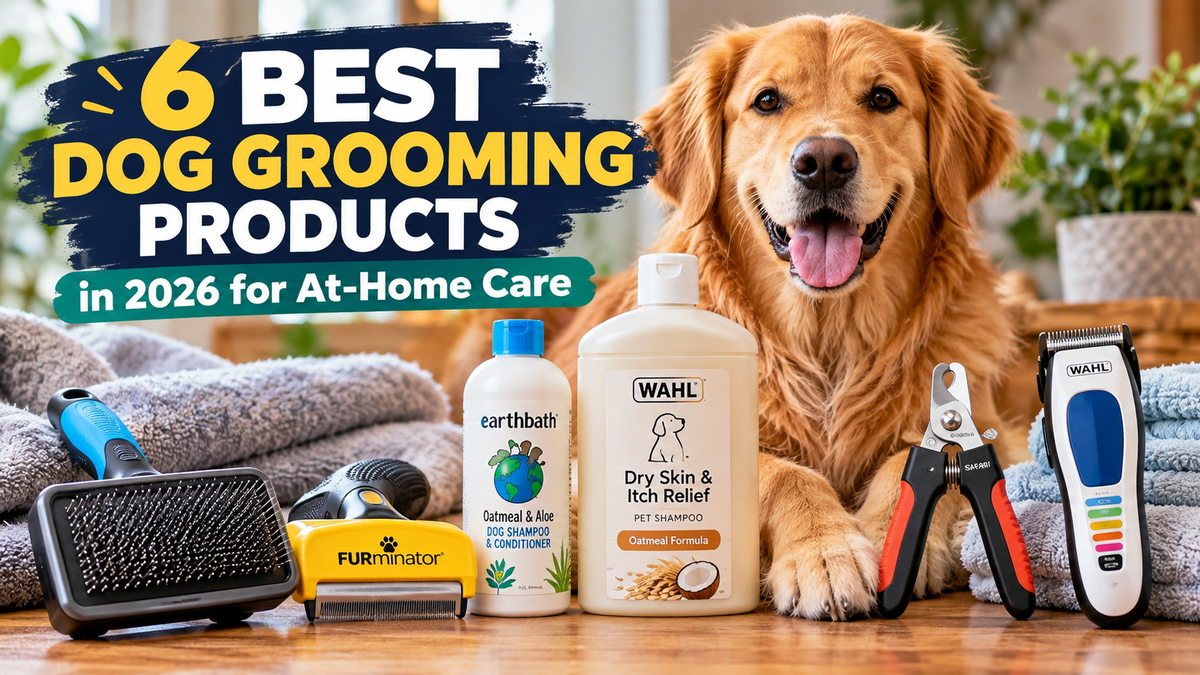
Good grooming helps keep your dog’s coat, nails, and skin in better condition, but choosing the right products can be surprisingly confusing. A slicker brush is useful for a different job than an undercoat deShedding tool, while a dog shampoo and a nail trimmer solve completely different grooming needs.
That is why the best dog grooming products are not necessarily the products with the longest feature lists. The right choice depends on your dog’s coat type, size, shedding level, grooming routine, and the specific task you are trying to handle.
In this guide, we’ll compare six grooming products covering everyday brushing, shedding control, bathing, nail care, and trimming. We’ll also explain what each product is best suited for, what to consider before buying, and when a home grooming tool is not the right solution.
Disclosure: This article contains affiliate links. As an Amazon Associate, PawTroveHub may earn from qualifying purchases made through links on this page.
Quick Answer: Which Dog Grooming Products Do You Actually Need?
Most dogs do not need every grooming tool available. Start with the products that match your dog’s coat and routine.
| Product | Grooming Type | Best For | Coat / Size Fit | Key Feature | Main Consideration |
|---|---|---|---|---|---|
| Swihauk Self-Cleaning Slicker Brush | Brushing | Everyday brushing and loose fur | Many coat types with appropriate technique | Self-cleaning design | Use gentle pressure and match it to the coat |
| FURminator Medium Dog Undercoat deShedding Tool | DeShedding | Reducing loose undercoat hair | Short-haired dogs, 25–50 lb version | Undercoat-focused design | This specific model is size- and coat-specific |
| earthbath Oatmeal & Aloe Dog Shampoo and Conditioner | Bathing | Routine bathing | Dogs needing an oatmeal-and-aloe formula | Shampoo + conditioner | Choose products according to your dog’s individual needs |
| Wahl USA Dry Skin & Itch Relief Pet Shampoo | Bathing | Owners wanting a large shampoo format | Dogs | Oatmeal formula, 64 oz option | Persistent skin problems need more than a grooming product |
| Coastal Pet Safari Professional Dog Nail Trimmer | Nail Care | At-home nail trimming | Large-dog version | Precision edge and safety stop | Size and careful technique matter |
| Wahl Color Pro Cordless Rechargeable Clipper | Light Trimming | Owners considering cordless trimming | General hair-clipping use | Cordless operation and guide combs | The linked model is marketed as a human hair clipper, not a dog-specific clipper |
The key takeaway is simple: choose the grooming product for the job, not just because it appears on a “best” list.
How to Choose the Best Dog Grooming Products for Your Dog
Before buying anything, identify the grooming problem you are trying to solve. A dog that sheds heavily may need a different combination of products from a short-haired dog that mainly needs occasional brushing and nail care.
Start With Your Dog’s Coat Type
Your dog’s coat should be the starting point for brush and deShedding-tool decisions.
Short, smooth coats often need straightforward brushing to remove loose hair and keep the coat manageable. Dogs with longer or denser coats may need tools designed to work through more hair without unnecessarily pulling the coat.
Curly or woolly coats can require a more structured grooming routine because tangles and mats can develop quickly. Double-coated dogs may also shed large amounts of undercoat, making a dedicated deShedding tool useful when it is appropriate for that coat.
For more detailed guidance, you can also read our complete pet grooming tools guide.
Match the Product to the Grooming Job
It helps to think of grooming tools as categories rather than interchangeable products.
A slicker brush is primarily for brushing and working through loose hair and manageable tangles.
A deShedding tool is designed for removing loose undercoat hair from appropriate coats. It is not simply a stronger version of an everyday brush.
A dog shampoo is used for bathing and should be selected as a dog-specific product rather than treated as a generic household shampoo.
A nail trimmer is for nail maintenance and requires careful control.
A clipper is intended for trimming hair, but coat thickness, matting, skill level, and the particular clipper all matter.
Understanding those differences makes it much easier to narrow down the best dog grooming products for your routine.
Look for Comfort and Control
A grooming tool should be manageable for the person using it and comfortable for the dog.
For brushes, avoid pulling aggressively through the coat. For nail trimming, a secure grip and controlled movement are especially important. For clipping, the dog should be comfortable with the sound and sensation of the tool before you attempt a longer grooming session.
In practice, control is often more useful than simply buying the most feature-heavy product.
Check Size and Product Compatibility
Product size matters more than many first-time buyers realize.
The FURminator linked in this guide is specifically the Medium Dog Undercoat deShedding Tool for Short Hair, intended for dogs in the 25–50 lb range. That means you should not treat it as a universal recommendation for every dog.
The Safari nail trimmer in this guide is also the Large version. Always check the applicable size before purchasing.
Know When a Product Is Not Enough
Grooming products are designed for routine maintenance. They are not a substitute for professional or veterinary care when a problem goes beyond normal grooming.
Severe matting, irritated skin, wounds, unusual skin changes, difficult nail problems, or a dog that becomes extremely distressed during grooming can all justify getting additional help.
6 Best Dog Grooming Products for 2026
Rather than pretending that one product is universally “the best,” the six products below are organized around specific grooming jobs. That makes it easier to choose according to your dog’s actual needs.
1. Swihauk Self-Cleaning Slicker Brush — Best for Everyday Brushing
A slicker brush is one of the most useful basic grooming tools for many dogs because it can help remove loose hair while keeping brushing sessions manageable.
The Swihauk Self Cleaning Slicker Brush is marketed as a skin-friendly grooming and deShedding tool for dogs and cats, with a self-cleaning design. The self-cleaning feature can be convenient because it helps remove collected hair from the brush without requiring you to pull it out strand by strand.
The more important question, however, is whether the brush matches your dog’s coat and whether you use it gently. A slicker brush should not be treated as a tool for forcing through severe mats or pulling aggressively on stubborn tangles.
It makes the most sense as an everyday brushing option for owners who want a straightforward tool for routine coat maintenance and loose-fur removal.
Best for: Everyday brushing and general loose-fur management.
Keep in mind: Coat type and brushing technique matter more than the brush alone.
Check the Swihauk Self-Cleaning Slicker Brush on Amazon
2. FURminator Medium Dog Undercoat deShedding Tool for Short Hair — Best for Targeted Shedding Control
A deShedding tool has a more specialized role than an everyday brush. The FURminator model included here is specifically the Medium Dog Undercoat deShedding Tool for Short Hair, listed for dogs weighing 25–50 lb.
That specificity is important.
This is not a recommendation for every breed, every coat, or every dog size. Its usefulness depends on having the right coat characteristics and choosing the correct model.
For an appropriately matched short-haired medium dog, the purpose is to help remove loose shedding hair from the undercoat. Used correctly, that makes it different from simply brushing the outer coat.
Do not assume that more pressure or more frequent use automatically means better results. A deShedding tool should be used according to the manufacturer’s directions and with attention to your dog’s coat and comfort.
Best for: Owners dealing with regular shedding in an appropriately matched short-haired medium dog.
Keep in mind: The linked model is specifically for short hair and the 25–50 lb size range.
Check the FURminator Medium Dog Undercoat deShedding Tool on Amazon
3. earthbath Oatmeal & Aloe Dog Shampoo and Conditioner — Best for Routine Bathing
Bathing is an important part of a dog’s grooming routine, but shampoo selection should be based on your dog’s needs rather than fragrance or marketing alone.
The earthbath Oatmeal & Aloe Dog Shampoo and Conditioner linked here is a 16-ounce product positioned for dogs with dry or itchy skin and uses an oatmeal-and-aloe formula.
One practical advantage is the shampoo-and-conditioner combination, which gives the product a straightforward role in a regular bathing routine.
Even when a shampoo is marketed for dry or sensitive skin, however, it should not be treated as a treatment for an unexplained skin condition. Ongoing itching, redness, sores, or other unusual changes deserve appropriate veterinary attention.
For routine bathing, also focus on technique: use a dog-specific product, avoid getting shampoo in sensitive areas, and rinse thoroughly.
Best for: Routine bathing when you want an oatmeal-and-aloe dog shampoo and conditioner.
Keep in mind: A grooming product should not be used as a substitute for evaluating persistent skin problems.
See the earthbath Oatmeal & Aloe Dog Shampoo and Conditioner on Amazon
4. Wahl USA Dry Skin & Itch Relief Pet Shampoo for Dogs — Best for a Large-Format Bathing Option
The Wahl USA Dry Skin & Itch Relief Pet Shampoo for Dogs offers another approach to bathing. The linked version is a 64-ounce oatmeal formula with a coconut lime verbena scent.
The biggest practical distinction compared with the earthbath option is the format. If you are looking for a large bottle for repeated bathing, a larger-volume shampoo may be more convenient.
The oatmeal formula also makes it relevant to owners specifically looking for that type of grooming product.
That said, the same rule applies: “dry skin” and “itch relief” on a product label should not be interpreted as a diagnosis or a guarantee that shampoo alone will resolve a persistent problem.
Think of it as a bathing product first. If your dog has ongoing itching or skin changes, grooming and veterinary evaluation may both be necessary.
Best for: Routine dog bathing when a larger oatmeal-shampoo format is appealing.
Keep in mind: Persistent or unexplained skin irritation should be evaluated rather than managed indefinitely with shampoo alone.
See the Wahl Dry Skin & Itch Relief Dog Shampoo on Amazon
5. Coastal Pet Safari Professional Dog Nail Trimmer — Best for At-Home Nail Care
Nail care is easy to overlook until nails become noticeably long. Regular nail maintenance can be an important part of a complete grooming routine, but it requires patience and control.
The Coastal Pet Safari Professional Dog Nail Trimmer linked here is the Large version and is listed with a precision edge, non-slip grip, ergonomic design, and safety stop.
Those features are particularly relevant when you want more control during nail trimming.
The safest approach is to work gradually and avoid rushing. Dog nails contain sensitive tissue, so trimming too aggressively can cause pain and make future grooming sessions more stressful.
A nail trimmer can make routine maintenance possible at home, but owners who are uncomfortable identifying where to trim should consider having a groomer or veterinary professional demonstrate the technique.
Best for: Owners looking for a large-size dog nail trimmer for controlled at-home nail care.
Keep in mind: Choose the appropriate trimmer size and learn proper nail-trimming technique before attempting a full session.
Check the Coastal Pet Safari Professional Dog Nail Trimmer on Amazon
6. Wahl Color Pro Cordless Clipper & Trimmer — Best Considered for Light Trimming With Important Limitations
The final product needs a little more explanation than the others.
The linked item is the Wahl Color Pro Cordless Rechargeable Hair Clipper & Trimmer, Model 9649P. Its Amazon listing markets it as a cordless at-home hair clipper for men, women, and children.
That means it should not be described as a universal dog clipper.
For PawTroveHub readers, the useful point is the cordless concept and guide-comb system. However, whether a general-purpose hair clipper is suitable for a particular dog’s coat is a separate question.
Dog coats vary substantially in texture, thickness, density, and matting. A clipper that works for one trimming situation may not be appropriate for another, and heavily matted or complicated coats are especially poor candidates for improvised clipping.
For that reason, treat this product cautiously and check the manufacturer’s instructions rather than assuming that any cordless hair clipper is designed for dogs.
Best for: Owners researching a cordless trimming option, with the important caveat that this linked model is marketed as a human hair clipper.
Keep in mind: Do not assume it is suitable for every dog coat or every grooming situation.
View the Wahl Color Pro Cordless Clipper on Amazon
Build a Simple At-Home Dog Grooming Routine
You do not need to turn grooming into a complicated weekly project. A simple routine built around your dog’s coat and lifestyle is usually easier to maintain.
Between Baths
Use brushing to remove loose hair and check the condition of the coat.
While brushing, look for:
-
unusual tangles or mats
-
irritated areas
-
changes in the skin
-
debris caught in the coat
-
problems around the paws
-
nails that are becoming too long
Regular observation can help you notice small problems before they become harder to manage.
Before Bathing
Brush the coat before getting it wet, particularly if your dog has longer or denser hair.
Tangles can become more difficult to work with after bathing, so removing manageable loose hair and tangles beforehand makes the bathing process easier.
This is also a good time to check the skin and coat for anything unusual.
During Bathing
Use a shampoo formulated for dogs and follow the product directions.
Use comfortable water temperature, work the shampoo through the coat carefully, and avoid unnecessary pressure around the eyes and other sensitive areas.
Most importantly, rinse thoroughly. Shampoo left behind in the coat can be irritating.
After Bathing
Dry your dog appropriately for its coat and comfort level, then continue with coat maintenance as needed.
Longer or denser coats may need additional brushing after the bath to keep them manageable.
The goal is not to create a perfect salon-style finish after every bath. It is to keep the coat clean, comfortable, and easier to maintain.
Dog Grooming Mistakes to Avoid
Using Human or Baby Shampoo
Dogs have different skin characteristics from humans, so human shampoo should not automatically be treated as an appropriate substitute for a dog-specific formula.
Choose products intended for dogs unless a veterinary professional has specifically advised otherwise.
For additional background on brushing, bathing, and general grooming practices, see the AKC’s guide to grooming your dog at home.
Using the Wrong Brush for the Coat
A brush that works well for one coat may be ineffective or unnecessarily uncomfortable for another.
Do not choose a brush simply because it is popular. Match it to the coat and the grooming task.
Overusing a DeShedding Tool
A deShedding tool is specialized equipment, not necessarily an everyday replacement for a normal brush.
Using a specialized tool more aggressively or more often than appropriate can make grooming uncomfortable. Follow the product’s instructions and pay attention to your dog’s response.
Cutting Tight Mats With Scissors
Tight mats can sit very close to the skin, making home cutting risky.
Do not assume that a pair of scissors is the quickest solution. Severe matting may be better handled with the right professional equipment and experience.
Rushing Nail Trimming
Nail trimming is one of those tasks where slow and controlled is better than fast.
Work gradually, especially when your dog is not accustomed to nail care. If the dog becomes highly stressed, stop rather than turning the session into a struggle.
When Should You Use a Professional Groomer?
At-home grooming is useful for routine maintenance, but it does not need to cover every situation.
Professional grooming may be a better option when:
-
the coat is severely or extensively matted
-
you need a complicated haircut or trim
-
your dog becomes very distressed during grooming
-
you are uncomfortable trimming nails
-
you are not confident handling a difficult coat
-
grooming reveals a skin problem or unusual physical change
There is no prize for doing every grooming task yourself.
A good grooming routine is about keeping your dog comfortable and maintaining the coat and nails appropriately—not avoiding professional help at all costs.
For additional guidance on grooming and coat-care situations that may require extra attention, see VCA’s guidance on dog grooming and coat care.
Frequently Asked Questions About Dog Grooming Products
What grooming products do I actually need for my dog?
For many dogs, a practical starting set includes an appropriate brush, dog-specific shampoo, nail trimmer, and any additional tool required by the dog’s coat, such as a deShedding tool.
Dogs with long, curly, or specialized coats may need additional grooming equipment.
What are the best dog grooming products for a dog that sheds a lot?
Start by identifying the coat type before buying a deShedding tool.
A normal brush and a specialized deShedding tool do different jobs, and not every deShedding product is appropriate for every dog.
The FURminator included in this guide is one example of why compatibility matters: the linked model is specifically for medium dogs weighing 25–50 pounds with short hair.
What is the best brush for my dog’s coat?
There is no single brush that is ideal for every coat.
Short-haired dogs, long-haired dogs, double-coated dogs, and curly-coated dogs can have very different grooming needs. A good starting point is to identify the coat type and then choose a brush designed for that grooming task.
Are deShedding tools safe for all dogs?
No grooming tool should be assumed to be appropriate for every dog.
DeShedding tools are designed for particular coat situations, so match the tool to the dog and follow the manufacturer’s instructions. Use gentle technique and stop if your dog appears uncomfortable.
How often should I brush my dog?
The right frequency depends heavily on coat type, hair length, shedding level, and lifestyle.
Some dogs need frequent brushing to stay comfortable and prevent tangles, while short-haired dogs may require less intensive coat maintenance.
The important thing is consistency rather than following one fixed schedule for every breed.
How often should I bathe my dog?
Bathing frequency depends on your dog’s coat, lifestyle, activity level, and individual needs.
A dog that spends a lot of time outdoors may need bathing more often than a mostly indoor dog, while excessive bathing may be unnecessary for some dogs.
Use a dog-specific shampoo and avoid treating a generic calendar schedule as a rule that applies to every dog.
Can I use human or baby shampoo on my dog?
It is better to use shampoo formulated specifically for dogs unless a veterinary professional recommends something different.
Dog skin and human skin are not identical, so a product designed for people should not automatically be considered suitable for routine canine bathing.
How often should I trim my dog’s nails?
Nail growth varies from dog to dog, so there is no universal interval that fits every animal.
Check the nails regularly and trim when they become too long, while learning how much to remove safely.
If you are unsure where to cut, a groomer or veterinary professional can help you learn the technique.
Can I groom my dog at home?
Yes, many routine grooming tasks can be handled at home when you use appropriate tools and take your time.
Brushing, routine bathing, and careful nail maintenance are common examples.
More complicated clipping, severe matting, or situations involving skin problems may be better handled professionally.
Should I brush my dog before or after a bath?
For many coats, brushing before the bath is helpful because it can remove loose hair and manageable tangles before the coat gets wet.
After bathing, the coat may still need additional brushing depending on its length and texture.
When should I take my dog to a professional groomer?
Consider professional grooming when the coat is severely matted, the haircut is complicated, your dog becomes highly stressed, or you are not confident performing a particular task safely.
Professional grooming is also useful when you need guidance on maintaining a difficult coat at home.
Final Thoughts: Choose Grooming Products for the Job, Not the Hype
The best dog grooming products are the ones that match your dog’s actual grooming needs.
A slicker brush can be a practical everyday choice for brushing. A specialized deShedding tool can make sense for an appropriately matched shedding coat. Dog shampoo handles bathing, while a nail trimmer addresses a completely different part of routine care.
The most important step is to start with your dog—not the product.
Consider coat type, size, shedding, grooming frequency, your own comfort level, and the specific task you need to perform. That approach makes it much easier to avoid buying tools you will rarely use.
For broader shopping across dog categories, you can explore PawTroveHub’s dog products.
You can also browse all PawTroveHub pet products when you are shopping for supplies beyond grooming.
The right grooming routine does not need to be complicated. Start with the essentials, choose tools that fit your dog’s coat and needs, and add specialized products only when they solve a genuine grooming problem.