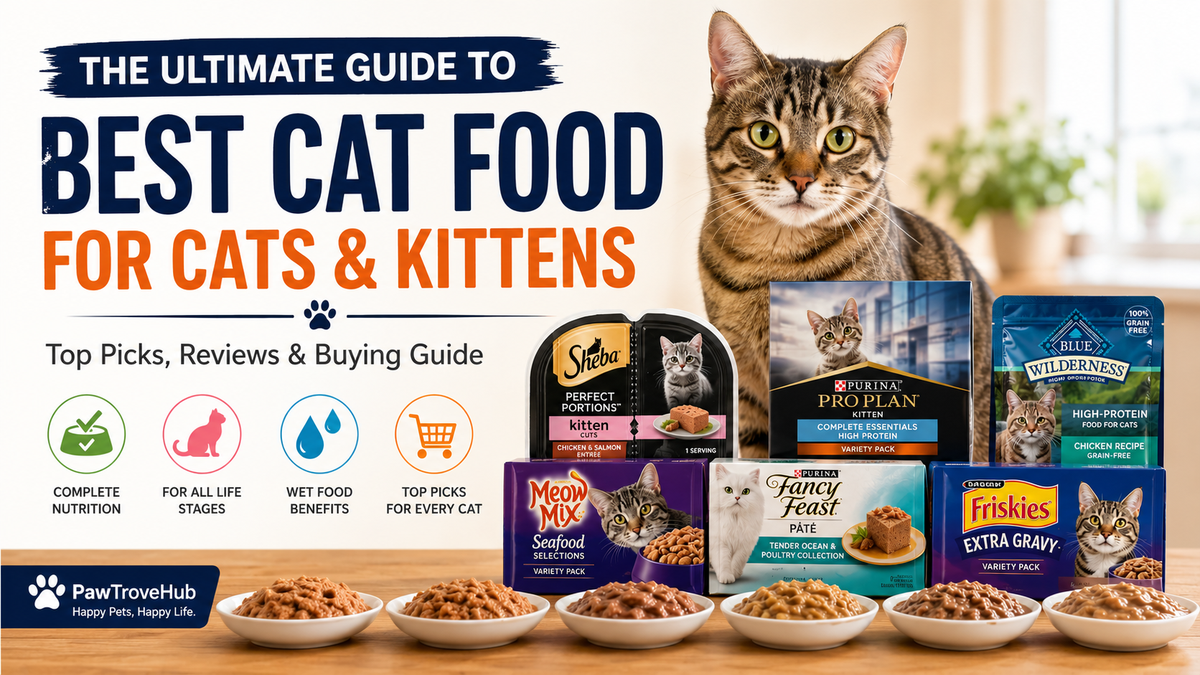
Choosing the best cat food can feel surprisingly complicated. There are wet foods, dry foods, kitten formulas, adult formulas, pâtés, gravy recipes, variety packs, high-protein options, and countless labels competing for your attention.
The good news is that choosing a good cat food does not have to be confusing.
The most important starting point is to choose a food that is appropriate for your cat’s life stage and provides complete and balanced nutrition. From there, you can consider your cat’s preferences, feeding routine, food texture, moisture content, calorie needs, and budget.
In this guide, we’ve selected six cat food options available through our Cat Food product collection and explain what each one may be best suited for.
Quick Answer: What Is the Best Cat Food?
There is no single cat food that is perfect for every cat. The best choice depends on your cat’s age, nutritional needs, preferences, feeding routine, and any health conditions that require a specific diet.
For kittens, two options in our selection are specifically positioned for growing cats:
- Sheba Perfect Portions Kitten Wet Cat Food – Chicken & Salmon Variety Pack
- Purina Pro Plan High Protein Wet Kitten Food – Complete Essentials Variety Pack
For adult cats, our selection includes several wet-food options, including Fancy Feast, Friskies, Meow Mix, and Blue Buffalo.
The most important thing is not simply choosing the most expensive food. Start by checking whether the food is nutritionally complete and balanced for your cat’s life stage, then consider what your cat actually eats consistently and comfortably.
Our Top Cat Food Picks
1. Sheba Perfect Portions Kitten Wet Cat Food
Best for: Growing kittens and convenient portioned meals
If you’re shopping specifically for a kitten, the Sheba Perfect Portions Kitten Wet Cat Food – Chicken & Salmon Variety Pack is one of the kitten-focused options in our selection.
Its individual twin-tray portions can also be convenient for owners who prefer serving smaller fresh portions rather than opening a large container at once.
Consider it if:
- You have a growing kitten
- You prefer wet food
- You want individually portioned meals
- Your kitten enjoys chicken or salmon flavors
Always confirm the product’s current nutritional adequacy statement and life-stage suitability on the package before purchasing.
2. Meow Mix Seafood Selections Wet Cat Food
Best for: Adult cats that enjoy seafood variety
The Meow Mix Seafood Selections Wet Cat Food Variety Pack offers several seafood-style recipes in single-serve cups.
The variety format can be useful for cats that enjoy different flavors or for owners who prefer convenient single-serving portions.
Consider it if:
- Your cat enjoys seafood flavors
- You want variety
- You prefer convenient single-serve packaging
- You’re looking for wet food for everyday feeding
As with any food, check the current package label to make sure the formula matches your cat’s life stage and nutritional needs.
3. Purina Fancy Feast Wet Cat Food Variety Pack
Best for: Cats that enjoy pâté and flavor variety
The Purina Fancy Feast Wet Cat Food Variety Pack – Tender Ocean & Poultry Pâté Collection is a wet-food variety option featuring ocean and poultry pâté recipes.
Pâté texture can be appealing to cats that prefer smooth wet food, while the variety pack gives owners multiple recipes to work with.
Consider it if:
- Your cat likes pâté
- You want flavor variety
- You prefer wet food
- You’re looking for convenient multipack feeding
4. Purina Friskies Extra Gravy Wet Cat Food
Best for: Cats that prefer gravy-style wet food
The Purina Friskies Extra Gravy Wet Cat Food Variety Pack is designed around gravy-rich recipes and multiple savory flavors.
Texture and moisture can matter greatly to individual cats. If your cat consistently prefers gravy-style foods over pâté or dry food, a product in this style may be worth considering.
Consider it if:
- Your cat prefers gravy
- You want a larger variety pack
- Your cat enjoys different savory recipes
- Wet food is part of your regular feeding routine
5. Purina Pro Plan High Protein Wet Kitten Food
Best for: Growing kittens and owners looking for a kitten-focused variety pack
The Purina Pro Plan High Protein Wet Kitten Food – Complete Essentials Variety Pack is another kitten-focused option in our selection.
Because kittens have different nutritional requirements from adult cats, choosing a formula specifically intended for growth is important.
Consider it if:
- You have a growing kitten
- You prefer wet food
- You want a kitten-specific formula
- You want a variety pack rather than one recipe
6. Blue Buffalo Wilderness High-Protein Wet Cat Food
Best for: Adult cats and owners looking for a high-protein wet-food option
The Blue Buffalo Wilderness High-Protein Wet Cat Food – Grain-Free Chicken Recipe is an adult-cat option in our selection featuring a chicken-based, high-protein recipe.
If you’re considering a grain-free food, remember that “grain-free” by itself does not automatically mean a food is nutritionally superior. The complete nutritional profile and suitability for your individual cat matter more.
Consider it if:
- You are looking for an adult wet food
- Your cat prefers chicken
- You are specifically interested in a high-protein recipe
- You want a grain-free option
How We Chose These Cat Food Options
Our selection is based on the types of products currently available in the PawTroveHub Cat Food collection, while this guide focuses on helping you understand which type of option may fit different cats and feeding preferences.
When comparing cat food, we recommend looking at:
- Life-stage suitability
- Complete and balanced nutritional status
- Wet versus dry format
- Protein and calorie information
- Feeding instructions
- Ingredient information
- Your cat’s preferences
- Packaging and portion convenience
- Your budget and feeding routine
A product should not be considered better simply because its ingredient list sounds more impressive. Nutritional adequacy, life-stage suitability, and the overall diet are more useful starting points.
What Makes a Good Cat Food?
A good cat food should provide the nutrients your cat needs in appropriate amounts for its life stage.
Cats are obligate carnivores and require specific nutrients, including amino acids, fatty acids, vitamins, and minerals. However, choosing food is not simply a matter of finding the product with the highest protein percentage or the longest list of meat ingredients.
Look for a nutritional adequacy statement indicating that the food is complete and balanced for the appropriate life stage.
Life stage matters because kittens have different nutritional requirements from adult cats. A food designed for growth is not necessarily the same as one intended only for adult maintenance.
Best Cat Food for Kittens
Kittens are growing rapidly, so their nutritional requirements differ from those of adult cats.
When choosing kitten food, look for a formula intended for growth or an appropriate all-life-stages formula.
Two kitten-focused options in our selection are:
Kittens also generally need more frequent meals than adult cats. Cornell University notes that kittens under six months commonly do well with three meals per day, while kittens between six months and one year generally do well with two meals daily.
Always follow the food label’s feeding guidance and your veterinarian’s advice for your individual kitten.
Best Cat Food for Adult Cats
Adult cats generally need food formulated for adult maintenance or an appropriate all-life-stages formula.
There is no universal requirement that every adult cat eat wet food or every adult cat eat dry food. Some cats prefer wet food, some prefer dry food, and some do well with a combination.
Our adult-focused selection includes:
- Meow Mix Seafood Selections
- Purina Fancy Feast Wet Cat Food
- Purina Friskies Extra Gravy Wet Cat Food
- Blue Buffalo Wilderness High-Protein Wet Cat Food
The right choice ultimately needs to be something that fits your cat’s nutritional needs and that your cat will consistently eat.
Wet vs. Dry Cat Food: Which Is Better?
Both wet and dry cat foods can be appropriate choices when they provide complete and balanced nutrition.
Wet Cat Food
Wet food generally contains substantially more water than dry food. This can make it useful for cats that benefit from higher dietary moisture.
Wet food may also be attractive to picky cats because of its smell, texture, and variety of flavors.
Advantages can include:
- Higher moisture content
- Many texture and flavor choices
- Often highly palatable
- Convenient portion options
Potential disadvantages:
- Can be more expensive
- Requires refrigeration after opening
- Can spoil if left out too long
Dry Cat Food
Dry food is convenient, easy to store, and often easier to portion and handle.
Advantages can include:
- Convenient storage
- Easy serving
- Often economical
- Useful for owners with busy routines
Potential disadvantages:
- Contains much less moisture than wet food
- Some cats may prefer wet food
- Free feeding can contribute to overeating in some cats
There is no need to treat wet and dry food as opposing choices. A complete and balanced combination can work well for some cats.
How to Read a Cat Food Label
Don’t choose cat food based only on marketing words on the front of the package.
Instead, look at the nutrition information.
1. Check the life stage
Make sure the food is appropriate for:
- Growth
- Adult maintenance
- Pregnancy or lactation
- Or all life stages
2. Look for nutritional adequacy
The nutritional adequacy statement is one of the most important parts of the label.
A “complete and balanced” claim indicates that the food is intended to meet established nutritional requirements when fed as directed.
3. Check calories
Two foods can have very different calorie densities even when their ingredient lists look similar.
Calories matter when determining how much your cat should eat.
4. Read the ingredients
Ingredients are listed by weight, but the ingredient list alone does not tell you everything about the nutritional quality of a food.
Use it together with the guaranteed analysis, nutritional adequacy statement, calorie information, and feeding instructions.
How Much Should a Cat Eat?
There is no single feeding amount that works for every cat.
The right amount depends on factors such as:
- Age
- Body size
- Activity level
- Current body condition
- Calorie density of the food
- Health status
- Whether the cat is growing or maintaining weight
Start with the feeding instructions on the package, then adjust with guidance from your veterinarian if your cat needs more or less food.
Overfeeding can lead to unwanted weight gain, while feeding too little can result in inadequate nutrition.
How Often Should You Feed a Cat?
Feeding frequency depends on age, health, preference, and household routine.
Kittens generally need more frequent meals than adult cats.
For many adult cats, once- or twice-daily feeding can be appropriate, while some cats do better with smaller meals spread throughout the day.
If you free-feed dry food, pay attention to how much your cat actually consumes. Unlimited access can cause some cats to overeat.
Fresh water should always be available.
Best Cat Food for Picky Eaters
Picky eating is common enough that food texture and flavor deserve consideration when choosing a food.
Some cats prefer:
- Pâté
- Gravy
- Shredded textures
- Seafood flavors
- Poultry flavors
- Wet food
- Dry food
- Or a combination
Variety can sometimes help, but constantly changing foods is not always necessary.
If a cat suddenly refuses food, particularly if the refusal is accompanied by weight loss or other signs of illness, don’t simply keep trying different foods. A veterinarian should evaluate the situation.
Common Cat Food Buying Mistakes
Choosing food only because it is expensive
Higher price does not automatically mean better nutrition.
Ignoring life stage
Kitten food and adult-maintenance food are designed around different nutritional needs.
Focusing only on one ingredient
A single ingredient rarely tells the whole story.
Overfeeding
Even a nutritionally complete food can contribute to excess weight if too much is fed.
Changing food too quickly
Cats can be sensitive to sudden dietary changes. Gradual transitions are generally easier for many cats.
Assuming grain-free automatically means healthier
Grain-free is a dietary characteristic, not a universal guarantee of better nutrition.
Ignoring your cat’s preferences
The best food on paper is not very useful if your cat consistently refuses to eat it.
How to Switch Your Cat to a New Food
If you’re changing your cat’s food, a gradual transition can help reduce digestive upset and improve acceptance.
A simple approach is to gradually increase the proportion of the new food while decreasing the old food over several days.
For particularly sensitive cats, a slower transition may be appropriate.
If your veterinarian has prescribed a specific diet, follow their transition instructions instead.
When You Should Talk to a Veterinarian
A general cat-food guide cannot replace veterinary advice for cats with medical conditions.
Talk with your veterinarian if your cat:
- Suddenly stops eating
- Is losing weight unexpectedly
- Has persistent vomiting or diarrhea
- Has a diagnosed medical condition
- Needs a therapeutic diet
- Has ongoing food-related problems
- Is significantly overweight or underweight
Cats that refuse food can develop serious health problems, so prolonged loss of appetite should not be treated as ordinary pickiness.
Helpful Cat Nutrition Resources
For readers who want to understand cat nutrition beyond product comparisons, we recommend these two independent educational resources:
- Cornell University College of Veterinary Medicine — Feeding Your Cat — covers feline nutritional needs, wet and dry food, life stages, food labels, treats, feeding considerations, and other important nutrition topics.
- U.S. Food & Drug Administration — “Complete and Balanced” Pet Food — explains nutritional adequacy statements, AAFCO nutrient profiles, life-stage requirements, and how guaranteed-analysis information works.
These resources are useful if you want to understand the reasoning behind the label information discussed in this guide.
Frequently Asked Questions
What is the best cat food?
The best cat food is one that is complete and balanced for your cat’s life stage, appropriate for its individual needs, and consistently accepted by your cat. There is no single food that is best for every cat.
Is wet or dry cat food better?
Neither is automatically better for every cat. Wet food provides considerably more moisture, while dry food is convenient and easy to store. Some cats do well with either format or a combination.
What is the best cat food for kittens?
Choose a food specifically formulated for growth or an appropriate all-life-stages formula. Two kitten-focused options in our selection are Sheba Perfect Portions Kitten Wet Cat Food and Purina Pro Plan High Protein Wet Kitten Food.
Can kittens eat adult cat food?
Adult-maintenance food may not provide the nutritional profile a growing kitten needs. Kittens should generally receive food formulated for growth or an appropriate all-life-stages diet.
How often should I feed my cat?
Feeding frequency depends on age, health, preferences, and routine. Kittens generally require more frequent meals than adult cats, while many adult cats can be fed once or twice daily.
Is high-protein cat food better?
Protein is an essential part of feline nutrition, but the highest protein number does not automatically make one food the best choice. Consider complete and balanced nutrition, life stage, calorie density, and your cat’s individual needs.
How do I know if cat food is complete and balanced?
Look for the nutritional adequacy statement on the package. It should indicate that the food is complete and balanced for the appropriate life stage.
Final Thoughts
The best cat food is not necessarily the food with the most impressive marketing claims or the highest price.
Start with the fundamentals: choose a nutritionally complete and balanced food appropriate for your cat’s life stage, consider wet versus dry based on your cat’s needs and preferences, pay attention to portions and calories, and make changes gradually.
If you’re ready to compare the products currently available through PawTroveHub, you can also browse our Cat Food collection and compare the available options before choosing what works best for your cat.
For a broader look at products for cats and other pets, visit the PawTroveHub Products page.
PawTroveHub participates in the Amazon Associates Program and may earn from qualifying purchases.