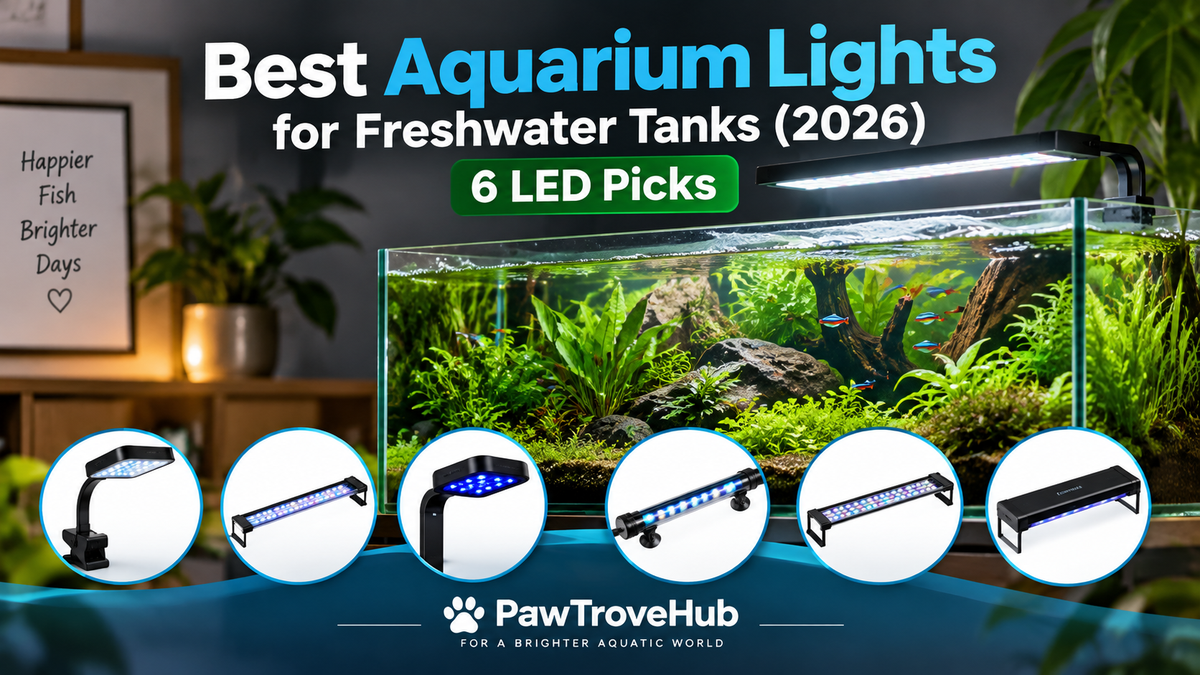
Choosing the right aquarium light is about more than making your fish tank look bright. The best aquarium lights should match your tank’s size, depth, inhabitants, plants, and the amount of control you want over the daily lighting schedule.
A fish-only aquarium has different lighting needs from a planted tank, while a nano reef requires a fixture designed for marine use. Features such as adjustable brightness, full-spectrum output, timers, programmable 24/7 modes, and suitable mounting can also make a major difference.
To help narrow the choices, we’ve compared six aquarium lighting options featured in the PawTroveHub Aquarium Lighting collection. The goal isn’t to declare one light universally best, but to show which type of setup each option is best suited for.
If you’re building out your aquarium equipment, you can also explore the broader PawTroveHub Fish Products collection for other fishkeeping essentials.
Best Aquarium Lights at a Glance
| Product | Best Suited For | Format | Main Strength | Tank Consideration | Plant Use | Control |
|---|---|---|---|---|---|---|
| Hygger Clip-On 24/7 LED Aquarium Light | Small freshwater setups and automated lighting | Clip-on LED | 24/7 lighting and adjustable brightness | Match fixture to tank width | Suitable for basic planted setups | Timer and brightness control |
| AQUANEAT Full Spectrum LED Aquarium Light | Straightforward freshwater lighting | LED bar | Full-spectrum illumination and extendable brackets | Choose the appropriate fixture size | Suitable for basic planted setups | Simple controls |
| Fluval SEA Marine Nano Bluetooth LED Light | Nano reef and marine setups | Marine LED | Bluetooth-controlled marine lighting | Designed for nano marine applications | Marine-focused rather than general freshwater use | Bluetooth control |
| Hygger 24/7 Full Spectrum Submersible LED Light | Hidden or supplemental illumination | Submersible LED | 24/7 modes and adjustable brightness | Match light length to aquarium | Useful for display and supplemental lighting | Timer and brightness control |
| AQQA 24/7 Full Spectrum LED Aquarium Light | Medium freshwater aquariums | LED bar | 24/7, DIY and memory functions | Check fixture range against tank length | Suitable for basic planted setups | Timer, brightness and memory |
| Current USA Satellite Freshwater LED Aquarium Light | Freshwater display tanks | LED fixture | Freshwater-oriented illumination | Select the correct fixture size | General freshwater plant/display use | Fixture controls |
The right choice depends on what you want the light to accomplish. A fixture designed for a nano reef, for example, shouldn’t automatically be treated as the right choice for a planted freshwater aquarium.
How to Choose the Best Aquarium Light
Before comparing individual products, it helps to understand the factors that actually matter.
Start With Your Aquarium Type
The first question is simple: What kind of aquarium are you lighting?
For a fish-only freshwater tank, lighting is primarily about creating a useful day/night rhythm and making the aquarium easy to view. You generally don’t need to choose a high-intensity planted-tank fixture simply because it produces more light.
A planted aquarium requires more consideration. Different aquatic plants have different light requirements, and aquarium depth matters because light intensity decreases as it travels through water.
For a nano reef, the situation changes again. Marine and reef organisms can have different lighting requirements, so a marine-specific fixture may make more sense than a general freshwater LED.
That’s why the phrase “best aquarium lights” doesn’t have one universal answer. The best option depends on the job the light needs to perform.
Match the Light to Your Tank Length and Depth
Tank dimensions are just as important as the light’s headline features.
A light that is too short may leave parts of the aquarium poorly illuminated. A fixture that is physically compatible with the tank but too weak for its depth may also produce disappointing results in a planted setup.
Before purchasing, check:
- Aquarium length
- Aquarium depth
- Fixture length
- Adjustable bracket range
- Mounting style
- Light coverage
- Whether the fixture sits safely above or inside the aquarium as intended
For planted tanks, depth deserves particular attention. Aqueon explains that some aquatic plants require stronger light and that greater aquarium height can require a stronger light source because light does not penetrate water as effectively. Their guidance also cautions against relying on a simple watts-per-gallon calculation for modern LED lighting.
Understand PAR, Lumens and Watts
One of the easiest aquarium-lighting mistakes is assuming that more watts automatically means more useful light.
Watts measure electrical power consumption. They do not directly tell you how much usable light reaches aquarium plants.
Lumens describe visible brightness from a human perspective, while PAR — photosynthetically active radiation — is more relevant when considering the light available for photosynthesis.
If you’re choosing lighting for live plants, don’t make your decision based solely on wattage.
For a more detailed explanation of aquatic plant lighting, see Aqueon’s guide to aquatic plant basics.
The practical takeaway is simple: consider the light’s intended use, tank depth, plant requirements, coverage and adjustability rather than chasing the highest wattage.
What Does Full Spectrum Mean?
“Full spectrum” appears on many aquarium-light listings, but it shouldn’t be treated as a guarantee that every full-spectrum fixture performs identically.
Spectrum refers to the range of wavelengths produced by the light. Aquarium LEDs may combine different colors to produce natural-looking illumination while also providing wavelengths useful for photosynthesis.
For a planted aquarium, look beyond the words “full spectrum.” Consider:
- Intended aquarium type
- Light intensity
- Tank depth
- Coverage
- Adjustable brightness
- Plant requirements
- Available lighting schedules
Full-spectrum lighting can be useful, but the phrase itself doesn’t eliminate the need to match the fixture to your aquarium.
Do You Need Dimming and a Timer?
For many aquarium owners, controllability is one of the most useful features of modern LED lighting.
A timer helps maintain a consistent photoperiod instead of relying on memory to switch the light on and off every day. Adjustable brightness can also help you avoid running a fixture at maximum output when your aquarium doesn’t require it.
Some lights go further with programmable 24/7 cycles, gradual transitions or app-based control.
These features aren’t essential for every aquarium, but they can make maintaining a consistent routine much easier.
6 Best Aquarium Lights for Freshwater Tanks in 2026
The six options below cover several different use cases. Rather than treating them as interchangeable, consider the type of aquarium and lighting routine each one is designed to support.
1. Hygger Clip-On 24/7 LED Aquarium Light
Best for: Smaller freshwater aquariums and users who want convenient automated lighting.
The Hygger Clip-On 24/7 LED Aquarium Light is a compact option built around programmable lighting modes, adjustable brightness and a clip-on mounting design. Its 24/7 functionality makes it particularly relevant for aquarium owners who want a more structured day-to-night lighting routine.
The main advantage of this style of fixture is convenience. A clip-on design can also be useful when you want a relatively compact light rather than a larger conventional bar.
Before purchasing, check the fixture size against your aquarium and make sure the mounting arrangement is compatible with your tank.
For the current Amazon listing, see the Hygger Clip-On 24/7 LED Aquarium Light.
2. AQUANEAT Full Spectrum LED Aquarium Light
Best for: Straightforward freshwater aquarium illumination.
The AQUANEAT Full Spectrum LED Aquarium Light is designed around full-spectrum LED illumination with extendable brackets. That makes tank-size compatibility an important part of the buying decision.
This type of light can make sense for an owner who wants a conventional aquarium LED bar without necessarily needing advanced app-based controls.
For planted aquariums, remember that the appropriate light depends on the plants, aquarium depth and overall setup. A “full spectrum” label alone should not be used to assume that the fixture is suitable for every plant species.
Check the available size before ordering and match it to your aquarium’s dimensions.
You can view the AQUANEAT Full Spectrum LED Aquarium Light on Amazon.
3. Fluval SEA Marine Nano Bluetooth LED Light
Best for: Nano reef and marine aquarium applications.
This product is the important exception in this six-product comparison. The Fluval SEA Marine Nano Bluetooth LED Light is designed for nano reef aquariums, so it should not be treated as a general-purpose freshwater planted-tank light.
Its Bluetooth control and marine-oriented lighting make it a more specialized choice for an appropriate nano marine setup.
If your aquarium is freshwater, start by looking at freshwater-oriented fixtures instead. If you’re setting up a nano reef, however, a marine-specific light is a much more relevant category to investigate.
For the current listing, see the Fluval SEA Marine Nano Bluetooth LED Light.
4. Hygger 24/7 Full Spectrum Submersible LED Light
Best for: Aquarium owners interested in hidden or supplemental underwater illumination.
The Hygger 24/7 Full Spectrum Submersible LED Light takes a different approach from a conventional light bar. Its submersible format can be useful when the intended setup calls for illumination positioned within the aquarium rather than only above it.
It also provides adjustable brightness and 24/7 lighting functionality.
Because submersible lighting is a different design category, pay particular attention to the manufacturer’s installation instructions and intended use before placing any fixture in an aquarium.
It can be an interesting choice for someone prioritizing a less visually prominent lighting arrangement or supplemental illumination.
See the Hygger 24/7 Full Spectrum Submersible LED Light for the current Amazon listing.
5. AQQA 24/7 Full Spectrum LED Aquarium Light
Best for: Freshwater aquarium owners who want 24/7 and DIY lighting options.
The AQQA 24/7 Full Spectrum LED Aquarium Light combines full-spectrum LEDs with adjustable brightness, timer functionality, memory features and an extendable design.
The 24/7 functionality can appeal to users who prefer an automated lighting routine rather than manually switching between daytime and nighttime settings.
Its listed size range also makes checking your tank dimensions important before ordering.
For a freshwater aquarium where scheduling flexibility is a priority, this is one of the more feature-oriented options in the comparison.
See the AQQA 24/7 Full Spectrum LED Aquarium Light on Amazon.
6. Current USA Satellite Freshwater LED Aquarium Light
Best for: Freshwater aquarium display lighting.
The Current USA Satellite Freshwater LED Aquarium Light is specifically oriented toward freshwater aquariums. Its conventional fixture format makes it a useful option to consider when you want a dedicated freshwater light rather than a marine or submersible design.
As with any aquarium light, selecting the correct size matters. The supplied listing is for a particular aquarium-size range, so check the current listing and your tank dimensions before ordering.
For a traditional freshwater aquarium lighting setup, the Current USA Satellite Freshwater LED Aquarium Light is worth comparing with the other options above.
Aquarium Lighting for Fish-Only vs. Planted Tanks
Your lighting decision should change depending on whether you’re keeping fish alone or growing live plants.
Fish-Only Freshwater Tanks
Fish-only aquariums generally don’t require intense plant-growing light simply because the tank contains fish.
The main goals are:
- A consistent day/night rhythm
- Comfortable aquarium viewing
- Attractive fish coloration
- Controlled illumination
- Avoiding unnecessary light exposure
Aqueon’s aquarium lighting guidance suggests about eight hours of light per day for a fish-only tank and emphasizes keeping a consistent schedule.
If you’re dealing with algae, reducing the daily lighting period can be one practical adjustment to consider.
Low-Tech Planted Tanks
Low-tech planted aquariums require more attention to lighting because plants depend on light for photosynthesis.
Start by identifying the plants you want to keep. Plants with relatively modest lighting requirements are easier to accommodate than demanding species that require stronger illumination.
Aquarium height also matters because light intensity decreases as it travels through water.
For additional educational information on setting up and planting an aquarium, see Purdue University’s aquarium planting guide.
Higher-Light Planted Tanks
A higher-light planted aquarium requires more than simply purchasing the brightest fixture you can find.
Light interacts with the rest of the aquarium system, including plant selection, nutrients, carbon availability and maintenance.
If you substantially increase lighting without considering the rest of the setup, you may create an imbalance rather than automatically getting faster or healthier plant growth.
For demanding planted aquariums, look for a fixture whose actual output and coverage are appropriate for your tank rather than relying on marketing terms alone.
How Long Should Aquarium Lights Stay On?
There isn’t one universal lighting schedule for every aquarium.
Aqueon’s guidance recommends around eight hours per day for fish-only aquariums and around 10–12 hours for planted tanks and reefs. Its aquatic plant guidance also recommends approximately 10–12 hours for aquatic plants and stresses the importance of a consistent day/night cycle.
That doesn’t mean every aquarium should immediately be run at the maximum end of those ranges.
A practical approach is to establish a consistent schedule appropriate to your aquarium and then observe how the fish, plants and algae respond.
A timer is especially useful because it removes guesswork from the daily routine.
If algae becomes a recurring problem, lighting duration is one of the factors worth reviewing rather than simply increasing the light’s intensity.
Can Aquarium Lighting Cause Algae?
Yes, excessive or poorly managed lighting can contribute to algae problems, but light isn’t the only factor involved.
Algae can also be affected by nutrient availability, aquarium conditions, direct sunlight and the overall balance between light, plant growth and maintenance.
This is why turning the aquarium light to maximum brightness for long periods isn’t automatically a good strategy.
How to Reduce Lighting-Related Algae Problems
Try these practical steps:
- Use a consistent timer.
- Avoid unnecessarily long photoperiods.
- Don’t automatically run adjustable lighting at maximum intensity.
- Keep the aquarium away from excessive direct sunlight.
- Consider plant requirements before increasing lighting.
- Make changes gradually instead of changing several aquarium variables at once.
Aqueon specifically notes that direct sunlight can contribute to algae overgrowth and recommends reducing daily illumination if algae becomes a problem.
Aquarium Lighting Features That Actually Matter
When comparing the best aquarium lights, focus on features that solve real problems rather than simply choosing the longest feature list.
Adjustable Brightness
Adjustable brightness gives you more control over the amount of light produced. This can be useful when your aquarium doesn’t need maximum output or when you’re trying to establish a manageable lighting routine.
Timer and 24/7 Modes
A timer helps maintain consistency.
24/7 modes can add gradual transitions between daytime and nighttime lighting, depending on the particular fixture.
The important thing is that the feature should make your aquarium routine easier rather than adding unnecessary complexity.
Full-Spectrum Output
Full-spectrum LEDs can provide attractive, natural-looking illumination and may be appropriate for planted aquariums.
However, don’t use the phrase “full spectrum” as the only purchasing criterion. Tank depth, intensity, plant requirements and coverage still matter.
Mounting and Adjustability
Check whether the fixture uses:
- Clip-on mounting
- Extendable brackets
- A conventional bar
- A submersible design
The best mounting system is the one that safely and appropriately fits your aquarium.
Water Resistance
Aquarium lights operate around water, so the manufacturer’s water-resistance specifications matter.
Never assume that a light is suitable for submersion simply because it is marketed as an aquarium light. Submersible and above-tank fixtures are designed differently.
App or Bluetooth Control
Bluetooth control can be useful when you want to adjust or schedule lighting from a compatible device.
But if you prefer simplicity, a basic timer and physical controller may be all you need.
Heat and Energy Use
LED fixtures are popular partly because they can provide aquarium illumination without relying on older, more power-hungry lighting formats.
Still, compare the actual fixture and its intended use rather than assuming every LED produces the same amount of useful light.
Common Aquarium Lighting Mistakes
Choosing by Watts Alone
Watts tell you how much electrical power the fixture consumes. They don’t tell you exactly how much usable light reaches the plants.
For planted aquariums, consider PAR and the fixture’s intended application instead.
Buying the Brightest Light Available
More light isn’t automatically better.
A fixture that is unnecessarily intense for your aquarium can make lighting management more difficult and may contribute to algae when the rest of the setup isn’t balanced.
Ignoring Tank Depth
A light that performs well over a shallow aquarium may not provide the same useful intensity deeper in the water column.
Always consider the height of the aquarium.
Running the Light Too Long
A longer photoperiod doesn’t necessarily compensate for inadequate lighting.
Instead, establish a consistent schedule appropriate to your aquarium and monitor its response.
Assuming “Full Spectrum” Means Every Light Performs the Same
Two products can both be marketed as full spectrum while having different designs, output levels, coverage and controls.
Look at the complete product specifications and intended application.
Forgetting About Mounting Compatibility
A light that doesn’t fit securely is the wrong light regardless of its other features.
Check the fixture dimensions and mounting range before ordering.
Using a Marine Light for a Freshwater Setup Without Checking Its Intended Use
The Fluval SEA Marine Nano option in this article is a good example of why product purpose matters.
It’s intended for nano reef and marine applications. A freshwater aquarium owner should not choose it simply because it has advanced lighting controls.
How to Choose the Right Aquarium Light for Your Tank
A simple decision process can make the choice much easier.
If You Have a Fish-Only Freshwater Tank
Prioritize:
- Correct tank coverage
- Comfortable brightness
- Reliable scheduling
- Suitable mounting
- A lighting routine that doesn’t unnecessarily encourage algae
If You Have Easy Live Plants
Look for:
- Suitable spectrum
- Appropriate intensity
- Correct fixture length
- Adjustable brightness
- A timer or programmable schedule
If You Have a Deeper Planted Aquarium
Pay particular attention to:
- Light penetration
- PAR
- Fixture height
- Coverage
- Plant requirements
Don’t choose solely according to wattage.
If You Want Automated Lighting
Look for:
- Programmable schedules
- 24/7 modes
- Sunrise/sunset transitions
- Adjustable brightness
- Memory functions
The Hygger and AQQA options in this guide are examples of fixtures where automated lighting features are a significant part of the product design.
If You Have a Nano Reef
Start with marine-specific lighting requirements.
The Fluval SEA Marine Nano Bluetooth LED Light is designed for a nano reef application, making it fundamentally different from the freshwater-focused options in this comparison.
If you want to compare the available aquarium-lighting options again before making a decision, you can compare the aquarium lighting options in the PawTroveHub category.
Frequently Asked Questions About Aquarium Lighting
What is the best aquarium light for a freshwater tank?
The best aquarium light depends on your tank dimensions, whether it contains live plants, the plants you’re growing, and the lighting features you want.
A fish-only aquarium generally has different requirements from a planted tank. For planted aquariums, consider spectrum, intensity, tank depth and coverage rather than choosing solely by wattage.
What type of light is best for aquarium plants?
Aquatic plants generally benefit from lighting designed specifically for aquarium plants, with appropriate spectrum and sufficient usable intensity for the species being grown.
Tank depth matters as well. Aqueon notes that full-spectrum lighting is appropriate for aquatic plants and that PAR and PUR are more meaningful measurements than a simple watts-per-gallon calculation.
Are LED lights good for aquariums?
Yes. LED aquarium fixtures are widely used because they can provide efficient, controllable illumination in compact formats.
The important question isn’t simply whether a light is LED. You still need to match its output, coverage, controls and intended application to your aquarium.
How many hours a day should an aquarium light be on?
The appropriate photoperiod depends on the aquarium.
Aqueon’s current guidance suggests about eight hours for fish-only tanks and around 10–12 hours for planted tanks and reefs. For aquatic plants, it also recommends a consistent day/night cycle.
Start with a sensible schedule for your particular setup and adjust if you encounter issues such as excessive algae.
Does aquarium lighting cause algae?
Excessive lighting can contribute to algae, but algae is not caused by lighting alone.
Photoperiod, light intensity, direct sunlight, nutrients and plant growth all matter. If algae becomes a problem, review the entire aquarium balance rather than assuming the light itself is defective.
What does full-spectrum aquarium lighting mean?
Full-spectrum describes lighting designed to provide a broad range of visible wavelengths.
For aquarium use, however, the label shouldn’t be considered a complete performance specification. The fixture’s intensity, coverage, spectrum, tank depth and intended use are all important.
Is PAR more important than watts for planted aquariums?
For planted aquariums, PAR is generally more useful than wattage when thinking about the light available for photosynthesis.
Watts measure electrical consumption. Different lighting technologies can produce different amounts of usable light from similar electrical power.
Do fish need aquarium lights?
Fish don’t generally need intense aquarium lighting simply for the sake of brightness.
Lighting helps establish a day/night routine and allows you to view the aquarium. The lighting requirements become more demanding when you’re growing live plants or keeping organisms with specific lighting needs.
Should aquarium lights be left on at night?
A normal aquarium lighting routine should include a dark period rather than leaving the main aquarium light running continuously.
Some products offer 24/7 modes that simulate gradual transitions, but these should not be interpreted as a requirement to keep the aquarium brightly illuminated throughout the entire night.
How do I choose the right aquarium light size?
Start with your aquarium’s length and depth.
Check the fixture’s stated size range, mounting system and coverage. An extendable fixture may accommodate several tank lengths, while a fixed-size fixture may have a narrower application.
Final Thoughts
The best aquarium lights are the ones that fit the aquarium you actually have — not simply the ones with the highest wattage or the longest feature list.
For fish-only freshwater tanks, focus on suitable coverage, a comfortable lighting level and a consistent schedule. For planted tanks, give more attention to spectrum, usable intensity, tank depth and plant requirements. If automation matters to you, features such as timers, adjustable brightness and 24/7 modes can make everyday maintenance easier.
The six products in this guide cover several different use cases, from compact clip-on freshwater lighting to submersible illumination and a dedicated nano marine option. The key is to match the product to your aquarium rather than treating every aquarium light as interchangeable.
For more aquarium equipment and fishkeeping essentials, explore more fishkeeping products. You can also browse the wider PawTroveHub Products collection or discover additional guides through the PawTroveHub blog.
If you’re specifically comparing lights, the Aquarium Lighting collection is the natural place to review the available options before choosing the fixture that best matches your tank.