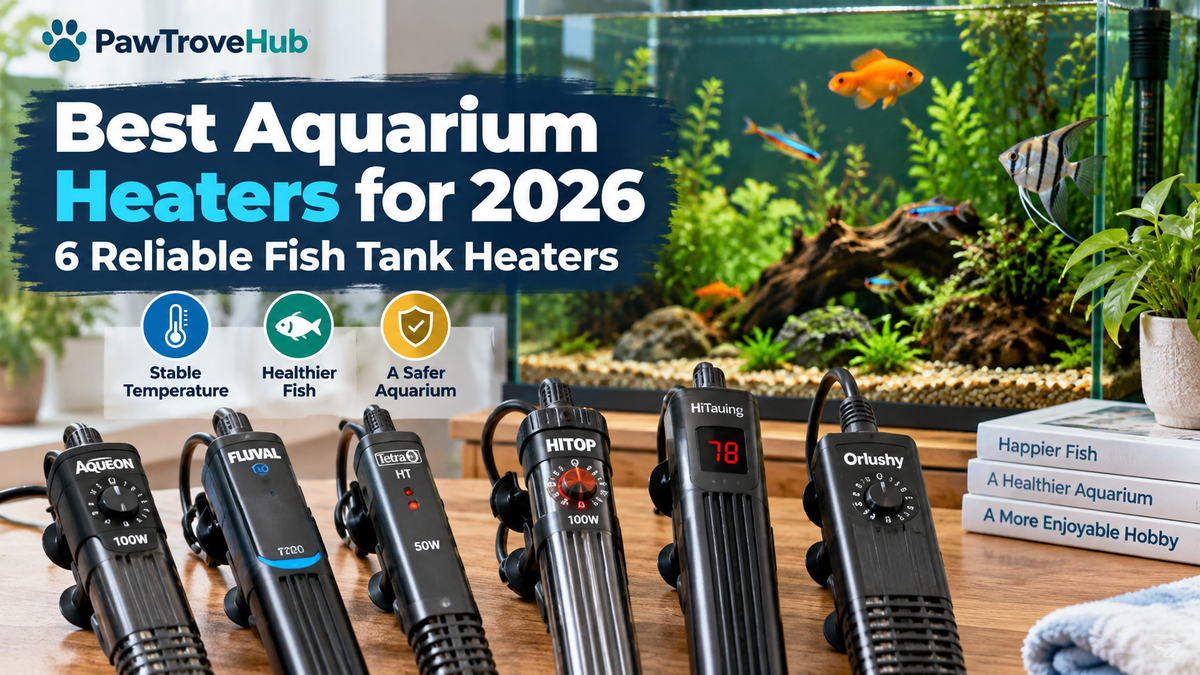
Choosing one of the best aquarium heaters is about more than simply picking the highest wattage available. The right heater needs to match your aquarium size, room temperature, target water temperature, and the needs of the fish you keep.
A heater that is correctly sized can help maintain a stable environment, while the wrong size may struggle to warm the aquarium or cycle more aggressively than necessary. Safety features, temperature control, placement, and independent monitoring also matter.
In this guide, we compare six aquarium heaters ranging from 50W to 300W and explain how to choose the right option for your setup. You’ll also find a practical aquarium heater wattage guide, installation and safety advice, and answers to common questions about fish tank heating.
Note: Product specifications, availability, and Amazon variations can change. Always confirm the current wattage, tank-size recommendation, and included features on the product listing before purchasing.
Best Aquarium Heaters at a Glance
| Aquarium Heater | Wattage | Best For | Control Type | Key Consideration |
|---|---|---|---|---|
| Aqueon Pro Adjustable Aquarium Heater | 100W | Adjustable heating | Adjustable | Match wattage to your aquarium and temperature needs |
| Fluval T200 | 200W | Medium-to-large aquariums | Electronic | Designed for aquariums up to 65 gallons |
| Tetra HT | 50W | Small aquariums | Electronic thermostat | Designed for 2–10 gallon aquariums |
| HITOP HP-608 | 100W | Small-to-medium aquariums | Adjustable | Designed for 12–30 gallon aquariums |
| HiTauing Submersible Heater | 300W option | Larger aquariums | Adjustable/digital family | Confirm the selected wattage before ordering |
| Orlushy Submersible Heater | 300W | Larger setups | Adjustable | Choose wattage according to actual tank conditions |
The table is only a starting point. Tank volume matters, but so does the temperature difference between your room and the temperature you need to maintain.
For a broader look at aquarium equipment and other pet supplies, browse PawTroveHub’s pet products collection. For fish-specific equipment, you can also explore the PawTroveHub Fish Products collection.
How We Chose These Aquarium Heaters
A useful aquarium heater comparison should look beyond wattage. Two heaters with the same wattage can still differ considerably in how they control temperature, how easy they are to install, and what safety features they offer.
Here are the main factors to consider.
Tank-Size Compatibility
The first question is whether the heater is intended for your aquarium volume.
A 50W heater can make sense for a small aquarium, while a larger tank may require 100W, 150W, 200W, or more. But tank size should not be the only consideration.
Always check the manufacturer’s recommended aquarium range for the exact heater and wattage you are buying.
Temperature Control
Adjustable heaters let you select a target temperature instead of relying entirely on a fixed setting.
That flexibility is useful when you keep species with different temperature requirements or when seasonal room temperatures change.
Electronic and digital models can also make temperature management easier to monitor, but a display on the heater should not replace an independent aquarium thermometer.
Safety Features
Important features can include:
- Automatic shutoff or power interruption when the heater is out of water
- Over-temperature protection
- Durable or protective heater construction
- Clear heating indicators
- Secure mounting hardware
No electronic heater should be treated as incapable of failure. Good equipment and independent monitoring work together.
Ease of Installation
A heater should be practical to mount and position inside your aquarium.
Look at the mounting method, heater length, power-cord arrangement, and the manufacturer’s instructions before installing it.
Independent Temperature Monitoring
The actual aquarium temperature can differ from the heater’s setting because of water circulation and the location of the aquarium. A separate thermometer provides an independent check of what is happening in the tank.
How to Choose the Right Aquarium Heater Wattage
Aquarium heater wattage is one of the most important decisions you’ll make, but there is no single watt-per-gallon formula that works perfectly for every aquarium.
The key variables are:
- Aquarium volume
- Target water temperature
- Lowest normal room temperature
- Tank location
- Heat loss from the aquarium
- Water circulation
- The manufacturer’s heater-sizing recommendation
Aqueon’s current heater guide, for example, changes recommended wattage depending on how many degrees the aquarium needs to be raised above room temperature. For a 20-gallon aquarium, its guidance ranges from 50W to 100W depending on the required temperature increase, while a 55-gallon aquarium may require 150W to 200W under the conditions shown in its chart. Aqueon’s aquarium heater sizing guide provides the detailed sizing information.
Aquarium Heater Wattage Chart
The following ranges are useful starting points rather than universal rules:
| Tank Size | Common Starting Range |
|---|---|
| 5–10 gallons | 25–50W |
| 10–20 gallons | 50–100W |
| 20–30 gallons | 50–100W |
| 30–40 gallons | 100–150W |
| 40–55 gallons | 150–200W |
| 55–75 gallons | 200–300W |
| 75+ gallons | Consider system-specific sizing or multiple heaters |
These ranges should not override the heater manufacturer’s instructions.
Why Room Temperature Matters
Imagine two identical 20-gallon aquariums that both need water maintained at 78°F.
If one aquarium is in a room at 74°F, the heater only has to maintain a relatively small temperature difference.
If the other aquarium is in a room at 65°F, the heater needs to provide substantially more heat to maintain the same target.
This is why choosing an aquarium heater based only on gallons can produce poor results.
Should You Use One Large Heater or Multiple Smaller Heaters?
Larger aquariums sometimes benefit from distributing heating capacity rather than relying on a single extremely high-wattage heater.
Multiple appropriately sized heaters can distribute heat more evenly and provide some redundancy, but the exact setup depends on the aquarium, equipment, and manufacturer’s recommendations.
For large installations, avoid automatically assuming that the biggest available heater is the right answer.
Best Aquarium Heaters for 2026
The six products below cover several aquarium sizes and feature preferences. They are presented by use case rather than as a universal first-to-last ranking.
Aqueon Pro Adjustable Aquarium Heater — 100W
The Aqueon Pro Adjustable line is designed for aquariums where adjustable temperature control and a durable heater body are priorities.
Aqueon describes its Pro heaters as fully submersible, with an adjustable dial and an LED indicator showing when the heater is actively heating. The company also publishes heater-sizing guidance based on aquarium size and the required temperature increase above room temperature.
Best for: Aquarium owners who want adjustable heating for a small-to-medium setup.
What to consider:
- 100W capacity
- Adjustable temperature control
- Fully submersible design
- Heating indicator
- Heater sizing should still be matched to the aquarium and room conditions
For the exact current 100W configuration, compatibility, and availability, see the Aqueon Pro Adjustable Aquarium Heater listing on Amazon.
Fluval T200 Fully Electronic Aquarium Heater — 200W
The Fluval T200 is a 200W fully electronic aquarium heater designed for aquariums up to 65 US gallons according to Fluval’s current specifications.
It uses electronic temperature control, provides a 360-degree heat-status indicator, and is designed to cut power when no water is detected. Fluval also states that the heater can be positioned vertically or horizontally when installed according to its instructions.
Best for: Medium-to-large aquariums where electronic temperature control and monitoring features are important.
What to consider:
- 200W output
- Rated for aquariums up to 65 US gallons
- Adjustable temperature range
- Electronic temperature monitoring
- Water-absence power cutoff
- Heater guard for additional protection
The Fluval T200 200W aquarium heater is worth considering when a 200W electronic heater fits your aquarium’s actual heating requirements.
Tetra HT 50W Submersible Aquarium Heater
For small tanks, a 300W heater would make little sense simply because it produces more heat. A properly sized 50W heater can be much more appropriate.
The Tetra HT 50W is designed for 2–10 gallon aquariums. Its electronic thermostat maintains a preset temperature, and indicator lights show whether the heater is actively heating or on standby.
The heater is installed inside the aquarium with a suction cup, and Tetra recommends positioning it in an area with good water circulation.
Best for: Small aquariums in the 2–10 gallon range.
What to consider:
- 50W output
- Designed for 2–10 gallon aquariums
- Electronic thermostat
- Heating and standby indicator lights
- Submersible installation
- Good water circulation is important
See the Tetra HT 50W aquarium heater on Amazon for the current product configuration.
HITOP HP-608 Adjustable Aquarium Heater — 100W
The HITOP HP-608 is a 100W adjustable submersible aquarium heater listed for 12–30 gallon aquariums.
Its adjustable thermostat gives aquarium owners more control than a fixed-temperature heater, while suction cups help secure the unit inside the aquarium.
Best for: Small-to-medium tanks where adjustable heating is important.
What to consider:
- 100W output
- Listed for 12–30 gallon aquariums
- Adjustable thermostat
- Submersible design
- Suction-cup mounting
Before ordering, verify that the selected Amazon variation is the 100W configuration and that its recommended aquarium range matches your tank.
You can check the HITOP HP-608 100W aquarium heater for the current listing and specifications.
HiTauing Submersible Aquarium Heater — 300W Option
The HiTauing listing offers multiple wattage variations, including a 300W option. Because the Amazon page is a multi-variation listing, check the selected wattage carefully before purchasing rather than assuming that the default variation is the 300W model.
The product family emphasizes digital temperature display and protection features, making it relevant for aquarium owners who want more visible temperature information.
Best for: Larger aquariums that genuinely require the higher wattage option and users who prefer a digital display.
What to consider:
- 300W option available within the product family
- Digital temperature display
- Submersible design
- Temperature adjustment
- Protective functions advertised by the manufacturer
- Exact tank suitability depends on the selected wattage and aquarium conditions
If the 300W version is the appropriate size for your aquarium, check the HiTauing submersible aquarium heater listing and confirm the wattage selection before ordering.
Orlushy 300W Submersible Aquarium Heater
A 300W heater belongs in the conversation for larger aquariums or setups where the required temperature increase calls for more heating capacity.
The important point is that 300W should not be selected simply because it appears more powerful. It needs to be appropriate for the tank volume and environmental conditions.
Best for: Larger aquariums that are appropriately matched to a 300W heating capacity.
What to consider:
- 300W heating capacity
- Adjustable submersible design
- Suitable for larger aquarium setups when properly sized
- Verify the exact tank-size recommendation for the current Amazon configuration
- Use a separate thermometer to confirm actual water temperature
For current configuration and compatibility details, see the Orlushy 300W aquarium heater.
Aquarium Heater Types Explained
Understanding heater types makes it easier to narrow down your choices.
Submersible Aquarium Heaters
Submersible heaters are designed to operate inside the aquarium water.
They are among the most common choices for home aquariums because they can be positioned within the tank and work with normal water circulation.
Always follow the individual product’s immersion and installation instructions.
Adjustable Aquarium Heaters
An adjustable aquarium heater allows you to choose a target temperature rather than relying on a fixed preset.
This can be useful when your fish require a particular temperature range or when room conditions change through the year.
Electronic and Digital Aquarium Heaters
Electronic heaters can provide more visible temperature controls or status information.
Digital displays may make adjustments easier to read, but they should not be treated as an independent confirmation of actual tank temperature.
Preset Aquarium Heaters
Preset heaters are designed around a predetermined temperature.
They can be convenient when the preset temperature is appropriate for your aquarium, but they provide less flexibility than an adjustable model.
Aquarium Heater Safety: What Actually Matters
Even one of the best aquarium heaters needs to be installed and monitored correctly.
A heater is an electrical device operating around water, so safe installation is just as important as the heater’s advertised features.
Never Run a Heater Out of Water
Do not plug in an aquarium heater before the aquarium is filled and the heater is positioned as instructed.
Merck Veterinary Manual’s aquarium fish guidance specifically advises against plugging in the heater until the tank is full because exposed heater tubes can overheat and may shatter.
Use a Separate Aquarium Thermometer
The heater setting does not necessarily tell you the exact temperature everywhere in the aquarium.
Water circulation, aquarium location, ambient temperature, and equipment can all affect the actual water temperature.
An independent thermometer gives you another way to check what is really happening.
Unplug Before Water Changes
Before lowering the water level around a submerged heater, switch it off and unplug it according to the product’s safety instructions.
Never assume a heater will remain safe simply because it contains an automatic protection feature.
Let the Heater Cool Before Removing It
A recently operating heater can be hot.
Allow it to cool according to the manufacturer’s instructions before removing it from the aquarium. Avoid pulling a hot heater directly into the air.
Inspect the Heater Regularly
Look for visible problems such as:
- Cracks
- Damage to the cable
- Damaged suction cups
- Unusual temperature behavior
- Physical deterioration
Replace equipment that shows signs of damage rather than continuing to operate it.
Where Should You Place an Aquarium Heater?
Heater placement affects how effectively warmth is distributed through the aquarium.
A good location generally has reasonable water circulation so warmed water can spread throughout the tank instead of remaining concentrated around the heater.
Place It Where Water Moves
Installing the heater near a suitable area of water movement can help distribute heat more evenly.
The goal is not to create a hot spot but to allow warmed water to circulate through the aquarium.
Follow the Manufacturer’s Positioning Instructions
Some heaters can be positioned vertically, horizontally, or in specific orientations.
For example, Fluval’s T Series allows vertical or horizontal placement according to its current product guidance.
The manufacturer’s instructions for your exact model take priority over general aquarium advice.
Keep the Heater Secure
Use the supplied mounting hardware and make sure the heater cannot easily swing, fall, or contact objects in a way that could damage it.
Do You Need a Separate Aquarium Thermometer?
Yes, an independent thermometer is a sensible part of a heated aquarium setup.
A heater’s control setting is not the same thing as a direct measurement of water temperature. A separate thermometer lets you verify whether the aquarium is actually maintaining the range you expect.
This is especially useful when:
- The room temperature changes seasonally
- The aquarium is near a window or exterior wall
- You have recently installed or replaced a heater
- You are troubleshooting unusual temperature readings
- The fish show behavior that makes you question the water temperature
Think of the heater as the device that manages temperature and the thermometer as the device that independently tells you what the water is doing.
Can an Aquarium Heater Be Too Powerful?
Yes. More wattage is not automatically better.
A heater should provide enough capacity for the aquarium and the required temperature increase without being selected solely because it has the highest number on the package.
For example, a 300W heater may be appropriate for some larger aquariums but unnecessary for a small tank. Conversely, a heater that is too small for a large aquarium may struggle to maintain the desired temperature, particularly in a cool room.
The better approach is to consider:
- Tank volume
- Room temperature
- Desired water temperature
- Heat loss
- Manufacturer recommendations
- Whether a single heater or multiple appropriately sized heaters make more sense
How to Install an Aquarium Heater Safely
Always read the instructions for your specific heater first, but the general process looks like this.
1. Inspect the Heater and Cord
Check for visible damage before installation.
2. Fill the Aquarium
Do not energize the heater before it is safely installed in the water as instructed.
3. Position the Heater
Secure it firmly where water circulation is appropriate.
4. Check the Water Level
Make sure the heater’s required immersion level is satisfied.
5. Connect Power Safely
Follow the manufacturer’s instructions for powering the heater.
6. Verify Temperature With a Separate Thermometer
Do not rely solely on the heater’s display or setting.
7. Monitor the Aquarium
Check the temperature after installation and again as the aquarium settles into its normal operating conditions.
Common Aquarium Heater Mistakes to Avoid
Avoid these common mistakes when choosing or using a fish tank heater:
- Choosing wattage only according to gallons
- Assuming the biggest heater is automatically the best heater
- Ignoring room temperature
- Running a heater before it is properly submerged
- Skipping independent temperature monitoring
- Installing the heater where water circulation is poor
- Ignoring damaged equipment
- Making sudden temperature changes without considering the fish species
- Assuming advertised safety features make regular monitoring unnecessary
- Failing to verify the exact wattage variation before ordering a multi-wattage product
A few minutes spent checking sizing and installation can prevent many avoidable problems.
Frequently Asked Questions
What is the best aquarium heater for a fish tank?
There is no single best aquarium heater for every tank. The appropriate choice depends on aquarium size, room temperature, desired water temperature, heater wattage, control type, and installation requirements.
A small aquarium may need only a 50W heater, while a much larger aquarium can require 200W or 300W capacity.
What size aquarium heater do I need?
Start with your aquarium volume, then consider how many degrees you need to raise the water above the surrounding room temperature.
The warmer the aquarium needs to be relative to the room, the more heating capacity may be required. Always compare your situation with the manufacturer’s heater-sizing recommendation.
Is 100W enough for a 20-gallon aquarium?
A 100W heater can be appropriate for some 20-gallon aquariums, but it is not a universal rule.
The answer depends on room temperature and the target aquarium temperature. Heater sizing guidance from Aqueon, for example, gives different wattage recommendations for a 20-gallon aquarium depending on the required temperature increase.
Is a 200W heater enough for a 55-gallon tank?
A 200W heater can fall within a reasonable range for a 55-gallon aquarium, especially when a larger temperature increase is required, but the exact choice should be based on your room temperature and the manufacturer’s recommendation.
Don’t choose the wattage from tank size alone.
Is 300W too much for a 40-gallon aquarium?
Not necessarily, but it should not be selected automatically.
A 300W heater may be appropriate in some environmental conditions, while another 40-gallon aquarium may need less heating capacity. Consider the room temperature, target temperature, heater specifications, and manufacturer guidance before choosing.
Should an aquarium heater be fully submerged?
Many submersible aquarium heaters are designed to operate fully underwater, but the correct immersion depth depends on the exact model.
Follow the heater’s instructions carefully and never operate it outside the required immersion range.
Can an aquarium heater overheat a fish tank?
A heater can malfunction, be incorrectly sized, or behave differently from what you expect. That is why independent temperature monitoring is important.
Use a separate thermometer, inspect the equipment, and follow the manufacturer’s safety instructions.
Where should I put an aquarium heater?
Place it where it can be securely mounted and where water circulation can distribute the warmed water through the aquarium.
The exact orientation and location should follow the heater manufacturer’s instructions.
Do I need a thermometer if my heater has a digital display?
Yes. A separate thermometer provides independent temperature monitoring.
The heater’s setting or display does not replace checking the actual aquarium water temperature.
How often should I check my aquarium heater?
Check the aquarium temperature regularly and inspect the heater whenever you perform normal aquarium maintenance.
Pay particular attention after installation, a water change, seasonal temperature changes, or any noticeable change in fish behavior.
Build a More Complete Aquarium Setup
An aquarium heater is only one part of a stable aquarium environment.
Your tank also depends on appropriate filtration, lighting, water preparation, and aquarium size. Once you’ve selected a properly sized heater, you can explore related fish tanks and aquariums, review aquarium filters, and learn more about aquarium water conditioners and treatments.
Lighting is another important part of the overall setup, so see the aquarium lighting collection when planning the rest of your aquarium equipment.
Which Aquarium Heater Should You Choose?
The right aquarium heater is the one that fits your actual setup rather than simply having the highest wattage or the longest feature list.
For a small aquarium, the 50W Tetra HT may be worth considering when its 2–10 gallon recommendation matches your tank. For small-to-medium aquariums, 100W options such as the Aqueon Pro and HITOP HP-608 provide adjustable-heating choices. For larger aquariums, the Fluval T200 provides 200W of electronic heating capacity, while 300W options can make sense when the tank and room conditions genuinely call for that level of heating.
Before purchasing, check three things:
Tank size → required temperature increase → manufacturer’s recommended wattage.
Then consider whether you prefer adjustable controls, electronic monitoring, a digital display, or a simpler setup.
Finally, use a separate thermometer and follow safe installation practices. A well-sized heater paired with independent monitoring is much more useful than simply choosing the most powerful heater you can find.
When you’re ready to compare the available options, return to the comparison table above and choose the model whose wattage, controls, and intended aquarium range match your specific setup.