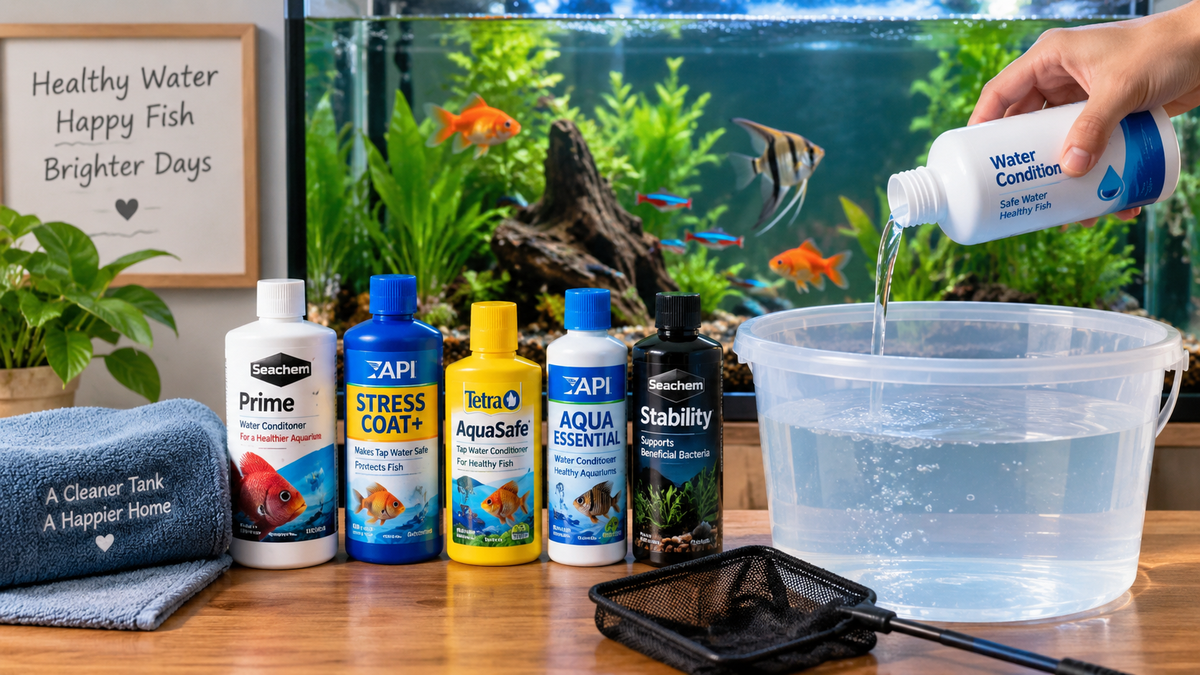
Tap water may be perfectly fine for people, but that does not automatically make it safe for aquarium fish. Depending on where you live, tap water can contain chlorine, chloramine, or other substances that can harm fish and the beneficial bacteria your aquarium depends on.
That is why aquarium water conditioners are an important part of routine fishkeeping.
A good water conditioner can treat new tap water before it goes into your aquarium, making routine water changes safer and easier. But not every aquarium treatment does the same thing, and some products that are marketed for aquarium water care have completely different purposes.
In this guide, we’ll look at the best aquarium water conditioners and related treatments, explain what they actually do, show you how to use them, and help you choose the right option for your fish tank.
Quick Answer: Aquarium water conditioners are used to treat tap water before it is added to a fish tank. Depending on the formula, they may neutralize chlorine and chloramine and may also address certain heavy metals or provide additional benefits. Always follow the dosage instructions for the specific product you use.
Best Aquarium Water Conditioners
The right conditioner depends on your water source, aquarium setup, and what you want the product to do. The following options cover several common needs, from straightforward tap-water treatment to products designed to provide additional aquarium support.
| Product | Best For | Type |
|---|---|---|
| Seachem Prime | All-around aquarium water conditioning | Water conditioner |
| API Stress Coat | Water conditioning with additional protective features | Water conditioner |
| Tetra AquaSafe | Routine tap-water treatment | Water conditioner |
| Seachem Stability | Supporting biological filtration | Aquarium stabilizer |
| API Tap Water Conditioner | Straightforward tap-water treatment | Water conditioner |
| API Aqua Essential | Routine aquarium water treatment | Water conditioner |
1. Seachem Prime
Best for: All-around aquarium water conditioning
Seachem Prime is a popular choice among aquarium keepers who want a concentrated water conditioner for routine aquarium maintenance.
It is designed for treating tap water before it enters the aquarium and is particularly useful during regular water changes. Because concentrated formulas can treat a relatively large amount of water from a small quantity of product, it can also be practical for fishkeepers maintaining larger tanks.
As with any aquarium conditioner, the important thing is to follow the dosage instructions on the bottle rather than assuming that every conditioner uses the same concentration.
2. API Stress Coat
Best for: Fishkeepers who want water conditioning with additional protective features
Check API Stress Coat on Amazon
API Stress Coat is another well-known aquarium water treatment. It can be useful for fishkeepers looking for a conditioner that offers more than basic tap-water treatment.
It is commonly considered when fish are being introduced, handled, or experiencing stressful aquarium-maintenance situations. However, it should still be used according to the product’s instructions and should not replace good aquarium management.
3. Tetra AquaSafe
Best for: Routine tap-water treatment
Check Tetra AquaSafe on Amazon
Tetra AquaSafe is designed for treating tap water before it is added to an aquarium.
For many beginners, straightforward products like this can be appealing because the main purpose is easy to understand: treat incoming water before it reaches your fish.
The most important thing is to determine the amount of water you are actually treating and then use the dosage specified by the manufacturer.
4. Seachem Stability
Best for: Supporting biological filtration
Check Seachem Stability on Amazon
Important: Seachem Stability is not a conventional dechlorinating water conditioner.
It belongs in the broader aquarium water-treatment category because its purpose is related to supporting biological filtration rather than simply conditioning tap water.
That distinction matters. If you are performing a water change with untreated municipal tap water, you should choose a product specifically designed to address the contaminants in your source water. A biological stabilizer should not automatically be treated as a substitute for a dechlorinator.
5. API Tap Water Conditioner
Best for: Straightforward tap-water treatment
Check API Tap Water Conditioner on Amazon
API Tap Water Conditioner is designed specifically for treating tap water used in aquariums.
It can be a practical option for fishkeepers who want a dedicated conditioner for routine water changes without trying to turn the process into something complicated.
As always, check the product label for the appropriate dosage based on the amount of water being treated.
6. API Aqua Essential
Best for: Routine aquarium water treatment
Check API Aqua Essential on Amazon
API Aqua Essential is another aquarium water-treatment option worth considering when preparing water for your fish tank.
Rather than choosing a conditioner solely because it is popular, compare what each product is designed to treat and how its dosage works with the size of your aquarium.
For regular maintenance, the best conditioner is usually the one that matches your water source and can be used correctly and consistently.
What Does Aquarium Water Conditioner Do?
Aquarium water conditioner is primarily used to make tap water safer for aquarium use.
Municipal water supplies are commonly disinfected using substances such as chlorine or chloramine. These disinfectants are useful for producing safe drinking water, but they can be harmful to fish and aquatic organisms.
They can also interfere with the beneficial microorganisms that help keep an aquarium’s biological filtration system functioning properly.
A suitable aquarium conditioner can therefore be an important part of preparing new water before a water change.
However, not every conditioner treats exactly the same things. Some formulas are designed primarily around chlorine and chloramine, while others make additional claims about heavy metals or other water-quality concerns.
That is why the product label matters.
Chlorine vs. Chloramine: What’s the Difference?
Understanding the difference between chlorine and chloramine can help you choose an appropriate water-treatment product.
Chlorine
Chlorine has traditionally been used to disinfect municipal drinking water. It can be harmful to fish when untreated tap water is added directly to an aquarium.
Some people assume that allowing tap water to sit for a while will always solve the problem. That is not something you should rely on, particularly when your local water supply uses chloramine.
Chloramine
Chloramine is a disinfectant formed by combining chlorine with ammonia. It is used by many water systems because it remains more stable in water distribution networks.
That stability is useful for drinking-water systems, but it means fishkeepers should not assume that simply leaving tap water exposed to air will remove the disinfectant.
If you are unsure whether your local water supply contains chlorine or chloramine, check your water provider’s information or use appropriate water testing.
Do You Need a Water Conditioner for Your Aquarium?
If you use ordinary municipal tap water for your aquarium, a suitable water conditioner is generally an important part of your water-change routine.
You should pay particular attention if your source water contains:
- Chlorine
- Chloramine
- Other substances that your chosen conditioner is specifically designed to address
The exact requirements can vary depending on your water source and aquarium setup.
If you use water from a different source, such as properly prepared reverse-osmosis water, your treatment requirements may be different. But you should still understand the chemistry of the water you are putting into the aquarium rather than assuming it is automatically suitable.
The goal is simple:
Know what’s in your source water, then choose a treatment that addresses the relevant problem.
How to Use Aquarium Water Conditioner
Using a water conditioner does not need to be complicated.
Step 1: Determine how much water you are treating
Know the approximate volume of replacement water rather than guessing.
If you are performing a partial water change, calculate the amount of new water being prepared.
Step 2: Check the product instructions
Different conditioners have different concentrations and dosing instructions.
Never assume that the dosage for one product applies to another.
Step 3: Measure the conditioner
Use the manufacturer’s recommended amount.
Accurate measuring is especially important when using concentrated products.
Step 4: Treat the replacement water
Follow the product’s instructions for adding and mixing the conditioner.
Step 5: Add the prepared water to the aquarium
Once the water has been treated according to the product directions, it can be used for your aquarium maintenance routine.
A simple rule to remember
Measure the water, read the label, measure the conditioner, and don’t guess.
How Much Aquarium Water Conditioner Should You Use?
There is no universal dosage for every aquarium water conditioner.
Two products can have very different concentrations, so using a generic number of drops or milliliters without checking the bottle can result in an incorrect dose.
Instead:
- Determine how much water you are treating.
- Find the manufacturer’s dosage instructions.
- Calculate the required amount.
- Measure it accurately.
- Follow any additional directions on the product label.
If you change brands, do not automatically continue using the dosage from your previous conditioner.
Can You Put Water Conditioner Directly in the Aquarium?
It depends on the product.
Some aquarium conditioners provide instructions for adding the product directly to the aquarium, while others are intended to treat replacement water before it enters the tank.
There is no reason to guess.
Follow the instructions printed on the specific product you are using.
If the manufacturer gives separate instructions for treating new water and treating an aquarium directly, use the instructions that match your situation.
Does Letting Tap Water Sit Remove Chlorine?
Leaving tap water sitting for a period of time is sometimes suggested as a way to reduce chlorine, but it should not be treated as a reliable solution for every water supply.
The bigger issue is chloramine.
Because chloramine is considerably more stable than free chlorine, simply allowing water to sit does not provide the same approach to treatment.
For fishkeepers who use municipal water, a properly selected aquarium water conditioner is generally a much more straightforward way to prepare replacement water.
Aquarium Water Conditioner vs. Other Water Treatments
Not every aquarium water treatment is a water conditioner.
Understanding the difference can prevent you from buying the wrong product.
| Treatment | Main Purpose |
|---|---|
| Water conditioner/dechlorinator | Treat incoming tap water, including chlorine or chloramine depending on the formula |
| Biological stabilizer | Support beneficial bacteria and biological filtration |
| Water clarifier | Help deal with certain types of suspended particles or cloudy water |
| pH treatment | Adjust or influence aquarium pH |
| Aquarium salt | Used for specific aquarium applications; it is not a substitute for a dechlorinator |
This is also why Seachem Stability should not be presented as though it performs exactly the same job as a conventional tap-water conditioner.
Different problems require different solutions.
How to Choose the Best Aquarium Water Conditioner
You don’t necessarily need the most expensive or most heavily marketed product.
Instead, look at what your aquarium actually needs.
1. Find out what’s in your tap water
The first question is whether your local water supply contains chlorine, chloramine, or something else that needs to be addressed.
2. Check what the conditioner treats
Read the product label carefully.
Don’t assume every aquarium conditioner handles the same substances.
3. Consider the size of your aquarium
A highly concentrated product may be convenient if you regularly treat large quantities of water.
4. Think about your aquarium type
Make sure the product is appropriate for your setup, including freshwater or other aquarium applications where relevant.
5. Don’t pay for features you don’t need
Additional claims can sound impressive, but the most important thing is whether the product reliably addresses the water-quality issue you actually have.
6. Follow the dosage instructions
A good product used incorrectly is not a good water-treatment routine.
Correct dosage is part of choosing and using a conditioner responsibly.
Common Aquarium Water Conditioner Mistakes
Even a simple water change can cause problems when water-treatment basics are overlooked.
Mistake 1: Adding untreated tap water
If your tap water contains chlorine or chloramine, adding it directly to the aquarium can expose fish and beneficial bacteria to potentially harmful disinfectants.
Mistake 2: Guessing the dosage
Different products have different concentrations.
Always check the bottle.
Mistake 3: Assuming all conditioners work identically
A water conditioner, biological stabilizer, clarifier, and pH treatment are not interchangeable.
Mistake 4: Ignoring chloramine
Don’t assume that leaving tap water standing will solve every water-treatment problem.
Mistake 5: Using the wrong product for the problem
Cloudy water, ammonia, chlorine, chloramine, and pH issues are different problems. Treating one does not automatically fix another.
Mistake 6: Forgetting about water parameters
Water conditioner is only one part of aquarium maintenance. Regularly checking important water parameters can help you understand what is happening inside your tank.
Aquarium Water Conditioner FAQs
What is the best aquarium water conditioner?
There is no single best conditioner for every aquarium. A good choice is one that treats the substances present in your source water, is appropriate for your aquarium, and has clear dosing instructions you can follow consistently.
Do I need conditioner for every water change?
If you are adding tap water containing chlorine or chloramine, the replacement water should be appropriately treated before it reaches your fish. Follow the directions for your specific conditioner.
Does aquarium water conditioner remove chlorine?
Many aquarium water conditioners are specifically designed to neutralize chlorine. Check the product label to confirm exactly what the formula treats.
Does aquarium water conditioner remove chloramine?
Some conditioners are designed to address chloramine, but you should verify this on the specific product label rather than assuming all conditioners work the same way.
Can you overdose aquarium water conditioner?
Dosage requirements vary by product. Using more than the recommended amount is not a good substitute for following the manufacturer’s instructions. If you are unsure, check the product label before dosing.
How long does aquarium water conditioner take to work?
The answer depends on the product. Follow the manufacturer’s instructions for the specific conditioner rather than assuming every formula works at the same speed.
Can I add water conditioner directly to the fish tank?
Some products allow this, while others are intended to treat replacement water first. Follow the directions for the specific conditioner you use.
Does letting tap water sit remove chlorine?
Some chlorine can dissipate under certain conditions, but this should not be relied upon as a universal method, especially when the water supply uses chloramine.
Is water conditioner safe for freshwater fish?
Products specifically made for aquarium water treatment are designed for aquarium use when used according to their instructions. Always read the product label and dosage directions.
Do new aquariums need water conditioner?
If you’re using tap water that contains chlorine or chloramine, treating the water before adding it to a new aquarium is important. Remember that water conditioning and establishing beneficial biological filtration are two different processes.
Final Thoughts
Aquarium water conditioner is one of those fishkeeping products that seems simple until you realize how important the underlying water chemistry can be.
The best approach isn’t to buy a conditioner simply because it has the most reviews or the biggest marketing claims. First understand your water source, determine whether chlorine or chloramine needs to be addressed, and then choose a product that matches your aquarium and follow its dosing instructions.
For routine tap-water treatment, products such as Seachem Prime, API Stress Coat, Tetra AquaSafe, API Tap Water Conditioner, and API Aqua Essential are options worth comparing. If you’re looking at Seachem Stability, remember that it serves a different purpose by supporting biological filtration rather than acting as a conventional tap-water dechlorinator.
For more aquarium-related products and supplies, you can also browse PawTroveHub’s fish products or explore all pet products.
Helpful Aquarium Water-Quality Resources
Good aquarium care starts with understanding the water your fish live in. For additional educational information, these veterinary and government resources are useful:
- Merck Veterinary Manual: Providing a Home for Fish — background on aquarium water quality and the effects of chlorine and chloramine.
- Merck Veterinary Manual: Environmental Diseases of Aquatic Animals — additional veterinary information about environmental water-quality problems affecting aquatic animals.
- U.S. EPA: Chloramines in Drinking Water — explains what chloramines are and why drinking-water systems use them.
Affiliate disclosure: Some links on this page are affiliate links. If you purchase through one of these links, PawTroveHub may earn a commission at no additional cost to you. Our recommendations are intended to provide useful information for aquarium owners; always check the manufacturer’s current product instructions before use.