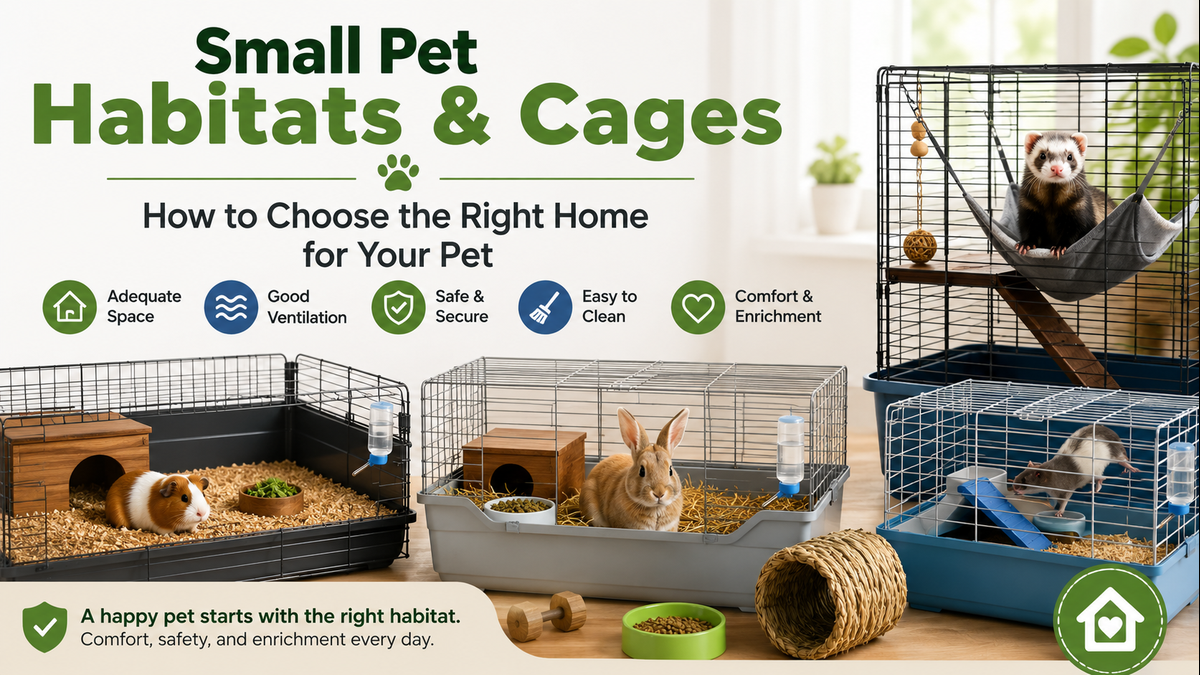
Choosing a habitat for a small pet is about much more than finding a cage that fits in your home. The right enclosure should give your pet enough usable space to move, rest, explore, eat, and behave naturally while also being safe and practical for you to maintain.
Guinea pigs, rabbits, ferrets, rats, hamsters, and other small pets don’t all have the same housing needs. A tall multi-level cage may be useful for an active climbing animal, while a ground-dwelling pet may benefit much more from generous uninterrupted floor space.
That’s why the best small pet habitat isn’t necessarily the biggest, tallest, or most expensive option. It is the one that matches your pet’s species, size, activity level, and daily needs.
In this guide, we’ll explain what to look for in a small pet habitat and highlight six established cage options worth considering.
What Makes a Good Small Pet Habitat?
Before choosing a cage, focus on the fundamentals.
1. Adequate Living Space
Space should be your first consideration.
Your pet needs enough room to move comfortably and should not have to spend most of its life squeezed between food bowls, hideouts, toys, and other accessories.
For many small animals, usable floor space is particularly important. Adding another level does not always compensate for an enclosure that is too narrow or cramped at ground level.
Think about the space your pet will actually be able to use after bedding, shelters, feeding equipment, and enrichment are added.
2. Safe Bar Spacing
If you’re choosing a wire habitat, check the spacing between the bars carefully.
The gaps need to be appropriate for your particular pet. A cage that is secure for a larger animal may not be safe for a smaller animal that can squeeze through the openings.
This becomes especially important with young, small, or particularly agile pets.
3. Good Ventilation
Small-pet habitats should provide plenty of fresh airflow while protecting the animal from dangerous drafts.
Wire-sided habitats generally provide excellent ventilation, but ventilation alone doesn’t make a habitat suitable. The enclosure still needs appropriate flooring, bedding, temperature control, and protection from excessive heat or cold.
4. Comfortable Flooring
Pay close attention to the surfaces your pet will actually walk and rest on.
Bare wire flooring can create problems for some small animals, so a habitat should provide appropriate solid areas and suitable bedding or coverings where necessary.
The correct flooring depends on the species, so don’t assume that a cage designed for one type of small animal is automatically suitable for another.
5. Easy Access
Large doors can make a surprisingly big difference.
You’ll need regular access for feeding, cleaning, replacing bedding, rearranging enrichment, and safely handling your pet.
A habitat with awkward doors may become frustrating to maintain even if the cage itself is otherwise well designed.
6. Easy Cleaning
A habitat should be practical enough that you’re willing to clean it regularly.
Look for features such as:
- Removable trays
- Accessible doors
- Easy-to-clean surfaces
- Removable platforms where appropriate
- Durable construction
- Parts that can be cleaned without completely dismantling the habitat
A cage that looks great but takes ages to clean isn’t necessarily a great long-term choice.
Choose the Habitat Based on Your Small Pet
One of the biggest mistakes shoppers make is choosing a cage first and asking whether it suits their pet afterward.
The better approach is the opposite:
Choose your pet’s housing requirements first, then find the habitat that meets them.
Guinea Pigs
Guinea pigs are ground-dwelling animals, so usable floor space deserves particular attention.
A suitable habitat should provide plenty of room for movement, feeding, resting, hiding, and enrichment. Solid flooring and comfortable bedding are also important.
Large single-level habitats can therefore be more useful for guinea pigs than cages that emphasize height.
Rabbits
Rabbits generally need substantially more living space than the phrase “small pet” might suggest.
A cage should not be treated as a rabbit’s entire exercise area. A suitable setup should provide adequate room and, where possible, opportunities for supervised exercise outside the enclosure.
When comparing rabbit habitats, pay close attention to floor area, access, flooring, and the amount of time your rabbit will actually spend inside the enclosure.
Ferrets
Ferrets are active, curious animals that benefit from an enclosure that allows them to move, explore, climb, and play.
For ferrets, a multi-level design can make good use of vertical space, provided the overall enclosure is sufficiently spacious and safely arranged.
Easy access and secure doors are especially valuable for an animal known for being an excellent escape artist.
Rats
Rats are active and intelligent animals that benefit from room to explore and opportunities to climb and investigate their surroundings.
A multi-level habitat can be useful because it allows you to create different areas for sleeping, feeding, climbing, and enrichment.
However, don’t choose a cage based on height alone. The overall dimensions and usable space still matter.
Hamsters and Other Small Rodents
Hamsters, mice, gerbils, and similar animals have their own specific housing requirements.
For smaller animals, bar spacing becomes especially important, while bedding depth, floor space, ventilation, and opportunities for natural behaviors should also influence your decision.
A habitat marketed as a “small animal cage” isn’t automatically appropriate for every species.
6 Small Pet Habitats & Cages Worth Considering
The following six habitats were selected because they offer different approaches to small-pet housing. Instead of declaring one universal winner, consider which design best matches your pet and your available space.
1. Prevue Universal Small Animal Home
Best for: Owners looking for a versatile small-animal cage design
The Prevue Universal Small Animal Home is a flexible option for owners who want a traditional wire habitat with a practical layout.
Its design makes it easier to provide bedding, food, enrichment, and other essentials while maintaining good airflow.
The main advantage of a versatile habitat like this is flexibility. You can arrange the interior around your pet rather than being locked into a complicated built-in layout.
Before purchasing, however, make sure its dimensions and bar spacing are appropriate for your particular animal.
Good choice if: You want a straightforward, versatile enclosure for an appropriate small pet.
Keep in mind: “Universal” doesn’t mean suitable for every species or every stage of life. Always compare the habitat’s dimensions and bar spacing with your pet’s needs.
2. MidWest Guinea Habitat Plus
Best for: Guinea pig owners who prioritize usable floor space
The MidWest Guinea Habitat Plus takes a different approach from tall multi-level cages.
Its design is centered around giving guinea pigs a generous living area at ground level, which makes it particularly appealing for owners who want a habitat built around movement and floor space.
The open layout also makes it easier to arrange food, water, hideouts, bedding, and enrichment without trying to fit everything into several small levels.
For guinea pig owners, this type of layout can be much more practical than choosing a tall cage simply because it looks larger.
Good choice if: Your priority is a spacious ground-level setup for guinea pigs.
Keep in mind: You’ll still need to consider the total area available to your pets, the number of animals sharing the habitat, and how much additional exercise space they receive.
3. Ferplast Cavie Guinea Pig & Rabbit Cage
Best for: Owners looking for a traditional habitat for guinea pigs or rabbits
The Ferplast Cavie is designed around the needs of larger ground-dwelling small pets such as guinea pigs and rabbits.
Its conventional cage format provides a defined living area while allowing owners to add bedding, feeding equipment, hideouts, and enrichment.
This type of habitat can work well for owners who prefer a straightforward cage setup rather than a tall, multi-level enclosure.
For rabbits especially, remember that a cage should not automatically be considered the animal’s complete exercise environment. Additional safe space and supervised activity may be necessary depending on your rabbit’s setup.
Good choice if: You prefer a traditional habitat format for an appropriate guinea pig or rabbit setup.
Keep in mind: Check the dimensions carefully and make sure the enclosure is large enough for your particular pet and intended use.
4. MidWest Critter Nation Double Unit
Best for: Active climbing small animals that benefit from vertical space
The MidWest Critter Nation Double Unit is a very different style of habitat from the large floor-oriented guinea pig enclosures.
Its double-level design creates substantial vertical living space, making it particularly interesting for animals that enjoy climbing and exploring different levels.
The full-width doors are also useful when you need to reach different areas of the habitat for cleaning, rearranging enrichment, or interacting with your pets.
Its large footprint and height mean that it requires a dedicated location, but the vertical design can make excellent use of available room.
Good choice if: You want a substantial multi-level habitat for an appropriate climbing small animal.
Keep in mind: Vertical space should complement, not replace, adequate usable floor area. Bar spacing must also be appropriate for the animals you intend to house.
5. Prevue Feisty Ferret Home with Stand
Best for: Ferrets and other appropriately sized animals that benefit from multiple levels
The Prevue Feisty Ferret Home is designed around vertical living space.
It features multiple levels, ramps, shelves, large doors, a removable debris tray, and rolling casters. The manufacturer also describes the cage as having an opening that can separate the enclosure into two areas or remain open as one larger space.
That combination makes it particularly practical for owners who want to organize different areas for sleeping, playing, feeding, and enrichment.
The stand also provides additional storage and makes moving the enclosure easier than carrying a large cage manually.
Good choice if: You want a tall, multi-level habitat with convenient access and mobility.
Keep in mind: Multi-level space is most useful when it matches the behavior of the species being housed. Don’t choose a tall habitat simply because it looks impressive.
6. MidWest Small Wabbitat Rabbit Cage
Best for: Rabbit owners looking for a dedicated rabbit-housing option
The MidWest Small Wabbitat is designed specifically with rabbits in mind, making it a more focused option than a generic small-animal cage.
That matters because rabbits have different housing needs from many smaller rodents.
When evaluating a rabbit habitat, consider not just whether your rabbit can fit inside, but whether the enclosure works as part of the animal’s overall living and exercise environment.
A dedicated rabbit cage can provide a useful home base for sleeping, eating, resting, and litter-related routines while allowing you to build a larger exercise setup around it.
Good choice if: You’re setting up a rabbit’s home and want a purpose-oriented rabbit habitat.
Keep in mind: Rabbits need more than a small enclosure alone. Plan the entire living and exercise environment rather than treating the cage as the complete solution.
How to Choose the Right Habitat for Your Pet
If you’re still unsure which type of enclosure to choose, work through these questions.
What species do you have?
Start here.
A habitat suitable for a rabbit may be completely inappropriate for a hamster, while a tall ferret-style cage may not be the best choice for a guinea pig.
How much usable space does your pet need?
Look beyond the advertised height.
Ask yourself:
- How much floor space is available?
- How much of it will remain usable after adding accessories?
- Can the pet move comfortably?
- Is there room for enrichment?
- Can more than one animal use the space comfortably?
Does your pet climb?
If yes, vertical space may be particularly valuable.
If your pet spends most of its time on the ground, prioritize an enclosure with a generous usable floor area instead.
Is the bar spacing safe?
Never overlook this.
A cage can be spacious and well constructed but still be unsuitable if an animal can escape through the bars or become trapped.
Can you clean it easily?
You’ll be cleaning the habitat repeatedly, not just once.
Choose something that makes routine maintenance manageable.
Can you safely access your pet?
Consider where the doors are located and how easily you can reach the entire enclosure.
Large doors can make cleaning and handling considerably easier.
Does it fit your home?
Measure your available space before buying.
Remember to account for:
- The cage itself
- Doors opening outward
- Stands and wheels
- Accessories
- Cleaning access
- Clearance around the habitat
A habitat that technically fits into a corner isn’t useful if you can’t comfortably open it or clean it.
Small Pet Habitat Setup Essentials
Buying the cage is only the beginning.
Your pet’s habitat should also include the appropriate supplies for its species.
Bedding or Substrate
Choose bedding appropriate for the animal and use enough to provide a comfortable, hygienic environment.
Different species have different preferences and requirements, so don’t automatically use the same bedding for every small pet.
Food and Water
Provide species-appropriate food and a reliable source of fresh water.
Place feeding equipment where it is easy to access and clean.
Hideouts
Many small pets benefit from having places where they can retreat and feel secure.
Provide appropriately sized hideouts rather than leaving the enclosure completely exposed.
Enrichment
A good habitat shouldn’t just provide somewhere to sleep.
Depending on the species, enrichment may include:
- Tunnels
- Chew items
- Climbing structures
- Foraging opportunities
- Toys
- Exercise equipment
- Platforms
The goal is to encourage appropriate natural behaviors rather than simply filling the cage with accessories.
Safe Flooring
Make sure the surfaces are appropriate for your pet’s feet and body.
Avoid assuming that wire or grid flooring is automatically suitable simply because it comes with a particular cage.
Cleaning Routine
A clean habitat supports a healthier and more comfortable living environment.
Make sure you can easily remove waste, replace bedding, wash accessories, and inspect the enclosure for damage.
Common Small Pet Habitat Mistakes to Avoid
Even a high-quality cage can become a poor habitat if it’s used incorrectly.
Choosing the Cage Before the Pet’s Requirements
Don’t start with:
“Which cage should I buy?”
Start with:
“What does my pet need from its habitat?”
Then choose the cage.
Focusing Only on Height
A tall cage can look impressive, but height doesn’t automatically equal adequate living space.
For many ground-dwelling animals, floor space deserves much more attention.
Ignoring Bar Spacing
This is particularly risky with smaller animals.
Always check the spacing before purchasing.
Overcrowding the Interior
It’s easy to fill a cage with toys, shelves, bowls, tunnels, and hideouts until the animal has very little open space left.
Accessories should improve the habitat rather than make movement difficult.
Buying for Convenience Instead of Long-Term Use
A cheap cage may appear attractive initially, but replacing an unsuitable enclosure later can cost more.
Think about your pet’s current size, expected growth, number of animals, and long-term needs.
Treating the Cage as the Entire Environment
A habitat is only one part of good small-pet care.
Exercise, enrichment, nutrition, social needs, cleaning, and appropriate veterinary care all matter too.
Frequently Asked Questions
What is the best type of cage for a small pet?
There isn’t one cage that is best for every small pet. The right choice depends on the species, number of animals, required space, activity level, bar spacing, flooring, and your ability to maintain the habitat.
Are multi-level cages better than single-level cages?
Not automatically. Multi-level cages can be excellent for climbing animals, but ground-dwelling pets may benefit more from generous uninterrupted floor space.
How important is cage size?
Extremely important. Your pet needs enough usable space for normal movement, resting, feeding, and enrichment. The enclosure should also leave enough room for appropriate accessories without becoming overcrowded.
Is wire flooring safe for small pets?
It depends on the animal and the design. Don’t assume exposed wire flooring is appropriate for every species. Provide suitable solid surfaces and bedding where required.
Can one cage work for different small-pet species?
Sometimes a habitat can be appropriate for more than one species, but that doesn’t mean every animal has identical housing requirements. Always evaluate dimensions, bar spacing, flooring, ventilation, and layout for the specific animal.
Should rabbits live in a cage all the time?
A cage can serve as a rabbit’s home base, but it shouldn’t automatically be treated as the rabbit’s entire exercise environment. Rabbits need appropriate opportunities for movement and exercise.
What should I consider before buying a small pet cage?
Start with your pet’s species and space requirements. Then check the habitat’s dimensions, floor area, bar spacing, flooring, ventilation, access, cleaning features, durability, and how well it will accommodate food, bedding, hideouts, and enrichment.
Final Thoughts
The best small pet habitat is not simply the cage with the most levels, the largest dimensions, or the longest list of features.
It is the habitat that fits your pet’s actual needs.
Ground-dwelling animals such as guinea pigs and rabbits often need you to think carefully about usable floor space. Active climbing animals such as ferrets and rats may benefit from well-designed vertical space. Smaller rodents require careful attention to bar spacing, bedding, ventilation, and secure construction.
Among the six options covered here, you’ll find several different approaches to small-pet housing:
- Prevue Universal Small Animal Home for versatility
- MidWest Guinea Habitat Plus for a spacious ground-level guinea pig setup
- Ferplast Cavie for a traditional guinea pig or rabbit habitat
- MidWest Critter Nation Double Unit for substantial multi-level living space
- Prevue Feisty Ferret Home for a tall, feature-rich ferret-style habitat
- MidWest Small Wabbitat for a dedicated rabbit-housing option
Before making your final decision, measure your available space, check the habitat’s exact specifications, and make sure the enclosure is appropriate for your particular pet.
And if you want to explore more small-animal housing options, visit our [Small Pet Habitats & Cages] category for related products and recommendations.
Affiliate Disclosure: PawTroveHub may earn a commission from qualifying purchases made through links to Amazon. This does not affect the price you pay.