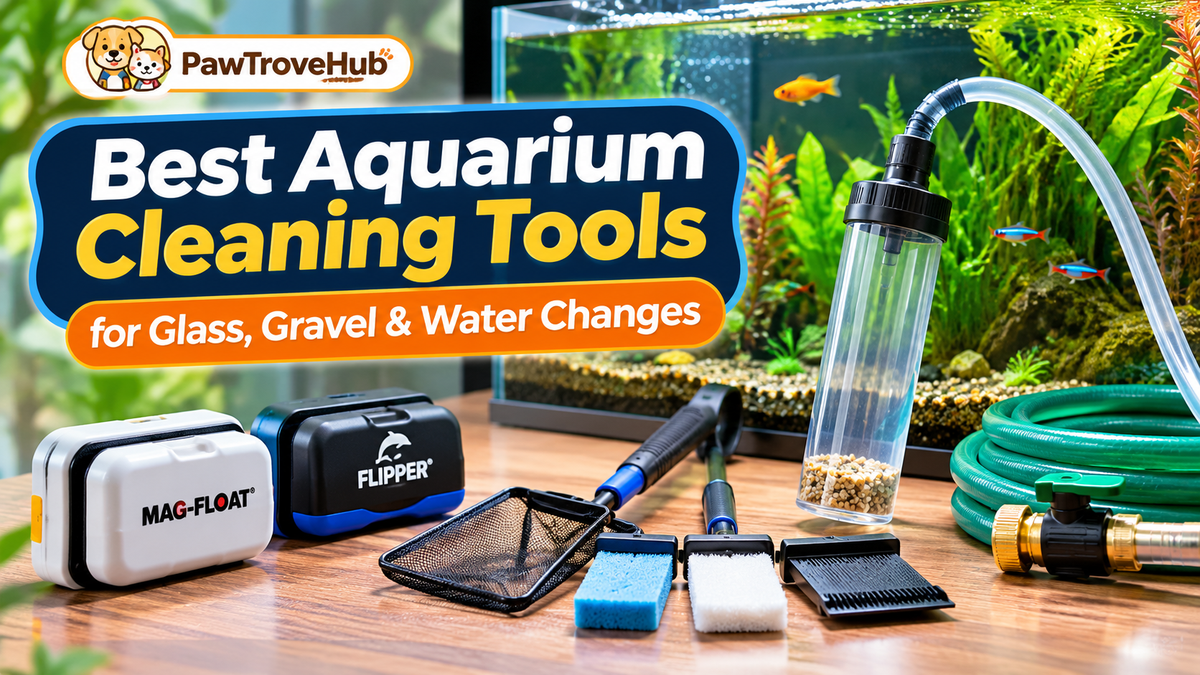
Keeping an aquarium clean involves more than removing algae from the glass. Fish waste, uneaten food, decaying plant material, and other debris can accumulate inside the tank, making regular maintenance essential for a healthy aquatic environment.
The best aquarium cleaning tools help make these tasks easier, whether you need to remove algae, clean gravel, or perform routine water changes. However, not every cleaning tool is designed for the same purpose. A magnetic glass cleaner, a gravel vacuum, and a faucet-connected water changer each serve different maintenance needs.
In this guide, we’ll compare six aquarium cleaning tools, including magnetic algae cleaners, a multipurpose cleaning kit, gravel siphons, and a water-changing system. We’ll also explain what to consider when choosing equipment, how to clean your aquarium safely, and which tools may suit different aquarium setups.
The goal is to help you choose practical equipment for your tank without purchasing tools you don’t actually need.
Disclosure: This article may contain affiliate links. PawTroveHub may earn a commission from qualifying purchases made through these links, at no additional cost to you.
Quick Picks: Which Aquarium Cleaning Tool Should You Choose?
The right cleaning equipment depends on the task you need to perform. Here is a quick overview of the six products covered in this guide.
| Product | Best suited for | Cleaning function |
|---|---|---|
| Mag-Float Floating Aquarium Glass Cleaner | Routine glass maintenance | Magnetic algae removal |
| Flipper Float 2-in-1 | Scrubbing and scraping | Combination glass cleaning |
| UPETTOOLS 6-in-1 Cleaning Kit | Multiple cleaning tasks | Interchangeable cleaning tools |
| Enomol Aquarium Gravel Vacuum | Gravel cleaning and water changes | Siphon-based maintenance |
| Tetra Water Cleaner Gravel Siphon | Routine substrate cleaning | Gravel vacuuming |
| Python No Spill Clean & Fill | Draining and refilling aquariums | Faucet-connected water changing |
Before choosing, consider your aquarium’s material, dimensions, substrate, and available space. A tool designed for glass may not be appropriate for acrylic, and a water-changing system may require specific faucet compatibility.
You can also explore our Aquarium Cleaning Supplies collection to browse the available cleaning equipment.
6 Best Aquarium Cleaning Tools Reviewed
The following products cover several common aquarium maintenance tasks. Rather than treating them as interchangeable alternatives, let’s examine what each type of equipment is designed to do and what you should consider before purchasing.
1. Mag-Float Floating Aquarium Glass Cleaner (Medium)
Best for: Routine algae removal from compatible glass aquariums
A magnetic aquarium glass cleaner can make routine maintenance more convenient by allowing you to clean algae from the inside of the aquarium while controlling the cleaning unit from outside.
The Mag-Float Floating Aquarium Glass Cleaner (Medium) is designed for this purpose. Its floating magnetic design can also make retrieval easier if the cleaning portion separates inside the aquarium.
For aquarium owners who regularly notice algae developing on their glass, a magnetic cleaner can be a useful addition to their maintenance equipment.
What to consider:
- Check the manufacturer’s recommended glass-thickness range.
- Make sure the cleaner is suitable for your aquarium’s dimensions.
- Inspect the cleaning surfaces for trapped sand or grit before use.
- Follow the manufacturer’s instructions regarding compatible surfaces.
- Do not assume every magnetic cleaner includes a separate scraping attachment.
A particularly important consideration is aquarium glass thickness. A magnet that is unsuitable for the thickness of your tank may not provide the intended cleaning performance.
Who should consider it?
Aquarium owners looking for a floating magnetic cleaner for regular algae removal from compatible glass tanks.
Check the Mag-Float Floating Aquarium Glass Cleaner (Medium) on Amazon.
2. Flipper Float 2-in-1 Magnetic Aquarium Glass Cleaner
Best for: Aquarium owners who want combined scrubbing and scraping functions
The Flipper Float 2-in-1 Magnetic Aquarium Glass Cleaner offers another magnetic cleaning approach.
Its product design combines a scrubber and scraper, giving aquarium owners two cleaning functions in one tool. This can be useful when dealing with different types of algae buildup on compatible aquarium glass.
A combination design may also reduce the need to switch between separate cleaning tools during routine maintenance.
What to consider:
- Confirm that the particular model is suitable for your aquarium’s glass thickness.
- Check the manufacturer’s surface-compatibility instructions.
- Understand how the scrubbing and scraping functions operate.
- Inspect the cleaning surfaces before every use.
- Follow the recommended cleaning and storage instructions.
Remember that a scraping attachment is not automatically suitable for every aquarium surface. Acrylic tanks, in particular, require tools specifically approved for acrylic to reduce the risk of scratches.
Who should consider it?
Fishkeepers who prefer a combination magnetic cleaning tool for scrubbing and scraping compatible aquarium glass.
View the Flipper Float 2-in-1 Magnetic Aquarium Glass Cleaner.
3. UPETTOOLS 6-in-1 Aquarium Cleaning Tool Kit
Best for: Multiple aquarium cleaning tasks
If you prefer having several cleaning tools available rather than purchasing individual accessories, a multipurpose cleaning kit may be worth considering.
The UPETTOOLS 6-in-1 Aquarium Cleaning Tool Kit is designed around interchangeable cleaning tools for different routine maintenance tasks.
This type of kit can be useful when you need equipment for more than one part of your aquarium. Instead of relying on a single cleaner, you can use the appropriate attachment for the task, depending on what the package actually includes.
What to consider:
- Check the current product listing for the complete list of included attachments.
- Examine the handle length and cleaning-tool dimensions.
- Confirm which aquarium surfaces the individual attachments can safely clean.
- Check whether replacement components are available.
- Consider whether you will actually use the included accessories.
A multipurpose kit is not necessarily the best purchase for everyone. Someone who only needs a magnetic glass cleaner may prefer a dedicated product instead.
Who should consider it?
Aquarium owners who want several maintenance tools in one kit and would benefit from having different cleaning attachments available.
Check the UPETTOOLS 6-in-1 Aquarium Cleaning Tool Kit on Amazon.
4. Enomol Aquarium Gravel Vacuum Water Changer Kit
Best for: Cleaning aquarium gravel while removing water
Aquarium gravel can collect fish waste, uneaten food, and other debris over time. Although filtration removes some suspended waste, material trapped between substrate particles may require manual removal.
A gravel vacuum uses a siphoning action to remove debris and water during maintenance.
The Enomol Aquarium Gravel Vacuum Water Changer Kit is designed for this kind of aquarium cleaning. Its siphon-based system makes it relevant to fishkeepers who want to combine substrate cleaning with routine water changes.
What to consider:
- Check the hose length and equipment dimensions.
- Understand the siphon-starting procedure.
- Consider your aquarium’s water depth and accessibility.
- Make sure the cleaning head is appropriate for your substrate.
- Use controlled flow to avoid removing too much gravel or disturbing the aquarium unnecessarily.
Pay particular attention when cleaning planted aquariums or tanks containing small fish, shrimp, or other sensitive inhabitants. Aggressive siphoning can disturb plants and substrate.
Who should consider it?
Aquarium owners who want a gravel-cleaning tool that can also assist with water changes.
View the Enomol Aquarium Gravel Vacuum Water Changer Kit.
5. Tetra Water Cleaner Gravel Siphon for Aquariums
Best for: Routine aquarium gravel cleaning
The Tetra Water Cleaner Gravel Siphon is another option for removing accumulated debris from aquarium substrate.
A gravel siphon can help lift solid waste from between substrate particles while water is drawn out of the aquarium. This makes it useful during scheduled maintenance, especially in tanks where waste regularly collects along the bottom.
Unlike magnetic glass cleaners, a gravel siphon addresses a different cleaning problem. It focuses on substrate maintenance rather than algae on aquarium walls.
What to consider:
- Check whether the siphon dimensions suit your tank.
- Examine the hose arrangement and priming method.
- Consider whether it is suitable for your substrate type.
- Follow the instructions for controlling water flow.
- Make sure the equipment is easy to rinse and store after use.
When comparing the Tetra and Enomol options, think about your primary requirement. Do you mainly want to remove gravel debris, or do you need a more broadly configured water-changing kit?
Who should consider it?
Fishkeepers looking for a dedicated gravel siphon for routine freshwater aquarium cleaning.
Check the Tetra Water Cleaner Gravel Siphon for Aquariums.
6. Python No Spill Clean & Fill Aquarium Maintenance System – 25 Feet
Best for: Faucet-connected aquarium water changes
Water changes are an important part of regular aquarium maintenance. However, manually carrying buckets between an aquarium and a water source can become inconvenient, particularly with larger setups.
The Python No Spill Clean & Fill Aquarium Maintenance System is designed to assist with aquarium draining and refilling through a faucet-connected system.
Its 25-foot configuration may be worth considering for aquarium owners who need additional hose reach between their aquarium and a suitable water connection.
This product has a different purpose from a basic gravel siphon. It focuses on making water removal and replacement more convenient.
What to consider:
- Check whether your faucet is compatible with the system.
- Confirm that the hose length suits your aquarium’s location.
- Consider the available space around your tank.
- Understand the correct draining and refilling procedure.
- Follow the manufacturer’s instructions when connecting and operating the equipment.
Remember that convenience does not eliminate the need for proper water preparation. Replacement water must be suitable for your fish and aquarium conditions.
Who should consider it?
Aquarium owners who want a faucet-connected approach to routine draining and refilling and have a compatible water connection.
View the Python No Spill Clean & Fill Aquarium Maintenance System (25 Feet).
How to Choose the Right Aquarium Cleaning Supplies
Choosing aquarium cleaning supplies involves more than comparing the number of accessories or the appearance of a product. The most useful equipment is the equipment that suits your aquarium and the maintenance tasks you perform.
Here are the most important factors to consider.
1. Match the Tool to Your Cleaning Task
Start by identifying what you need to clean.
| Cleaning requirement | Suitable tool type |
|---|---|
| Algae on aquarium glass | Magnetic glass cleaner |
| Stubborn buildup on compatible surfaces | Suitable glass scraper |
| Several different cleaning tasks | Multipurpose cleaning kit |
| Waste trapped in gravel | Gravel vacuum or siphon |
| Draining and refilling water | Aquarium water-changing system |
Buying equipment for a problem you do not have can lead to unnecessary spending. A small freshwater aquarium may only need a suitable glass cleaner and a gravel siphon for routine maintenance.
2. Check Aquarium Material: Glass vs. Acrylic
This is one of the most important considerations when choosing an aquarium cleaning tool.
Glass and acrylic have different surface properties, so equipment designed for one material may not be appropriate for the other.
A scraper or abrasive cleaning pad that works on compatible glass may scratch an acrylic aquarium.
Before purchasing, check the manufacturer’s compatibility information and use only cleaning accessories specifically approved for your tank material.
3. Check Glass Thickness and Magnetic Cleaner Size
Magnetic aquarium cleaners must be suitable for the thickness of the tank glass.
An unsuitable magnet may not hold or move as intended through the aquarium wall.
Also consider the size of the cleaning surface. A larger cleaning head may cover more area per movement, but it must remain practical for the aquarium’s dimensions and available access.
4. Consider Tank Size, Depth and Accessibility
Think about the physical layout of your aquarium.
A tall aquarium may require a longer handle or a suitable magnetic cleaner. A large aquarium may benefit from a water-changing arrangement that reduces manual water transportation.
Before purchasing, check:
- Aquarium height and depth.
- Available space around the tank.
- Hose length and connection requirements.
- Cleaning-head size.
- Accessibility behind decorations and equipment.
If you are still choosing an aquarium, our guide to fish tanks and aquariums for different setups can help you consider the equipment and maintenance requirements before buying.
5. Consider Gravel, Sand and Other Substrates
Not all aquarium substrates should be cleaned in exactly the same way.
Gravel can allow debris to collect between its particles, making a siphon useful for removing waste.
Sand requires more careful handling because lightweight grains can be drawn into the vacuum if the water flow is too strong or the cleaning head is positioned incorrectly.
For planted aquariums, avoid unnecessarily disturbing plant roots or removing large amounts of substrate.
Choose a gravel vacuum with dimensions and flow characteristics appropriate for your aquarium.
6. Prioritize Fish and Invertebrate Safety
Cleaning equipment should help maintain the aquarium without unnecessarily stressing its inhabitants.
Move tools carefully, avoid sudden movements, and check cleaning attachments before putting them into the tank.
Pay particular attention to small fish, shrimp, fry, and other inhabitants that might be drawn toward a siphon opening.
Never use household cleaning products, soaps, or detergents inside your aquarium.
7. Check Durability and Ease of Maintenance
A cleaning tool should also be practical to maintain after use.
Consider the quality of its construction, attachment arrangement, cleaning requirements, hose condition and storage needs.
Rinse aquarium equipment appropriately after use, following the manufacturer’s guidance. Keep aquarium cleaning tools separate from equipment used for household cleaning to avoid accidental chemical contamination.
How to Clean an Aquarium Safely Using the Right Tools
Having suitable aquarium cleaning tools is only part of maintaining a healthy tank. The order in which you perform maintenance and the way you handle the equipment also matter.
Step 1: Prepare the Aquarium
Before cleaning, gather your equipment and check that everything is in good working condition.
Prepare a suitable container or water-changing arrangement, and ensure you have an appropriate water conditioner when needed.
Check the aquarium temperature and observe your fish before starting.
For ordinary maintenance, moving healthy fish into a separate container is generally unnecessary and can introduce additional stress.
Step 2: Clean Aquarium Glass First
Begin by removing algae from the inside surfaces of your aquarium.
Use a magnetic cleaner or an appropriate algae scraper that is specifically compatible with the tank material.
Move the cleaner gently and avoid pushing trapped gravel or sand against the glass.
This precaution is especially important because small abrasive particles can scratch aquarium surfaces.
Step 3: Vacuum Gravel and Remove Debris
Next, use an appropriate gravel vacuum or siphon to remove accumulated solid waste.
Move the cleaning head through the substrate carefully rather than aggressively stirring the entire aquarium.
Avoid excessive cleaning that unnecessarily disturbs established biological filtration or damages plant roots.
If you keep small fish or shrimp, take additional care around the siphon opening.
Step 4: Perform an Appropriate Partial Water Change
Removing water while vacuuming the substrate can make routine maintenance more convenient.
The appropriate water-change amount and frequency depend on factors such as stocking, feeding, filtration, water quality and aquarium conditions.
For additional guidance on fish welfare and aquarium maintenance, consult the RSPCA’s aquarium water-quality and maintenance guidance.
Avoid making large or unnecessary changes without considering the aquarium’s specific requirements.
Step 5: Refill With Properly Treated Water
When replacing aquarium water, prepare the new water appropriately.
Tap water may contain chlorine or chloramine, which can be harmful to aquatic life. Use a suitable aquarium water conditioner according to its instructions.
You should also consider temperature compatibility to avoid sudden changes that could stress your fish.
Our guide to aquarium water conditioners and treatments explains why choosing suitable water-treatment products matters.
Step 6: Check Aquarium Equipment and Conditions
After maintenance, make sure that filtration and other equipment are operating correctly.
Check water temperature, observe the fish and look for any unusual changes in their behavior.
Avoid cleaning every filtration component aggressively at the same time. Biological filtration depends on beneficial microorganisms that help process fish waste.
Regular monitoring is as important as physical cleaning.
How to Keep Your Aquarium Cleaner Between Water Changes
A regular maintenance routine can reduce the amount of debris that accumulates inside your aquarium.
However, cleaning equipment alone cannot prevent every aquarium maintenance problem.
Here are several useful habits.
Avoid Overfeeding
Uneaten food can break down and contribute to waste accumulation.
Feed an appropriate amount for your fish and remove uneaten food when necessary.
Maintain Effective Filtration
A suitable aquarium filter helps remove suspended particles and supports biological filtration.
Mechanical filtration collects debris, while biological filtration helps beneficial microorganisms process toxic waste products.
Explore our guide to aquarium filters for effective filtration to understand the different equipment options.
Control Excessive Lighting
Excessive lighting can contribute to algae problems, particularly when combined with excess nutrients.
Choose an appropriate lighting schedule for your aquarium inhabitants and plants.
Our aquarium lighting options can help you explore equipment designed for different freshwater setups.
Remove Uneaten Food and Visible Debris
Check your aquarium regularly for uneaten food, dead plant leaves and other visible waste.
Removing these materials promptly can help prevent unnecessary organic debris from accumulating.
Follow a Consistent Maintenance Routine
The Merck Veterinary Manual’s fish-maintenance recommendations explain the importance of regular cleaning, water changes, water-quality monitoring and appropriate filter maintenance.
Your maintenance routine should be based on the needs of your particular aquarium rather than following an inflexible schedule.
Also remember that clear aquarium water does not automatically mean the water chemistry is suitable. Regular water testing remains important.
Frequently Asked Questions About Aquarium Cleaning Tools
1. What tools do you need to clean an aquarium?
The basic equipment includes an algae scraper or magnetic glass cleaner, a gravel vacuum or siphon, and suitable equipment for performing water changes.
You may also need a dedicated aquarium cleaning sponge, an appropriate water conditioner and equipment for monitoring water quality.
The exact requirements depend on your aquarium’s size, inhabitants and substrate.
2. How often should you clean an aquarium?
Cleaning frequency depends on stocking levels, feeding habits, filtration, tank size and water-test results.
Many freshwater aquariums benefit from regular partial water changes and routine substrate cleaning, but one schedule does not suit every tank.
Monitor water quality and adjust maintenance according to the needs of your fish.
3. Are magnetic aquarium cleaners safe for glass and acrylic tanks?
Not every magnetic cleaner is suitable for both materials.
Some models are intended for glass, while others are specifically designed for acrylic.
Always check the manufacturer’s compatibility instructions before using a magnetic cleaner on your aquarium.
4. Can an aquarium cleaning magnet scratch glass?
Yes. Although a suitable magnetic cleaner can be useful for removing algae, trapped sand or grit between the cleaning surfaces and the glass can cause scratches.
Inspect the cleaning pads regularly and avoid dragging abrasive particles across the aquarium surface.
5. What is the difference between a gravel vacuum and an aquarium siphon?
A gravel vacuum uses siphoning action to remove water and solid waste from the substrate.
An aquarium siphon describes the water-transfer mechanism that allows water to flow from the tank into another container or drainage point.
Many gravel vacuums combine both functions, making them useful during routine water changes.
6. Should you remove fish when cleaning an aquarium?
For ordinary aquarium maintenance, removing healthy fish is generally unnecessary.
In most cases, cleaning can be performed gently while fish remain inside their aquarium.
Take care around small fish, fry, shrimp and other sensitive inhabitants, particularly when using a gravel vacuum.
7. Can you use household cleaning products inside an aquarium?
No. Avoid ordinary soaps, detergents and household cleaning chemicals inside an aquarium.
Even small residues can contaminate the water and potentially harm fish and beneficial microorganisms.
Use aquarium-appropriate equipment and follow the manufacturer’s cleaning instructions.
8. Which is better: a manual gravel vacuum or a faucet-connected water changer?
It depends on your aquarium and available facilities.
A manual gravel vacuum can be practical for smaller tanks and routine substrate cleaning. A faucet-connected system may be more convenient for suitable larger setups where the faucet connection, hose reach and installation requirements are compatible.
Consider your tank location, substrate, maintenance frequency and equipment budget before choosing.
Final Recommendations: Choosing the Right Aquarium Cleaning Tool
The best aquarium cleaning tools are those that match your actual maintenance requirements.
There is no single product that performs every aquarium cleaning task equally well. Magnetic cleaners address algae on suitable glass surfaces, multipurpose kits offer several cleaning attachments, and gravel vacuums help remove waste from substrate.
For easier water changes, a siphon-based or faucet-connected system may be worth considering, depending on your aquarium setup.
Here is a final reminder of how the six options fit different needs:
| Your main requirement | Product to consider |
|---|---|
| Routine glass algae removal | Mag-Float Medium |
| Combined scrubbing and scraping | Flipper Float 2-in-1 |
| Multiple cleaning attachments | UPETTOOLS 6-in-1 |
| Gravel cleaning with water changes | Enomol Gravel Vacuum |
| Routine gravel siphoning | Tetra Water Cleaner |
| Faucet-connected draining and refilling | Python No Spill Clean & Fill |
Before purchasing any aquarium cleaning equipment, confirm its compatibility with your aquarium material, glass thickness, substrate and dimensions. Always follow the manufacturer’s instructions and prioritize the safety of your fish.
If you’re still setting up your aquarium, you can also explore our guide to the best fish tanks for beginners to understand the equipment and maintenance considerations involved in choosing a suitable aquarium.
A sensible combination of compatible cleaning tools, effective filtration, proper water treatment and regular maintenance can make aquarium care more manageable while supporting a healthier environment for your fish.
Explore the available equipment, identify the cleaning tasks you need help with, and choose the tools that make the most sense for your aquarium.