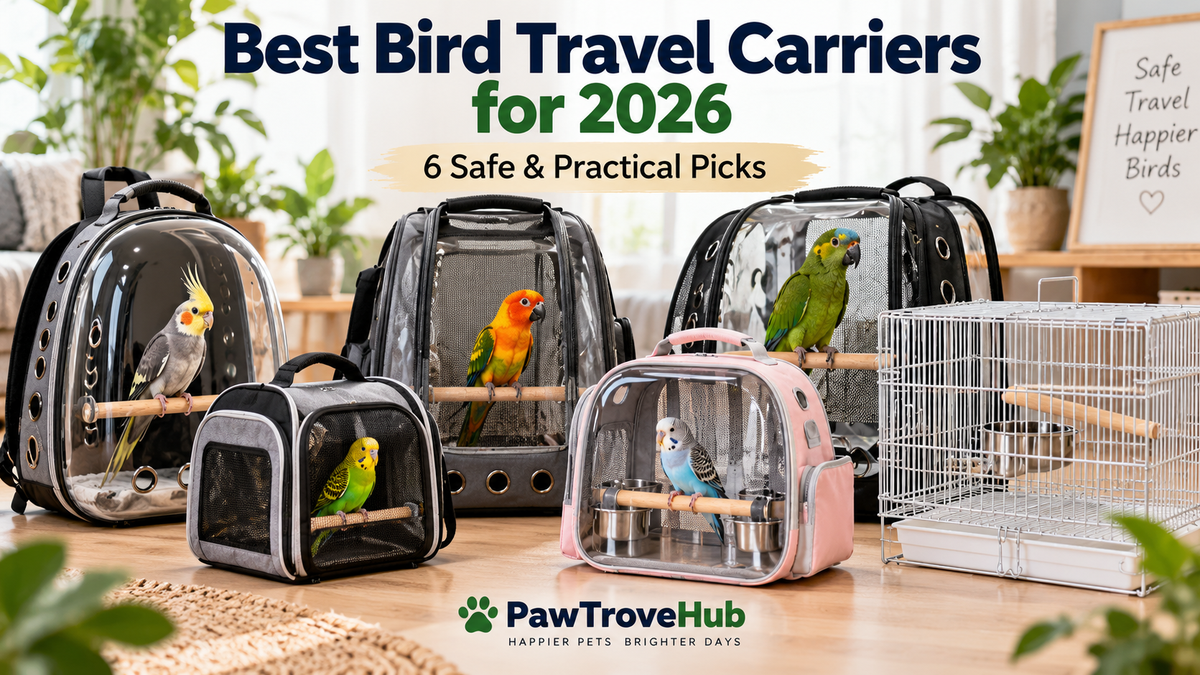
Traveling with a pet bird can be much easier when the carrier matches the bird, the trip, and the way you plan to travel. The best bird travel carriers should provide secure containment, suitable ventilation, stable footing, practical access, and enough usable space for the individual bird.
Whether you need a carrier for a veterinary appointment, a car journey, a short outdoor trip, or occasional travel, the right choice is not simply the one with the most attractive design. Your bird’s size, tail length, temperament, chewing behavior, and tolerance for movement all matter.
In this guide, we compare six bird travel carriers with different designs, including clear capsule backpacks, soft-sided carriers, backpack-style travel cages, and a rigid wire travel cage. You can also browse PawTroveHub’s pet products for other pet essentials.
Affiliate disclosure: PawTroveHub may earn a commission from qualifying purchases made through Amazon links in this article, at no additional cost to you.
Best Bird Travel Carriers at a Glance
| Carrier | Style | Best suited use | Notable features | Main consideration |
|---|---|---|---|---|
| halinfer Clear Capsule Bird Travel Carrier | Clear capsule backpack | Short trips and portable travel | Ventilation holes, metal tray, wood perch | Check usable interior space and bird comfort with the clear design |
| halinfer Portable Small Bird Carrier | Compact soft-sided carrier | Vet visits and short trips | Standing perch, mat, side-access window, collapsible design | Better suited to appropriately sized small birds |
| ORIZZP Bird Backpack | Backpack carrier | Hands-free outings and outdoor travel | Stand perch, ventilation panels, viewing area | Airline acceptance must be confirmed with the specific airline |
| Colorday Lightweight Bird Carrier Travel Cage | Larger cage-style carrier | Car travel and more spacious setups | Perch, feeder cups, tray, larger cage format | Less compact than backpack-style carriers |
| SUERTREE Bird Carrier Bag with Stand | Backpack/travel bag | Regular short travel | Transparent breathable design, stand, accessories | Check fit, construction, and chewing behavior |
| Prevue Hendryx Travel Bird Cage 1305 | Rigid wire travel cage | Vet visits and short car trips | Side door, wood perch, stainless-steel bowls, removable tray | Less compact than soft or backpack carriers |
The six options above are not ranked from first to last. They represent different designs and use cases, so the best fit depends on your bird and the type of travel you have planned.
For a wider selection of bird-specific products, explore more bird products on PawTroveHub.
6 Bird Travel Carriers to Compare
1. halinfer Clear Space Capsule Bird Travel Carrier
The halinfer clear capsule carrier is a backpack-style option built around a clear viewing area and multiple ventilation openings. The listing describes it as a bird travel carrier for parakeets, cockatiels, and parrots, with a metal tray and wood perch.
Best for: Owners looking for a portable clear capsule-style carrier for appropriately sized birds.
This type of design can appeal to owners who want a compact carrier that is easy to carry while allowing the bird to see its surroundings.
The design includes several features that are useful for short travel. A removable tray can make cleanup more practical, while a perch gives the bird a defined place to stand when the carrier is stationary or moving gently.
The biggest thing to check is not the advertised species list alone. Measure your bird and compare those measurements with the usable interior of the carrier. A carrier that looks spacious from the outside may provide less room than expected once the perch and other components are installed.
Clear carriers can also expose birds to more visual stimulation. Some birds tolerate that well, while others may become unsettled by passing people, traffic, or unfamiliar environments. Consider your bird’s temperament rather than assuming that visibility is automatically a benefit.
Check the halinfer clear capsule bird carrier on Amazon
2. halinfer Portable Small Bird Carrier with Standing Perch and Mat
This halinfer carrier is a more compact option designed around small companion birds. The listing identifies it as a portable small bird/parrot/parakeet carrier with a standing perch and mat, a side-access window, clear windows, and a collapsible design.
Best for: Small birds and owners who prioritize compact storage and easy carrying.
The collapsible format can be convenient when the carrier is only needed occasionally. The side-access design may also make loading and handling easier than a carrier that relies on a single entrance.
Because this is a compact carrier, fit is especially important. A budgie, parakeet, or other small bird should have enough room to stand comfortably and avoid having its tail pressed against the carrier walls. Always check the dimensions and compare them with your bird before purchasing.
The perch and mat can make the interior feel more prepared for travel, but avoid filling a small carrier with unnecessary accessories. During movement, fewer loose objects generally means fewer things that can shift unexpectedly.
This type of carrier is worth considering for short trips when portability matters more than providing a large interior.
See the compact halinfer small bird carrier on Amazon
3. ORIZZP Bird Backpack with Stand Perch
The ORIZZP Bird Backpack is a backpack-style travel carrier with a stand perch. The listing describes it as an airline-approved bird backpack carrier.
Best for: Hands-free carrying and short outdoor trips when the bird is appropriately suited to this style of carrier.
Backpack carriers can be convenient because they leave both hands available while walking or moving between locations. The backpack format can also work well for owners who prefer a more portable design than a traditional cage-style carrier.
The important consideration is ventilation and environmental control. A carrier should have adequate airflow while still protecting the bird from direct drafts and excessive exposure to sun or heat.
The listing uses the phrase “airline approved,” but that should not be treated as a guarantee that every airline will accept the carrier. Airline requirements can vary by airline, aircraft, route, and travel arrangement. Before flying, confirm the current rules directly with the airline and compare the carrier’s actual dimensions with those requirements.
For outdoor use, remember that the bird still needs active supervision. A portable carrier is a travel tool, not a substitute for monitoring the surrounding environment.
View the ORIZZP bird travel backpack on Amazon
4. Colorday Lightweight Bird Travel Cage, Large
The Colorday model is the larger carrier option in this group. Its listing presents it as a lightweight bird travel cage with a standing perch, feeder cups, and a removable tray.
Best for: Owners who want a more spacious cage-style carrier for travel, particularly when portability by backpack is not the main priority.
A larger cage can be useful when the bird needs more usable interior space. The cage-style format can also feel more familiar to owners who prefer a traditional carrier arrangement rather than a compact capsule backpack.
The larger footprint is useful when additional space matters, but it also means more bulk. Think about where the carrier will be placed in your vehicle and how you will move it between your home, car, veterinary clinic, or destination.
The included tray can simplify routine cleanup, while feeder cups and a perch make the carrier more functional for trips where the bird will spend more time inside.
Still, “Large” in a product title should never replace measuring your bird. Compare the actual interior dimensions, account for the perch and feeding area, and make sure your bird has appropriate standing and tail clearance.
Check the Colorday large bird travel cage on Amazon
5. SUERTREE Bird Carrier Bag with Stand
The SUERTREE carrier is a backpack-style travel bag with a stand. The listing identifies it as a lightweight backpack-style carrier for parrots and cockatiels with a transparent, breathable design.
Best for: Owners who want a portable backpack-style carrier with a travel-cage format.
The combination of backpack portability and a more structured interior makes this style useful for regular short-distance travel. A stand can also provide a defined place for the bird inside the carrier.
The transparent design gives the bird visibility, while the breathable construction is intended to support airflow. Even so, the carrier should be kept away from direct heat and intense sunlight, especially during warm weather.
The material and structure should also be considered in relation to your bird’s personality. A bird that persistently chews fabric or carrier components may need a more durable construction.
As with the other backpack options, check the dimensions carefully and think about whether your bird is comfortable in an enclosed carrier before taking a longer trip.
See the SUERTREE bird carrier backpack on Amazon
6. Prevue Hendryx Travel Bird Cage 1305
The Prevue Hendryx Travel Bird Cage 1305 provides a more traditional alternative to the clear capsule and soft-sided carriers in this guide. It uses a rigid wire cage design with a side-access door, solid-wood perch, two stainless-steel dishes, a removable plastic tray, and a wire bottom grille. The cage is also designed to fold flat for storage.
Best for: Short car trips, veterinary visits, and owners who prefer a rigid wire travel cage.
The cage-style design offers a different travel experience from a backpack. Instead of prioritizing compact carrying, it focuses on a structured interior with a conventional perch, feeding dishes, and easy-clean tray.
The side-access door can also be useful when introducing the bird to the carrier, particularly if the bird is comfortable walking into an open cage rather than being placed into a smaller enclosed bag.
Because this is a rigid cage rather than a compact backpack, storage and transport require more planning. Its fold-flat design helps when the cage is not being used, but it is still worth considering where you will keep and position it.
Wire spacing should also be checked against your individual bird. The carrier should provide secure containment without creating openings that are inappropriate for the bird’s size.
View the Prevue Hendryx travel bird cage on Amazon
How to Choose the Best Bird Travel Carrier
Once you move beyond product photos, several practical factors become much more important.
Start With Your Bird’s Size
Do not choose a carrier simply because the product page lists your bird’s species.
Measure your bird and check the carrier’s current interior dimensions. Pay particular attention to body length, tail length, and how much usable space remains after the perch or other included components are installed.
Your bird should be able to maintain a stable posture without being cramped. At the same time, a carrier used for transportation does not need to function like the bird’s everyday home cage.
A useful rule is to prioritize usable space, not just outside measurements.
For related enclosure guidance, see our guide to best bird cages for parakeets and cockatiels.
Hard-Sided vs. Soft-Sided Bird Carriers
Rigid carriers and wire travel cages provide more structure, while soft-sided carriers can be easier to store and carry.
Soft-sided designs may be practical for short trips, especially when the bird is calm and unlikely to chew the material. Rigid construction can make more sense when durability and structure are priorities.
The better question is: Which construction gives your particular bird secure containment, adequate ventilation, and appropriate space for the trip?
Ventilation Without Direct Drafts
Good airflow is essential, but more airflow is not the same as unlimited exposure.
Look for ventilation openings or breathable panels that allow air to circulate. Then consider where the carrier will actually be used.
Avoid placing a bird directly in the path of an air-conditioner vent. During warm weather, also prevent the carrier from sitting in strong direct sunlight.
Clear carriers deserve particular attention in warm conditions because the interior environment can become uncomfortable quickly when exposed to strong heat.
Secure Doors, Zippers and Latches
A carrier is only useful if the bird stays inside it.
Before every trip, inspect:
- Zippers
- Door fasteners
- Latches
- Seams
- Mesh panels
- Access openings
- Any areas your bird can reach with its beak
Do not assume that a carrier is secure simply because it was secure on the previous trip. A quick inspection takes very little time.
Perch, Flooring and Tray
A perch can provide a stable standing point, particularly during longer trips, although it is not always necessary for a short journey.
The floor also matters. A surface that gives the bird dependable footing can be preferable to a slippery interior.
A removable tray or easy-clean lining is another useful feature because travel can create messes quickly.
Keep the setup practical and avoid adding unnecessary loose objects that could shift during movement.
Weight, Handles and Car Restraint
A carrier that is comfortable to carry matters if you regularly travel on foot.
For car travel, however, physical stability becomes even more important.
The bird should remain inside the carrier rather than traveling loose in the vehicle. Keep the carrier secure and position it appropriately within the vehicle.
Before buying, think about whether the carrier can be positioned securely in your particular car.
Choosing a Carrier for Different Types of Trips
Best Type for Vet Visits
For a veterinary visit, prioritize:
- Easy loading
- Secure closure
- Stable footing
- Adequate ventilation
- Easy access for handling
- Straightforward cleaning
A compact carrier can be useful for short clinic trips, while a rigid wire travel cage may appeal to owners who want a more open, conventional setup.
It is also wise to practice carrier entry before an appointment rather than making the first attempt on the day of the visit.
Best Type for Car Travel
Car travel introduces movement, road noise, temperature changes, and sudden stops.
Use a secure carrier and keep it stable in the vehicle. Avoid letting the carrier slide around, and do not place the bird loose in the passenger area.
Passing traffic can also be visually alarming for some birds. A partial light covering may help reduce visual stimulation for birds that become frightened by movement outside the vehicle.
Best Type for Outdoor Walks or Hikes
Backpack-style carriers are convenient for hands-free outdoor travel, but the environment matters just as much as the carrier.
Avoid overheating, direct sun, and unsafe contact with other animals or wild birds. Supervision remains essential.
For additional outdoor safety guidance, see the AAV guidance for taking pet birds outdoors.
What About Air Travel?
Air travel requires more caution than simply buying a carrier advertised as “airline approved.”
The term can appear in a product title, but actual acceptance is determined by the airline’s current rules. Requirements may vary by airline and route, so verify the carrier dimensions and policies directly with the airline before purchasing tickets or traveling.
Do not rely on a product title as a substitute for airline confirmation.
How to Get Your Bird Used to a Travel Carrier
Even a well-designed carrier can become a stressful object if a bird only sees it when something unpleasant is about to happen.
Introduce the Carrier Before the Trip
Place the open carrier somewhere familiar and allow your bird to investigate it at its own pace.
You can leave the door open during early sessions so the bird does not immediately associate the carrier with confinement.
Use Positive Reinforcement
Reward calm behavior around the carrier.
Treats, praise, or another reward your bird values can help build a positive association with entering the carrier.
Avoid turning training into a chase.
Practice Short Closures
Once your bird is comfortable entering, gradually practice closing the door for short periods.
Keep sessions calm and stop before your bird becomes overwhelmed.
Take Short Practice Drives
For birds that will travel by car, brief practice drives can help make the experience less unfamiliar.
Start with short journeys and gradually build up the experience rather than making a long trip the first real test.
You can also prepare your bird for trips by providing familiar, appropriate enrichment during routine care. For ideas, explore our guide to safe and enriching bird toys.
Bird Travel Safety Checklist
Before leaving home, take a moment to check the basics.
- The carrier is appropriately sized for your bird.
- Doors, zippers, and latches are fully secured.
- Ventilation openings are unobstructed.
- The bird has stable footing.
- The carrier is not sitting in direct heat or strong sunlight.
- The carrier is secured appropriately in the vehicle.
- Loose toys or accessories cannot swing into the bird during movement.
- Food and water arrangements are appropriate for the length of the trip.
- Your bird has been introduced to the carrier before the actual journey.
- Any airline requirements have been confirmed directly with the airline.
- Contact information can be identified with the carrier if needed.
For longer journeys, plan ahead rather than treating travel as an ordinary trip around the block. Water can spill, birds can become stressed, and temperature conditions can change.
Common Bird Carrier Mistakes to Avoid
Choosing by Appearance Alone
A clear capsule or stylish backpack may look excellent in product photos, but appearance should come after fit, ventilation, security, and practicality.
Buying Too Small
A compact carrier is not automatically better.
Check the bird’s actual measurements and tail clearance before ordering.
Assuming “Airline Approved” Means Every Airline
It does not.
Always verify the current airline requirements that apply to your specific trip.
Ignoring Chewing Behavior
A calm bird and a determined chewer do not necessarily need the same carrier construction.
Think about how your bird behaves around fabric, mesh, zippers, plastic, and other accessible materials.
Forgetting to Secure the Carrier in the Car
A carrier that can slide or move during sudden braking creates an avoidable travel problem.
Secure it appropriately before driving.
Waiting Until an Emergency to Introduce the Carrier
A bird that has never seen a carrier before may resist it when time is limited.
Practicing in advance is far easier.
Leaving a Bird in a Parked Car
Never assume that a parked vehicle is safe because the weather feels comfortable outside.
Temperatures can change quickly, and a confined vehicle can become uncomfortable or dangerous.
Overloading the Carrier With Accessories
A travel carrier is not an everyday cage.
Too many loose objects can take up usable space or move unexpectedly during transport. Keep the setup practical and appropriate for the trip.
Frequently Asked Questions About Bird Travel Carriers
What is the best bird travel carrier?
The best bird travel carriers are the ones that fit the bird properly and suit the way you travel. Size, ventilation, secure closure, construction, temperament, and trip length should all be considered together.
A compact soft-sided carrier may work well for a calm small bird on a short vet visit, while a rigid wire travel cage may make more sense when structure and a conventional cage layout are priorities.
What size carrier should I get for my bird?
Start with your bird’s actual measurements rather than the species name on the product page.
Check the carrier’s usable interior space, including the room occupied by any perch or accessories. Make sure the bird can maintain a comfortable posture and has suitable tail clearance.
Are bird backpack carriers safe?
A backpack carrier can be suitable when it is correctly sized, securely closed, adequately ventilated, and appropriate for the bird’s temperament and the trip.
The carrier should also be used responsibly in the environment. Outdoor supervision remains essential, and extreme heat or direct sun should be avoided.
Are soft-sided bird carriers safe?
Soft-sided carriers can be practical for short trips, especially for calm birds that are unlikely to chew through the material. However, construction and durability should be considered carefully for persistent chewers.
Can I use a bird travel carrier in the car?
Yes. A proper carrier is preferable to allowing a bird to travel loose inside a vehicle.
The carrier should be positioned and secured so that it does not move unnecessarily, and it should be kept away from the front passenger airbag.
Can birds travel in an airplane cabin?
Some birds may be allowed to travel in an airline cabin, but this depends on the airline and the specific route.
Do not assume that a product labeled “airline approved” will automatically be accepted. Confirm the airline’s current rules before your trip.
How do I know if a bird carrier is airline approved?
Look at the product information, but treat the phrase as a starting point rather than a guarantee.
The final check should be made with the airline operating your flight. Confirm carrier dimensions, pet policies, documentation, and any species-specific restrictions that apply.
How do I get my bird used to a travel carrier?
Introduce the carrier well before the trip.
Leave it open in a familiar area, reward calm interaction, encourage voluntary entry, and gradually practice short periods inside. For car travel, add short practice drives once your bird is comfortable with the carrier.
What should I put inside a bird travel carrier?
Keep the setup simple and secure.
Depending on trip length and your bird’s needs, this may include appropriate lining, stable footing, a suitable perch when useful, and food or water arrangements that your bird already knows how to use.
Avoid loose objects that can swing or shift during movement.
Can a bird stay in a travel carrier for a long time?
The answer depends on the carrier, the bird, the temperature, the trip conditions, and how well the bird tolerates travel.
Longer journeys require more preparation than short errands. Plan for food, water, temperature control, breaks where appropriate, and close observation of the bird.
Final Thoughts: Choosing the Best Bird Travel Carrier
Choosing among the best bird travel carriers is really about matching the carrier to your bird rather than chasing a single “best” model.
For short vet visits, a compact carrier may be the most practical choice. For hands-free outdoor travel, a backpack-style carrier can be convenient. For owners who prefer a conventional rigid setup, the Prevue Hendryx Travel Bird Cage offers a distinctly different approach.
The six options in this guide cover several different travel styles, from clear capsule backpacks and compact carriers to larger cage-style and rigid wire travel cages.
Before ordering, check your bird’s measurements, current product specifications, carrier construction, ventilation, closure system, and intended use. For air travel, verify the current requirements directly with your airline rather than relying solely on product-page wording.
Most importantly, introduce the carrier before the day you actually need it. A familiar, appropriately sized carrier can make an otherwise stressful journey much easier to manage.
Browse all PawTroveHub bird travel carriers and compare the current options before making your final choice.