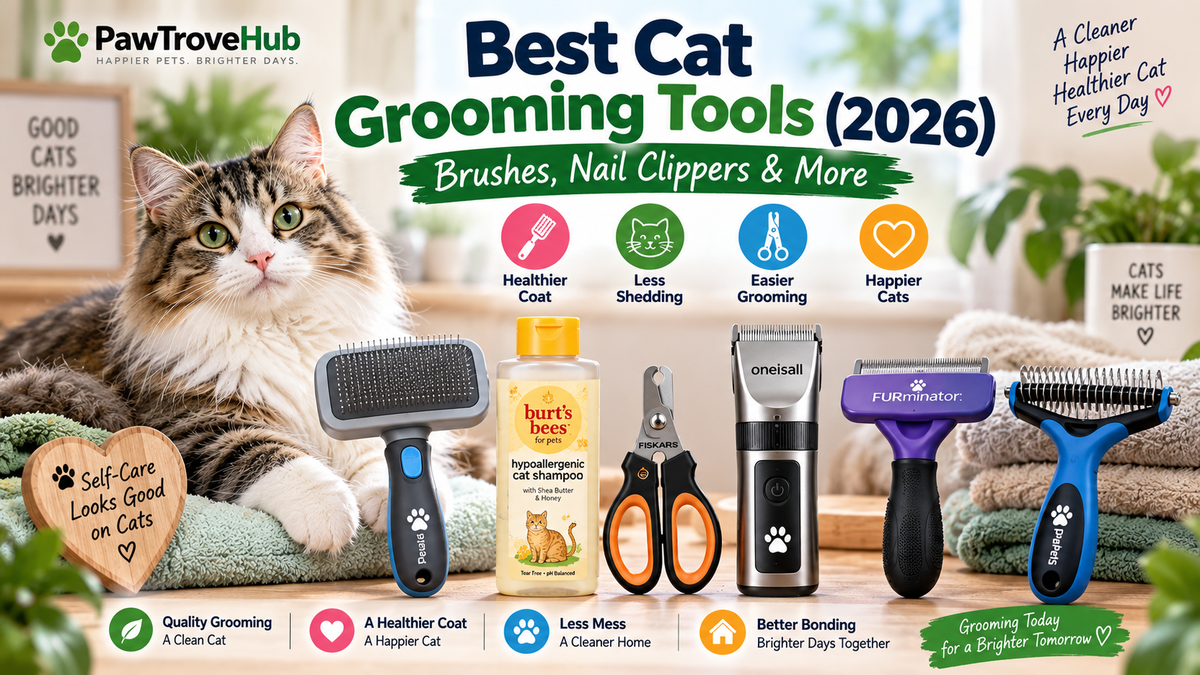
Finding the best cat grooming tools can make brushing, shedding control, nail care, and routine coat maintenance much easier. The right grooming setup depends on your cat’s coat length, shedding level, grooming habits, and tolerance for different tools.
A short-haired cat may need only a simple brush and nail clippers, while a long-haired or heavy-shedding cat can benefit from a combination of brushing and deshedding tools. Some cats may also need occasional bathing or professional grooming.
In this guide, we’ve selected several cat grooming products for different needs, including slicker brushes, deshedding tools, nail clippers, electric clippers, and cat shampoo. The goal is to help you choose the right tool for the grooming job instead of buying a large collection of products you may never use.
For more options, explore our cat grooming products.
Best Cat Grooming Tools at a Glance
| Product | Best For | Tool Type |
|---|---|---|
| Pecute Skin Friendly Self-Cleaning Slicker Brush | Everyday brushing and loose fur | Slicker brush |
| Burt’s Bees Hypoallergenic Cat Shampoo | Occasional bathing | Cat shampoo |
| Fiskars Pet Small Nail Clippers | Cat nail trimming | Nail clippers |
| oneisall Cordless Pet Clippers | Home coat trimming | Electric clippers |
| FURminator deShedding Tool for Cats | Loose undercoat | Deshedding tool |
| DakPets Stainless Steel Pet Deshedding Tool | Heavy shedding | Deshedding tool |
The best choice depends on the job you need the tool to perform. A slicker brush is useful for routine coat care, while a dedicated deshedding tool is designed for removing loose undercoat. Nail clippers handle claw maintenance, and electric clippers can help with certain coat-trimming tasks.
Our Top Cat Grooming Tools for 2026
1. Pecute Skin Friendly Self-Cleaning Slicker Brush
Best for: Everyday brushing and loose-fur removal
Regular brushing is one of the simplest ways to keep a cat’s coat maintained. A slicker brush can help lift loose fur and work through small tangles while keeping the grooming routine relatively straightforward.
The Pecute Skin Friendly Self-Cleaning Slicker Brush is designed for cats and dogs and features a self-cleaning mechanism that makes removing collected fur from the brush easier.
A slicker brush can be particularly useful for cats with medium or longer coats, although the appropriate brush should always match the cat’s coat and individual tolerance. Use gentle pressure and avoid repeatedly brushing the same area.
When choosing a slicker brush, consider the pin design, handle comfort, cleaning mechanism, and whether the brush is appropriate for your cat’s coat length.
Check the Pecute Self-Cleaning Slicker Brush on Amazon
2. Burt’s Bees Hypoallergenic Cat Shampoo
Best for: Occasional bathing
Most healthy cats are excellent self-groomers, so shampoo is not necessarily an everyday grooming essential. However, there can be situations where a cat needs an occasional bath or cleaning.
Burt’s Bees Hypoallergenic Cat Shampoo is an option for owners looking for a cat-specific shampoo. Its unscented formulation is designed for cats and is intended for use when bathing is appropriate.
When bathing a cat, use a product specifically intended for cats and rinse thoroughly. Avoid getting shampoo into the eyes, ears, or mouth.
A calm environment and a short, gentle bathing session can also make the experience easier for both you and your cat.
Check Burt’s Bees Hypoallergenic Cat Shampoo on Amazon
3. Fiskars Pet Small Nail Clippers
Best for: Cat nail trimming
Nail care is an important part of a complete grooming routine, particularly when a cat’s claws need occasional trimming.
The Fiskars Pet Small Nail Clippers are compact pet nail trimmers designed for cats and dogs. Their smaller format can be useful when you need greater control while trimming a cat’s claws.
When trimming cat nails, only remove the sharp tip of the claw and avoid the quick—the sensitive inner portion containing blood vessels and nerves. If you’re uncertain about the correct technique, asking a veterinarian or veterinary professional for guidance is a sensible option.
Choose clippers that feel secure in your hand and are appropriately sized for your cat.
Check the Fiskars Pet Small Nail Clippers on Amazon
4. oneisall Cordless Pet Clippers
Best for: Home coat trimming
Some cats may require limited coat trimming, particularly when certain areas become difficult to maintain. Electric pet clippers can make specific trimming jobs more manageable when used correctly.
The oneisall Cordless Pet Clippers provide a rechargeable cordless design that can be convenient for home grooming.
Before using electric clippers, make sure you understand how the device operates and whether it is appropriate for the particular coat-trimming task. Work slowly and avoid forcing clippers through severe mats.
If your cat has extensive matting, irritated skin, or a grooming problem that you cannot safely manage, professional help may be more appropriate than attempting a difficult trim at home.
Check the oneisall Cordless Pet Clippers on Amazon
5. FURminator deShedding Tool for Cats
Best for: Removing loose undercoat
A regular brush and a deshedding tool perform different jobs.
A deshedding tool is designed to reach through the outer coat and collect loose hair from beneath it. This can be particularly useful for cats that shed heavily.
The FURminator deShedding Tool for Cats is designed specifically for this purpose. Its stainless-steel edge is intended to collect loose undercoat while the ergonomic design provides a controlled grooming experience.
Deshedding tools should be used gently and appropriately for the cat’s coat. More pressure or more frequent use is not automatically better. Excessive grooming can irritate sensitive skin or remove more coat than necessary.
Check the FURminator deShedding Tool for Cats on Amazon
6. DakPets Stainless Steel Pet Deshedding Tool
Best for: Heavy shedding and loose fur
The DakPets Stainless Steel Pet Deshedding Tool is another option for owners dealing with significant amounts of loose fur.
Its stainless-steel deshedding surface is designed to collect loose hair from the coat, making it useful for owners looking for a dedicated shedding-management tool.
As with any deshedding tool, technique matters. Use controlled, gentle strokes and pay attention to how your cat responds. The goal is to remove loose fur without making grooming uncomfortable.
This type of tool can be particularly useful as part of a broader grooming routine rather than being treated as a replacement for every other grooming tool.
Check the DakPets Stainless Steel Pet Deshedding Tool on Amazon
How to Choose the Best Cat Grooming Tools
Choosing the best cat grooming tools starts with identifying what your cat actually needs.
Instead of buying every type of brush or grooming accessory available, consider your cat’s coat, shedding level, nail-care requirements, and tolerance for grooming.
Choose Tools Based on Coat Length
Different coats can require different grooming approaches.
| Cat Coat | Useful Grooming Tools |
|---|---|
| Short hair | Soft brush, slicker brush, grooming glove |
| Medium hair | Slicker brush, comb, appropriate deshedding tool |
| Long hair | Slicker brush, wide-tooth comb, suitable deshedding tool |
| Heavy shedding | Slicker brush plus appropriate deshedding tool |
| Routine claw care | Cat-specific nail clippers |
Long-haired cats generally require more frequent grooming than short-haired cats. Cats Protection notes that grooming needs vary according to fur length and recommends different brush or comb approaches depending on the coat.
Consider the Grooming Job
Each tool has a particular purpose.
A slicker brush is primarily useful for brushing and working through loose fur and minor tangles. A deshedding tool is designed to reach deeper into the coat and collect loose undercoat. Nail clippers are designed for claws, while electric clippers are intended for specific trimming jobs.
Understanding these differences can prevent you from expecting one grooming tool to do everything.
Think About Your Cat’s Temperament
A technically effective tool is not very useful if your cat refuses to tolerate it.
Start grooming gradually and keep early sessions short. Let your cat investigate a new brush before using it, and stop if your cat becomes highly distressed.
Recent 2026 grooming comparisons also emphasize that a tool’s usefulness depends not only on its ability to remove fur but also on whether the cat will tolerate the grooming process.
Cat Grooming Tools Every Owner Should Consider
Slicker Brushes
Slicker brushes have closely spaced pins designed to work through the coat and collect loose fur.
They can be particularly useful for medium- and long-haired cats and for routine coat maintenance.
The Pecute self-cleaning slicker brush featured above is an option for owners who want a brush with a convenient fur-removal mechanism.
Deshedding Tools
Deshedding tools are designed to remove loose undercoat fur.
They can be useful during periods of heavier shedding, but they should be used according to the manufacturer’s instructions and with appropriate pressure.
The FURminator and DakPets tools featured above are two examples of dedicated deshedding products.
Grooming Combs
Combs can be useful for checking the coat for tangles and working through areas where a brush may not be sufficient.
They are particularly relevant to long-haired cats, whose coats can develop tangles more easily.
A comb can also help you identify small knots before they become larger grooming problems.
Cat Nail Clippers
Nail clippers are useful for routine claw maintenance.
Choose a clipper designed for pets and make sure it provides enough control for your cat’s size.
Never rush the process. If your cat is very uncomfortable with nail trimming or you are unsure where to cut, seek professional guidance.
Electric Grooming Clippers
Electric clippers can be useful for specific coat-trimming situations.
However, they should not be treated as a universal solution for mats. Severe matting can be difficult to remove safely and may require professional grooming or veterinary assistance.
Cat Shampoo
Cat shampoo is generally an occasional grooming product rather than something most cats need frequently.
If bathing is necessary, choose a product made specifically for cats and follow the manufacturer’s directions carefully.
Best Cat Grooming Tools for Different Needs
There isn’t one grooming tool that is automatically perfect for every cat. Matching the product to the grooming job is more useful than choosing a single universal winner.
Best Cat Grooming Tool for Everyday Brushing
The Pecute Skin Friendly Self-Cleaning Slicker Brush is designed for routine brushing and loose-fur removal.
Best Cat Grooming Tool for Shedding
The FURminator deShedding Tool for Cats is designed specifically to target loose undercoat fur.
Best Cat Grooming Tool for Heavy Shedding
The DakPets Stainless Steel Pet Deshedding Tool is another option for owners looking for a dedicated deshedding tool.
Best Cat Nail Clippers for Routine Claw Care
The Fiskars Pet Small Nail Clippers provide a compact option for cat nail trimming.
Best Cat Clippers for Home Coat Trimming
The oneisall Cordless Pet Clippers offer a cordless option for specific home coat-trimming tasks.
Best Cat Shampoo for Occasional Baths
The Burt’s Bees Hypoallergenic Cat Shampoo is a cat-specific shampoo option for situations where bathing is appropriate.
How Often Should You Groom a Cat?
Grooming frequency depends heavily on the cat’s coat and individual needs.
Short-haired cats generally need less brushing than long-haired cats, while long-haired cats may require much more frequent attention to prevent tangles and mats.
Cats Protection recommends regular grooming and notes that short-haired cats may need approximately weekly brushing while long-haired cats can require daily grooming.
Shedding seasons can also change how often you need to brush your cat.
Rather than following a rigid schedule, monitor your cat’s coat and adjust grooming frequency accordingly.
Regular grooming also gives you an opportunity to notice changes in the coat or skin that may deserve professional attention.
How to Make Cat Grooming Less Stressful
Some cats enjoy brushing. Others act as if the brush has personally betrayed them.
A gradual approach can make grooming easier.
1. Introduce the Tool Slowly
Allow your cat to sniff and investigate a new brush or grooming tool before you start using it.
2. Start With Short Sessions
Begin with a few gentle strokes rather than attempting a complete grooming session immediately.
3. Use Gentle Pressure
Avoid pressing hard against the skin. Grooming should not become uncomfortable.
4. Pay Attention to Body Language
If your cat becomes increasingly stressed, stop and try again another time.
5. Reward Calm Behavior
Positive reinforcement can help create a more pleasant association with grooming.
6. Build a Routine
Short, predictable grooming sessions can be easier for a cat to accept than occasional long sessions.
For additional help with making grooming and handling more comfortable, you can explore our cat training products.
How to Trim a Cat’s Nails Safely
Nail trimming requires particular care because cutting too far can injure the quick.
Use cat-specific nail clippers and trim only the sharp tip of the claw. Never rush the process.
If you’re unsure where the quick is located, ask a veterinarian or veterinary professional to demonstrate the technique before attempting it yourself.
A useful guide to trimming cat claws safely can also provide additional educational guidance.
If your cat strongly resists nail trimming, forcing the process can make future grooming more difficult. Short sessions and gradual handling are usually more practical than trying to finish everything at once.
When You Should Ask a Professional for Help
Home grooming is useful, but it isn’t appropriate for every situation.
Consider professional grooming or veterinary assistance when:
- Your cat has severe or extensive matting.
- The skin underneath a mat appears irritated or injured.
- A nail is bleeding or appears damaged.
- Your cat becomes extremely distressed during grooming.
- You cannot safely handle the grooming tool.
- Your cat’s grooming behavior suddenly changes.
- You notice an unusual change in the skin or coat.
Sudden changes in grooming behavior can sometimes be associated with underlying problems, so significant or persistent changes should not simply be treated as a grooming issue.
Cat Grooming Tips for Short-Haired Cats
Short-haired cats generally require less coat maintenance than long-haired cats, but regular brushing can still help remove loose fur.
A practical setup may include:
- A soft or slicker brush
- A suitable deshedding tool when needed
- Cat nail clippers
- Basic grooming supplies
The key is not to overcomplicate the routine. Choose tools that your cat tolerates and use them appropriately.
Cat Grooming Tips for Long-Haired Cats
Long-haired cats typically need more consistent grooming because their coats are more prone to tangles and mats.
A useful grooming setup can include:
- A slicker brush
- A suitable comb
- A deshedding tool when appropriate
- Cat nail clippers
- Professional grooming support when necessary
Regular sessions can help identify tangles before they become difficult mats.
Avoid attempting to cut tight mats directly against the skin with ordinary scissors. The risk of accidentally cutting the skin is too high.
How to Build a Simple Cat Grooming Kit
You do not necessarily need a large multi-piece grooming kit.
For many households, a practical starting setup can be:
- A brush for routine coat maintenance.
- A deshedding tool if your cat sheds heavily.
- Nail clippers for claw maintenance.
- A comb if your cat has a longer coat.
- Cat shampoo only if occasional bathing is actually needed.
- Electric clippers only when there is a genuine trimming need and you know how to use them safely.
This job-based approach is consistent with current grooming guides that emphasize choosing tools according to coat type and specific grooming tasks rather than buying every available accessory.
Cat Grooming and Overall Cat Care
Grooming is only one part of keeping a cat comfortable.
Your cat’s overall routine may also include appropriate food, hydration, enrichment, training, health care, bedding, and other everyday supplies.
You can explore our wider range of cat products and supplies for additional cat-care categories.
You can also browse our pet products collection for products across cats, dogs, birds, fish, and small pets.
For additional everyday cat-care needs, explore our cat accessories and cat health products.
Frequently Asked Questions About Cat Grooming Tools
What are the best cat grooming tools for everyday use?
The most useful tools depend on your cat’s coat. A brush is the basic starting point for many cats, while long-haired cats may also need a comb. Cats that shed heavily may benefit from an appropriate deshedding tool, and cat-specific nail clippers can help with routine claw maintenance.
What brush is best for a short-haired cat?
A soft brush or suitable slicker brush can work well for many short-haired cats. The most important factors are gentle use, appropriate brush design, and your cat’s tolerance for grooming.
What grooming tools are best for long-haired cats?
Long-haired cats generally benefit from more frequent grooming and may need a slicker brush, comb, and appropriate deshedding tool. Regular grooming can help identify tangles before they become larger mats.
Are deshedding tools safe for cats?
Deshedding tools can be useful when used correctly, but they should be used gently and according to the manufacturer’s instructions. Excessive pressure or overly frequent use can irritate sensitive skin or remove too much coat.
What are the best nail clippers for cats?
Choose a clipper specifically designed for pet claws and sized appropriately for your cat. The Fiskars Pet Small Nail Clippers featured in this guide are one option to consider.
How often should I brush my cat?
It depends on coat length and individual needs. Short-haired cats generally require less frequent brushing, while long-haired cats can require much more frequent grooming. Shedding seasons may also increase the need for brushing.
Do cats need to be bathed?
Most healthy cats do not require frequent baths because they naturally groom themselves. However, occasional bathing may be appropriate in certain situations. When bathing is necessary, use a cat-specific shampoo and follow safe bathing practices.
How can I make grooming less stressful for my cat?
Introduce grooming tools gradually, keep sessions short, use gentle movements, and reward calm behavior. If your cat becomes highly distressed, stop the session and try again later rather than forcing the grooming process.
Final Thoughts on the Best Cat Grooming Tools
The best cat grooming tools are the ones that match your cat’s coat, shedding level, grooming needs, and temperament.
A slicker brush can provide a practical starting point for routine coat care, while a dedicated deshedding tool can help with loose undercoat fur. Long-haired cats may need a combination of brushes and combs, while nail clippers are useful for routine claw maintenance.
Electric clippers and shampoo can also have a place in a grooming routine, but they are more specialized tools and aren’t necessary for every cat.
Before buying, think about the specific grooming problem you are trying to solve. Choose the appropriate tool, introduce it gradually, and prioritize your cat’s comfort throughout the process.
For more options, visit our cat grooming products collection or explore the wider PawTroveHub pet products collection.