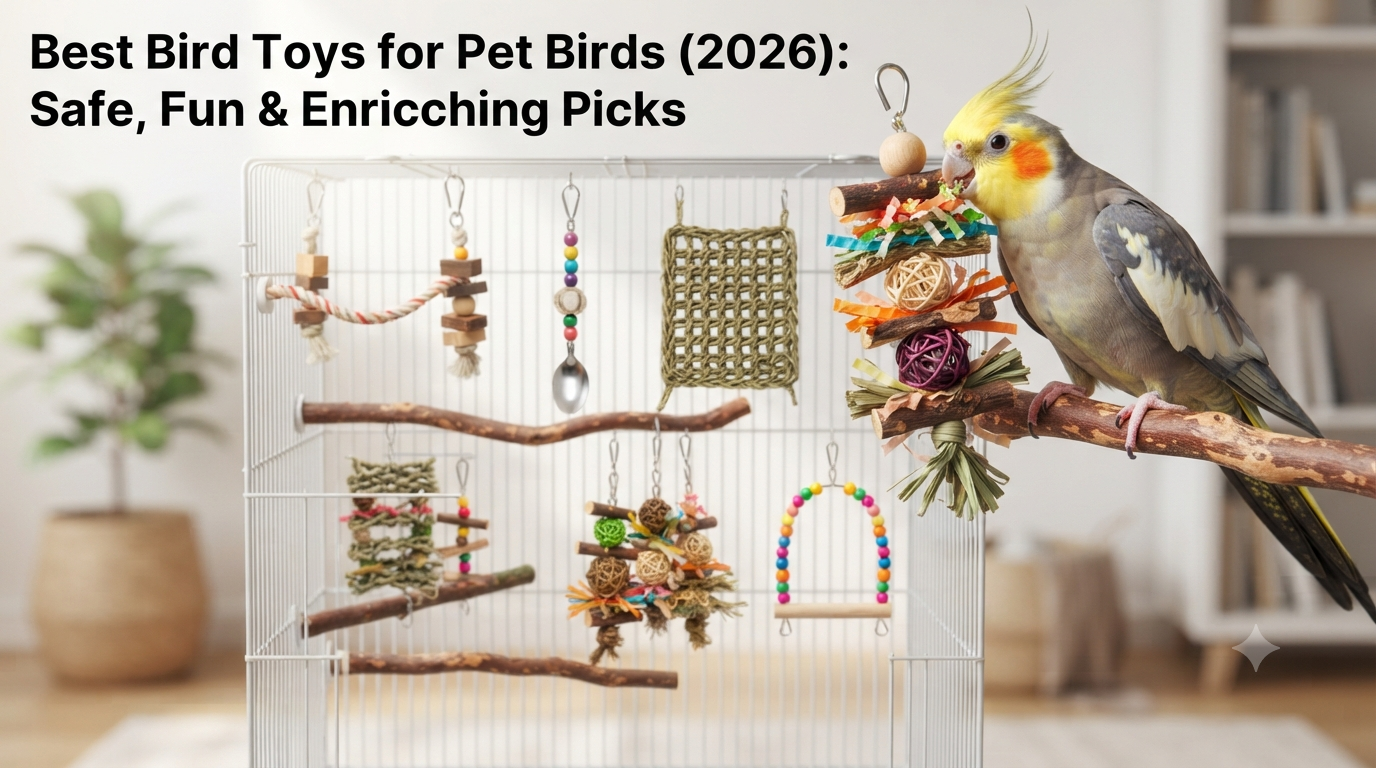
Keeping a pet bird happy involves more than providing good food and a comfortable cage. Birds are intelligent, active animals that need opportunities to chew, climb, forage, explore, and interact with their surroundings.
The best bird toys can provide that enrichment while giving your bird healthy ways to stay active and curious. However, not every toy is suitable for every bird. Size, materials, personality, chewing strength, and play style all matter.
In this guide, we’ll look at six bird toys for different types of play, explain how to choose the right option, and cover important safety considerations before introducing a new toy.
Quick Answer: What Are the Best Bird Toys?
| Bird Toy | Best For | Main Activity |
|---|---|---|
| Foraging Bird Toys with Rope Perch | Active, curious birds | Foraging & climbing |
| EBaokuup 2-Pack Shredder Toys | Chewers | Chewing & shredding |
| KATUMO Large Foraging Wall Toy | Active birds | Foraging & climbing |
| Bonka Bird Toys Spoon Delight | Curious birds | Exploration & manipulation |
| EBaokuup 3-Pack Toys | Birds that enjoy variety | Chewing & foraging |
| Bird Parakeet Toy Set | Parakeets & small birds | Climbing & play |
The best choice depends on what your bird actually enjoys. Some birds love destroying toys, while others prefer climbing, swinging, manipulating objects, or searching for food.
What Makes a Good Bird Toy?
A good bird toy should provide an activity that suits your bird while being appropriate for its size and strength.
When choosing bird toys, consider:
- Size: A toy should be appropriate for your bird’s body and beak.
- Play style: Consider whether your bird enjoys chewing, climbing, swinging, shredding, or foraging.
- Materials: Look for appropriately designed bird-safe materials and inspect toys regularly.
- Cage space: Toys should enrich the environment without preventing normal movement.
- Variety: Different types of toys can provide different forms of mental and physical stimulation.
- Condition: Damaged or excessively worn toys should be removed.
A bird that ignores one toy may simply prefer another type of activity. That’s why offering reasonable variety is often more useful than buying several toys that all provide the same experience.
1. Foraging Bird Toys with Rope Perch
Foraging toys can encourage birds to investigate their surroundings while combining mental stimulation with movement.
The Foraging Bird Toys with Rope Perch combines a hanging foraging activity with a perch, making it an option for active birds that enjoy climbing and exploring.
Best for: Active and curious birds that enjoy foraging and climbing.
Why consider it: It provides more than a simple stationary object and can encourage your bird to move around while investigating the toy.
Check the Foraging Bird Toys with Rope Perch on Amazon
2. EBaokuup 2-Pack Bird Chewing & Foraging Shredder Toys
Many pet birds enjoy chewing and shredding. For these birds, toys designed around destructive play can provide a more appropriate outlet for their natural behavior.
The EBaokuup 2-Pack Bird Chewing & Foraging Shredder Toys offers two toys centered around chewing, shredding, and foraging activities.
Best for: Birds that enjoy chewing and shredding.
Why consider it: Having two toys can also make rotation easier, allowing you to change the enrichment available to your bird without relying on one toy continuously.
Check the EBaokuup 2-Pack Bird Chewing & Foraging Shredder Toys on Amazon
3. KATUMO Large Bird Foraging Wall Toy & Seagrass Mat
A wall-style toy can give a bird a different surface to investigate and interact with.
The KATUMO Large Bird Foraging Wall Toy & Seagrass Mat combines a larger textured surface with foraging and climbing opportunities.
Best for: Active birds that enjoy climbing, exploring, and chewing.
Why consider it: It offers a different style of enrichment from smaller hanging toys and can add another activity to your bird’s environment.
Check the KATUMO Large Bird Foraging Wall Toy & Seagrass Mat on Amazon
4. Bonka Bird Toys Spoon Delight
Some birds are especially interested in objects they can manipulate, move, peck, and investigate.
The Bonka Bird Toys Spoon Delight provides an interactive design for curious birds that enjoy examining different components.
Best for: Curious birds that enjoy manipulation and exploration.
Why consider it: The design gives birds something to investigate and interact with rather than simply providing a stationary perch.
Check the Bonka Bird Toys Spoon Delight on Amazon
5. EBaokuup 3-Pack Bird Chewing & Foraging Toys
If your bird enjoys destroying toys, having multiple options can make enrichment rotation more practical.
The EBaokuup 3-Pack Bird Chewing & Foraging Toys focuses on chewing, shredding, and foraging-style activities.
Best for: Birds that enjoy chewing and owners who want several toys for rotation.
Why consider it: Rotating toys can introduce some novelty while allowing you to remove individual toys when they become worn or damaged.
Check the EBaokuup 3-Pack Bird Chewing & Foraging Toys on Amazon
6. Bird Parakeet Toy Set with Swings, Ladder & Hammock
Small birds such as parakeets can benefit from toys that encourage movement and exploration.
The Bird Parakeet Toy Set with Swings, Ladder & Hammock provides several different activities, including climbing and swinging.
Best for: Parakeets and other appropriately sized small birds.
Why consider it: The combination of different play areas can give an active small bird several ways to interact with its cage environment.
Check the Bird Parakeet Toy Set with Swings, Ladder & Hammock on Amazon
How to Choose Bird Toys by Bird Type
Parakeets
Parakeets are active small birds that may enjoy swings, ladders, climbing areas, shreddable toys, and other appropriately sized toys.
Always make sure the toy is designed for a bird of the appropriate size.
Cockatiels
Cockatiels often enjoy climbing, chewing, shredding, and exploring. A mixture of activity types can help you discover which toys your individual bird prefers.
Conures and Other Active Parrots
More active parrots may benefit from toys that encourage chewing, foraging, climbing, and manipulation. Their stronger beaks also mean toy durability and appropriate sizing deserve particular attention.
Strong Chewers
If your bird immediately starts destroying its toys, chewing-focused and shreddable options may be more suitable than delicate decorative toys.
Birds That Love Foraging
Foraging toys can give food-motivated birds an opportunity to investigate and work through an activity rather than simply receiving everything without exploration.
Bird Toy Safety: What Should You Check?
Safety should always come before appearance or entertainment value.
Before giving your bird a new toy, inspect it carefully and make sure it is appropriate for your bird’s size and behavior.
Pay particular attention to:
- Loose or damaged components
- Frayed or unraveling rope
- Small pieces that could be swallowed
- Openings where toes, feet, wings, or the head could become trapped
- Damaged hooks, clips, or connectors
- Materials that become unsafe after excessive chewing
Rope toys deserve especially regular inspection. If your bird begins pulling apart or heavily fraying a rope, remove the toy rather than continuing to use it.
It’s also important to remember that a toy being marketed for birds doesn’t mean it should remain in the cage indefinitely. Inspect toys regularly and remove anything that becomes damaged.
How Many Toys Should a Bird Have?
There isn’t one perfect number of toys for every bird.
Instead of filling the cage with as many toys as possible, aim for a manageable selection that gives your bird different activities without taking away too much usable space.
For example, you might provide:
- One chewing or shredding toy
- One foraging toy
- One climbing or swinging option
- One interactive toy
You can then rotate toys based on your bird’s interest and condition.
Variety is generally more useful than simply having a large quantity of toys.
What If My Bird Is Scared of a New Toy?
Some birds are cautious around unfamiliar objects.
If your bird becomes nervous when you introduce a new toy, don’t force interaction. Place the toy somewhere your bird can observe it safely and allow time for it to become familiar.
You can gradually move it closer as your bird becomes more comfortable.
Pay attention to what your bird naturally chooses to interact with. A toy that looks exciting to you may not be interesting to your bird—and that’s completely normal.
Bird Toy Safety Resources
For additional professional guidance on enrichment and choosing appropriate activities, see the Association of Avian Veterinarians’ enrichment and toy guidance.
For additional information about bird-toy hazards and safe use, see VCA Animal Hospitals’ Toys for Birds guide.
These resources can complement, but don’t replace, careful observation of your individual bird.
Explore More Bird Products
Bird toys are only one part of creating a suitable environment for a pet bird. Depending on your bird’s needs, you may also need appropriate food, housing, feeding supplies, and other accessories.
Explore the complete Bird Products collection at PawTroveHub for more bird-related products.
You can also browse the PawTroveHub Products page to explore products across different pet categories.
Final Verdict
The best bird toys are the ones that match your bird’s size, personality, and natural interests.
For a bird that loves to chew, shredding toys may be the best choice. For an active explorer, climbing and foraging toys can provide more engaging activities. Small birds such as parakeets may enjoy sets containing swings and ladders, while curious birds may prefer toys they can manipulate and investigate.
Rather than buying toys based only on appearance, watch what your bird actually enjoys.
Most importantly, inspect every toy regularly and remove anything that becomes damaged, frayed, loose, or otherwise unsafe.
The six options covered above provide a useful starting point for different play styles—from foraging and chewing to climbing, swinging, shredding, and exploration.