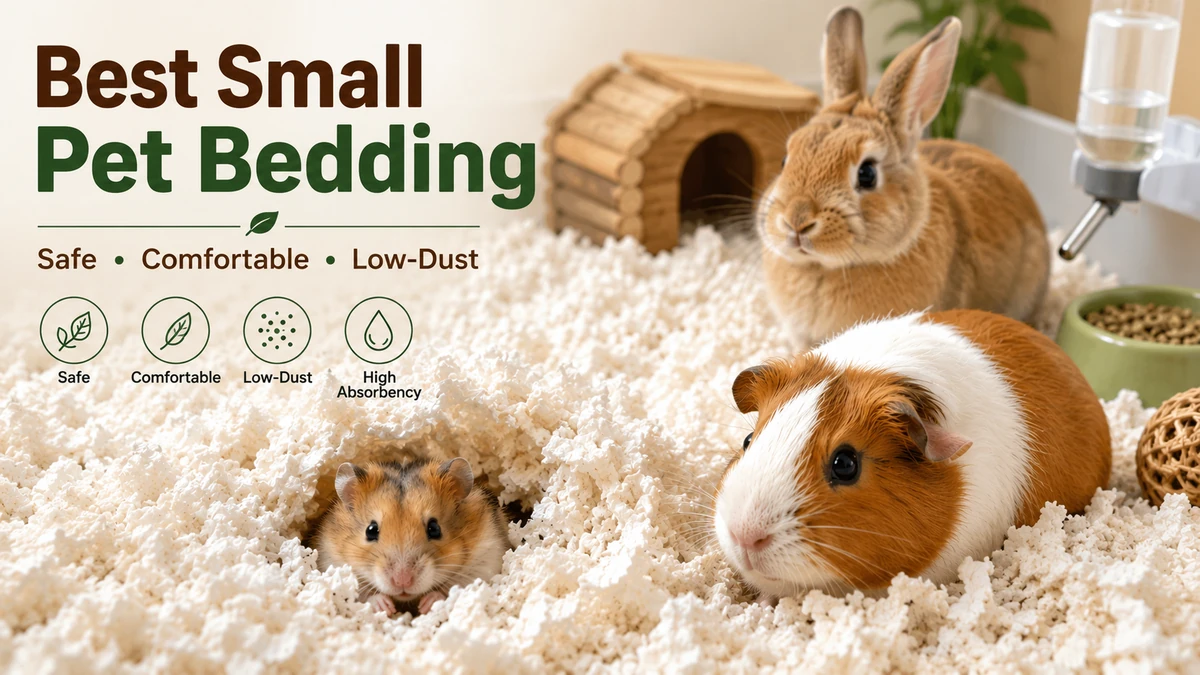
Choosing the right bedding is an important part of creating a clean, comfortable environment for a small pet. Bedding can help absorb moisture, reduce odors, provide a comfortable surface, and support natural behaviors such as nesting, digging, and burrowing.
But there is no single bedding material that is automatically best for every small animal.
Hamsters and gerbils may need bedding that supports digging and burrowing, while guinea pigs and rabbits have different flooring and hygiene considerations. Rats, chinchillas, and ferrets also have their own needs.
In this guide, we’ll explain how to choose small pet bedding based on species, material, dust level, absorbency, comfort, odor control, natural behavior, and cleaning requirements. We’ll also compare six small-pet bedding products currently featured by PawTroveHub so you can decide which one best fits your setup.
Why Small Pet Bedding Matters
Bedding does much more than simply cover the bottom of a habitat.
Depending on the species and setup, appropriate bedding can:
- Absorb moisture
- Help keep the living area dry
- Reduce unpleasant odors
- Provide a comfortable resting surface
- Support digging, burrowing, or nesting
- Make routine cleaning easier
For some small pets, bedding is also part of their enrichment.
Hamsters and gerbils, for example, naturally dig and burrow, so their substrate needs to do more than absorb waste. Other animals may place greater emphasis on softness, absorbency, and easy cleaning.
This is why buying bedding based only on package size or price can be a mistake.
Quick Answer: What Is the Best Small Pet Bedding?
There is no universal winner.
The best choice depends on your pet, the way its habitat is arranged, and which features matter most to you.
For example:
- Oxbow Pure Comfort is a strong all-around paper option for owners prioritizing pure, never-printed paper, softness, moisture absorption, and dust control.
- Carefresh White Natural Paper is appealing when odor control and absorbency are priorities.
- Kaytee Clean & Cozy White is a strong choice for owners who want soft paper bedding with very high dust control and strong liquid absorption.
- Vitakraft Fresh World Ultra Strength stands out for recycled paper construction and advertised long-lasting odor control.
- Kaytee Clean & Cozy Extreme Odor Control is the obvious choice from this group when odor control is the main buying priority.
- Sunseed Natural Corn Cob Bedding & Litter gives owners a different substrate option based on absorbent corn cob rather than paper.
These are feature-based recommendations, not claims that one product is universally better than another.
Six Small Pet Bedding Products Compared
| Product | Material | Key Strength | Best For | Main Consideration |
|---|---|---|---|---|
| Oxbow Pure Comfort | Pure, never-printed paper | Balanced comfort, absorbency, odor control, dust control | All-around paper bedding | Best matched to owners who prefer a straightforward paper option |
| Carefresh White Natural Paper | Reclaimed paper fiber | Absorbency and odor control | Everyday small-pet setups | Compare package size and value |
| Kaytee Clean & Cozy White | Premium paper | Softness, liquid absorption, dust control | Owners prioritizing softness and low dust | Paper bedding works best when matched to species and habitat needs |
| Vitakraft Fresh World Ultra Strength | Recycled paper | Long-lasting odor control | Odor-conscious owners | Advertised as 14-day odor control; regular cleaning is still required |
| Kaytee Clean & Cozy Extreme Odor Control | Paper | Strong odor management plus absorbency | Homes where odor control is the top priority | More specialized than standard Clean & Cozy |
| Sunseed Natural Corn Cob Bedding & Litter | 100% USA-grown corn cob | Absorbency and alternative substrate | Owners wanting a corn-cob option or litter use | Not a direct substitute for deep burrowing paper bedding |
PawTroveHub currently features all six products in its Small Pet Bedding category.
How We Evaluate Small Pet Bedding
When comparing bedding products, don’t focus only on the brand name or package size.
These are the factors that matter most.
1. Safety
Choose bedding made from materials appropriate for the animal using it.
The material should be suitable for the species, reasonably low in dust, and free from unnecessary fragrances or questionable additives.
A product being labeled “natural” or “small animal bedding” does not automatically make it the right choice for every pet.
2. Dust Level
Dust is an important consideration for small pets.
Look for bedding designed to minimize airborne dust, particularly for animals with sensitive respiratory systems.
Several of the products in the PawTroveHub selection specifically emphasize dust control, including Oxbow Pure Comfort, Kaytee Clean & Cozy, and Vitakraft Fresh World.
3. Absorbency
Good bedding should absorb moisture effectively and help keep the habitat dry.
Absorbency is particularly important in areas where pets regularly urinate.
For example, Kaytee states that Clean & Cozy bedding absorbs up to six times its weight in liquid, while Vitakraft Fresh World advertises three times its weight.
4. Odor Control
Odor control can make everyday care much easier.
However, odor-control claims should never be interpreted as a reason to delay cleaning.
Some of the products in our selection place a particularly strong emphasis on odor management. Kaytee’s Extreme Odor Control products and Vitakraft Fresh World both advertise up to 14 days of odor control under their product claims.
5. Comfort
Your pet should be able to rest comfortably on the bedding.
Soft paper products can provide a comfortable surface and are especially useful for owners who want bedding that can also support nesting.
6. Natural Behavior
Think about what your pet actually does with its substrate.
Hamsters and gerbils need bedding that allows digging and burrowing. PetMD specifically recommends paper-based bedding for hamsters and emphasizes sufficient depth for burrowing.
7. Ease of Cleaning
A good bedding system should make regular maintenance manageable.
Look for material that lets you identify and remove damp or soiled areas without unnecessarily disturbing the whole habitat.
Best Bedding by Small Pet
The right bedding depends heavily on species.
Best Bedding for Hamsters
Hamsters are natural burrowers, so bedding needs to support digging as well as absorb moisture.
Paper-based bedding is a common choice, and PetMD specifically recommends quality paper bedding for hamsters while warning against cedar and unprocessed pine products.
For a hamster, prioritize:
- Low dust
- Unscented material
- Good absorbency
- Comfortable texture
- Enough depth for digging and burrowing
Among the PawTroveHub options, the paper-based products are the most natural starting point for this type of setup.
Best Bedding for Guinea Pigs
Guinea pigs spend much of their time at floor level, so comfort, absorbency, dryness, and cleanliness matter.
Paper bedding can be a practical option, while fleece systems can also be used when correctly prepared and maintained.
The important point is that bedding should keep the living area comfortable and dry rather than simply providing the deepest possible layer.
Best Bedding for Rabbits
Rabbits require more than a generic “small animal bedding” product.
Bedding should be considered alongside flooring, litter areas, exercise space, and the overall habitat.
Paper products can be useful in appropriate areas, but buyers should evaluate the complete setup rather than assuming that one bedding material is suitable for every rabbit.
For the enclosure itself, see our Small Pet Habitats & Cages guide.
Best Bedding for Rats
Rats benefit from a clean, comfortable, low-dust environment.
Paper bedding can be useful because it provides absorbency and a soft surface while making routine cleaning relatively straightforward.
The bedding should also work with sleeping areas, hides, platforms, toys, and enrichment.
Best Bedding for Gerbils
Gerbils naturally dig and create tunnels.
Their substrate therefore needs to provide enough material for those behaviors rather than forming only a thin layer on the habitat floor.
Paper-based bedding can be useful when placed at an appropriate depth.
Best Bedding for Chinchillas
Chinchillas have specialized care needs, so bedding should be selected carefully.
Choose a product intended for chinchillas and pay attention to dust levels and moisture management.
Do not assume that a bedding product suitable for another small mammal is automatically suitable for a chinchilla.
Best Bedding for Ferrets
Ferrets can create considerable mess and odors, making absorbency and cleaning convenience important.
Paper bedding can work in compatible setups, while washable sleeping materials and suitable litter systems may also be used.
The important point is to match the bedding system to the ferret’s living arrangement rather than relying on one product for every part of the habitat.
The Six PawTroveHub Bedding Products
1. Oxbow Pure Comfort Small Animal Bedding
Best for: All-around paper bedding
Oxbow Pure Comfort is made from 100% pure, never-printed paper. Oxbow describes it as soft, moisture absorbent, odor absorbent, and 99.9% dust free. The manufacturer lists it for rabbits, guinea pigs, gerbils and hamsters, rats and mice, chinchillas, and ferrets.
It is a particularly straightforward choice for owners who want paper bedding without added perfume or dyes. Oxbow also recommends placing 1 to 3 inches in the enclosure, checking daily for soiled areas, and replacing all bedding at least weekly or more frequently as needed.
Why Consider It?
- 100% pure, never-printed paper
- 99.9% dust free
- Moisture absorbent
- Odor absorbent
- Soft and comfortable
- No perfumes or dyes
Best For
Owners who want a simple, versatile paper bedding option with strong all-around performance.
2. Carefresh White Natural Paper Small Pet Bedding
Best for: Absorbency and everyday odor control
Carefresh White Natural Paper bedding is made from reclaimed paper fiber and is designed around comfort, absorbency, and odor management.
Current product information describes it as virtually dust free and more absorbent than wood shavings, while also advertising odor suppression.
That makes it a natural option for owners who want a paper-based bedding with a strong emphasis on moisture and odor management.
Why Consider It?
- Paper-based material
- Soft texture
- Strong absorbency
- Odor control
- Low-dust positioning
Best For
Owners looking for a dependable everyday paper bedding option with good moisture and odor management.
3. Kaytee Clean & Cozy White Paper Bedding
Best for: Softness and very low dust
Kaytee Clean & Cozy White is premium paper bedding designed to be soft, absorbent, and comfortable.
Kaytee states that the product absorbs up to six times its weight in liquid and is 99.9% dust free and fragrance free. The company also describes it as soft on paws and gentle on noses.
Why Consider It?
- Premium paper bedding
- Very soft texture
- Up to 6x liquid absorption according to Kaytee
- 99.9% dust-free claim
- Fragrance free
- Designed for many common small-animal species
Best For
Owners who place a particularly high priority on soft paper bedding and strong dust control.
4. Vitakraft Fresh World Ultra Strength Bedding
Best for: Long-lasting odor control
Vitakraft Fresh World is made from 100% recycled paper and is designed around absorbency and odor control.
Vitakraft states that it controls odor for up to 14 days, absorbs three times its weight, and is 99.5% dust free. It is also made from recycled, unbleached paper and contains no phenols or aromatic oils.
Why Consider It?
- 100% recycled paper
- Up to 14-day odor-control claim
- 3x weight absorption according to Vitakraft
- 99.5% dust-free claim
- No phenols or aromatic oils
Best For
Owners who want paper bedding with a particularly strong focus on odor control and recycled materials.
5. Kaytee Clean & Cozy Extreme Odor Control Bedding
Best for: Maximum odor-management focus
This version of Kaytee Clean & Cozy is designed specifically for owners who want stronger odor control.
Kaytee states that it controls ammonia odors for 14 days, absorbs up to six times its weight in liquid, and is 99.9% dust free and fragrance free.
Why Consider It?
- 14-day odor-control claim
- Up to 6x liquid absorption
- 99.9% dust-free claim
- Fragrance free
- Soft paper construction
Best For
Owners for whom odor management is one of the most important factors when selecting bedding.
6. Sunseed Natural Corn Cob Bedding & Litter
Best for: A non-paper absorbent option
Sunseed Natural Corn Cob Bedding & Litter is the outlier in this six-product selection because it is made from corn cob rather than paper.
The manufacturer describes it as ultra absorbent, made from 100% USA-grown corn cob, and free from artificial dyes, fragrances, and additives. It is marketed for both small animals and birds.
This gives owners a genuine alternative to the five paper-based products above.
Why Consider It?
- 100% USA-grown corn cob
- Highly absorbent
- No artificial dyes
- No artificial fragrances
- No added additives
- Can be used as bedding or litter
Best For
Owners who specifically want to try a corn-cob bedding or litter option.
Important Consideration
Corn cob should not automatically replace deeper burrowing substrate for animals whose natural behavior requires substantial digging.
Paper Bedding vs. Corn Cob Bedding
The biggest material distinction in the PawTroveHub selection is between paper bedding and corn-cob bedding.
Paper Bedding
Paper bedding makes up five of the six featured products.
Its main advantages are:
- Soft texture
- Good absorbency
- Useful for nesting
- Suitable for many small-pet setups
- Widely available in low-dust formulas
Paper bedding is also particularly relevant for hamsters because quality paper substrate is commonly recommended for burrowing and nesting.
Corn Cob Bedding
Corn cob offers a different texture and is especially useful when absorbency and litter applications are the main priority.
Sunseed’s corn-cob product is marketed as an ultra-absorbent bedding and litter solution without artificial dyes, fragrances, or additives.
The right choice therefore depends on how your pet uses the substrate.
What Bedding Materials Should You Avoid?
Cedar Bedding
Cedar bedding should be avoided for hamsters. PetMD specifically warns against cedar because aromatic oils can irritate sensitive respiratory tissues.
Unprocessed Pine Bedding
PetMD also advises against unprocessed pine bedding for hamsters because of aromatic oils.
Strongly Scented Bedding
Artificial fragrance is unnecessary.
Unscented options are a sensible starting point for sensitive small pets.
Excessively Dusty Bedding
Avoid products that create obvious clouds of fine dust when handled.
Fluffy “Nesting” Material With Entanglement Risk
PetMD warns that commercial fluffy nesting materials can pose ingestion, obstruction, and limb-entanglement risks for hamsters.
Bedding With Unclear Ingredients
If you cannot clearly determine the material or intended species, choose a product with transparent product information instead.
How Deep Should Small Pet Bedding Be?
There is no single depth that works for every species.
The correct amount depends on the animal and its natural behavior.
Burrowing Animals
Hamsters and gerbils need particular attention to bedding depth.
PetMD specifically emphasizes giving hamsters enough bedding to support digging and burrowing.
Other Small Pets
Guinea pigs, rabbits, rats, chinchillas, and ferrets may use bedding differently, so the goal should be a comfortable and hygienic substrate that fits the species and habitat.
Follow the Product Instructions
When a manufacturer provides specific bedding-depth instructions, follow them unless a veterinarian has advised otherwise.
For example, Oxbow currently recommends 1 to 3 inches of Pure Comfort bedding and daily checking of soiled areas.
How Often Should You Change Small Pet Bedding?
There is no universal schedule for every species and every habitat.
Cleaning frequency depends on:
- Species
- Number of animals
- Habitat size
- Bedding material
- Toilet habits
- Moisture level
- How quickly the bedding becomes soiled
A practical routine is to:
- Check the habitat regularly.
- Remove wet or heavily soiled areas.
- Replace bedding as needed.
- Perform deeper cleaning based on the animal and habitat condition.
Oxbow, for example, recommends checking daily for soiled areas and replacing all Pure Comfort bedding at least weekly or more often as needed.
The goal is a clean, dry, comfortable environment, not blindly following the same schedule for every pet.
How to Control Odor Without Using Strong Fragrances
Good bedding can help with odor, but it should not be used to mask poor hygiene.
Improve Absorbency
More effective moisture absorption can help keep wet areas smaller and easier to remove.
Spot Clean Regularly
Remove heavily soiled areas before odors build up.
Keep Water Areas Dry
Spilled water can quickly turn clean bedding into damp bedding.
Clean Food Areas
Remove spoiled food and clean areas where fresh food has been dropped.
Choose Bedding With Appropriate Odor Control
Products such as Vitakraft Fresh World and Kaytee Extreme Odor Control specifically emphasize long-lasting odor control.
Don’t Rely on Fragrance
A scented habitat may smell better to humans while doing nothing to solve the underlying hygiene problem.
Which PawTroveHub Bedding Should You Choose?
Use the feature that matters most to you as the starting point.
Best All-Around Paper Option
Oxbow Pure Comfort
A straightforward paper bedding with pure, never-printed paper, strong moisture and odor absorption, and a 99.9% dust-free claim.
Best for Absorbency and Everyday Odor Control
Carefresh White Natural Paper
A practical paper-based option with strong absorbency and odor-control positioning.
Best for Softness and Dust Control
Kaytee Clean & Cozy White
A soft paper bedding with up to six-times liquid absorption and a 99.9% dust-free claim.
Best for Long-Lasting Odor Control
Vitakraft Fresh World Ultra Strength
A recycled-paper bedding with a 14-day odor-control claim and 99.5% dust-free claim.
Best for Strong Odor Management
Kaytee Clean & Cozy Extreme Odor Control
Designed specifically around ammonia odor control, with a 14-day odor-control claim and up to six-times liquid absorption.
Best Corn-Cob Option
Sunseed Natural Corn Cob Bedding & Litter
A non-paper alternative made from 100% USA-grown corn cob and designed for absorbency and litter use.
Common Small Pet Bedding Mistakes
Choosing Based Only on Price
The cheapest bag isn’t automatically the best value.
Compare absorbency, package size, cleaning frequency, and how much your pet actually needs.
Choosing Based Only on Package Size
A larger package can look like a better deal but may not be if the product performs poorly for your setup.
Assuming “Natural” Means Safe
Natural materials still need to be appropriate for the species.
Buying Strongly Scented Bedding
A fragrance added for human preference is not a reason to choose a product for your pet.
Ignoring Natural Behavior
A hamster that cannot dig or a gerbil that cannot create tunnels is missing an important form of natural enrichment.
Using One Product for Every Species
Small pets have different needs.
Choose bedding according to the animal rather than the broad label “small pet.”
Waiting Too Long to Clean
Even excellent bedding cannot compensate for accumulated waste or damp areas.
Bedding Is Only One Part of a Good Small Pet Setup
The right bedding works together with the rest of your pet’s environment.
Depending on the species, you may also need:
- Appropriate food
- Fresh water
- Feeding equipment
- Hiding areas
- Toys and enrichment
- Exercise opportunities
- Grooming supplies
- Health essentials
- Travel equipment
- Other accessories
You can explore the broader PawTroveHub Small Pet Essentials section to compare products across these categories.
If you’re choosing the enclosure itself, see our Small Pet Habitats & Cages guide.
That article focuses on selecting the habitat. This guide focuses specifically on bedding and substrate.
Keeping those decisions separate helps prevent a common mistake: choosing an enclosure first and then discovering that the bedding, accessories, or enrichment you need won’t fit comfortably inside it.
How to Build a Better Bedding Routine
Step 1: Start With Your Pet
Identify the species and its natural behaviors.
Step 2: Choose the Right Material
Decide whether a paper-based or alternative substrate makes the most sense.
Step 3: Check Dust and Ingredients
Look for low-dust, species-appropriate products and avoid unnecessary fragrances.
Step 4: Set the Correct Depth
Provide enough bedding for the animal’s needs and follow the manufacturer’s instructions.
Step 5: Identify Wet Areas
Learn where your pet normally urinates and monitor those areas.
Step 6: Spot Clean Regularly
Remove wet and heavily soiled bedding before it spreads.
Step 7: Deep Clean as Needed
Replace bedding and clean the habitat according to the species, product, and actual condition of the enclosure.
Step 8: Observe Your Pet
Watch for changes in comfort, behavior, breathing, or skin condition.
If a pet develops persistent respiratory symptoms, skin irritation, or another health concern, consult a veterinarian.
Frequently Asked Questions
What is the safest bedding for small pets?
There is no single bedding material that is safest for every species.
Choose a low-dust, species-appropriate, unscented material with clear ingredient information.
Is paper bedding good for small pets?
Paper bedding is a practical option for many small pets because it can provide softness, absorbency, and nesting or burrowing opportunities.
Which PawTroveHub bedding is best for hamsters?
The paper-based options are generally the most natural starting point for hamsters because quality paper bedding is commonly recommended for burrowing and nesting.
Is wood bedding safe for hamsters?
Some wood bedding may be suitable in specific circumstances, but PetMD specifically advises avoiding cedar and unprocessed pine for hamsters because of aromatic oils.
Is scented bedding safe for small pets?
Unscented bedding is generally the more sensible starting point.
Artificial fragrance is unnecessary, particularly for animals with sensitive respiratory systems.
How often should small pet bedding be changed?
It depends on the species, habitat, bedding material, and level of soiling.
Spot clean regularly and perform deeper cleaning when the habitat requires it. Product instructions may also provide useful guidance.
Can I use corn cob bedding for small pets?
Corn cob bedding is sold specifically for small animals and birds, and Sunseed describes its Natural Corn Cob Bedding as an absorbent option for small pets.
However, it should be matched to the species and intended use rather than treated as a universal replacement for all substrate types.
Do hamsters need deep bedding?
Hamsters naturally dig and burrow, so bedding depth is an important part of their environment. PetMD recommends enough bedding to support burrowing and digging behavior.
Does bedding eliminate odor?
No.
Bedding can help absorb moisture and control odors, but regular cleaning and proper habitat management remain essential.
Final Thoughts
The best small pet bedding isn’t necessarily the cheapest, biggest, softest, or most heavily advertised product.
The right choice is the one that matches your pet’s species, natural behavior, comfort needs, hygiene requirements, and habitat setup.
For many small pets, paper bedding is a practical starting point, which is reflected in five of the six products currently selected for PawTroveHub’s Small Pet Bedding category. The sixth option, Sunseed Natural Corn Cob Bedding & Litter, gives owners a different absorbent material to consider.
Within the PawTroveHub selection:
- Oxbow Pure Comfort is the strongest all-around paper option.
- Carefresh White Natural Paper is a practical choice for absorbency and everyday odor management.
- Kaytee Clean & Cozy White emphasizes softness, absorbency, and dust control.
- Vitakraft Fresh World Ultra Strength stands out for recycled paper and long-lasting odor-control claims.
- Kaytee Clean & Cozy Extreme Odor Control is the most odor-focused option.
- Sunseed Natural Corn Cob Bedding & Litter offers a genuine non-paper alternative.
Before buying, don’t simply ask, “Which bag is cheapest?”
Ask:
Is this bedding appropriate for my pet, comfortable to live on, suitable for its natural behavior, easy to keep clean, and compatible with its habitat?
That’s the better way to choose.
PawTroveHub currently features all six of these bedding options so pet owners can compare different materials and feature priorities in one place.
View the full Small Pet Bedding collection.
A good bedding choice won’t replace proper care, but it can help create a cleaner, more comfortable, and more enriching everyday environment for your small pet.