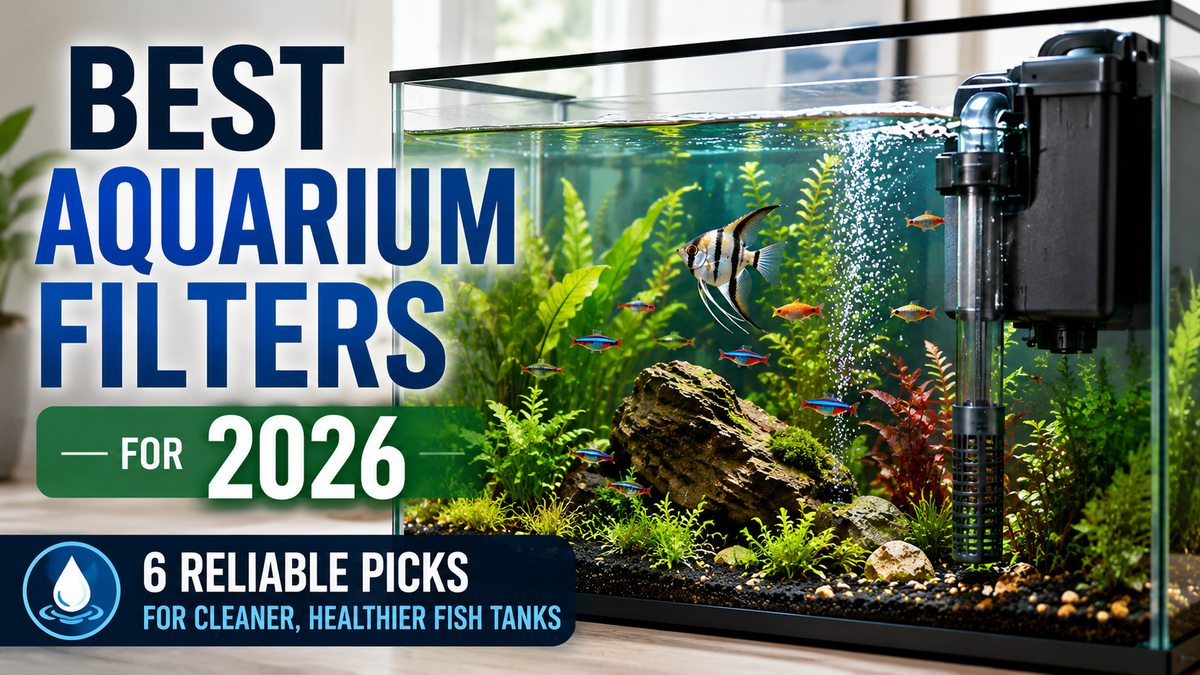
Choosing the best aquarium filter is one of the most important decisions you can make when setting up or improving a fish tank.
A good filter does much more than make aquarium water look clear. It helps remove physical debris, provides surfaces for beneficial bacteria, supports water circulation, and can reduce the buildup of waste that threatens fish health.
But choosing a filter isn’t always straightforward.
Should you use a power filter or a canister filter? How much filtration capacity do you actually need? Is the biggest filter always the best choice? And what matters more: aquarium size, flow rate, filtration stages, or the type and number of fish you keep?
This guide compares six aquarium filters featured in the PawTroveHub Aquarium Filters collection and explains what each one is best suited for.
The goal isn’t to tell you that one filter is automatically best for everyone. It’s to help you match the filter to your aquarium size, livestock, stocking level, water-flow requirements, available space, and maintenance preferences.
Quick Answer: What Are the Best Aquarium Filters in 2026?
Here are the six filters covered in this guide:
| Aquarium Filter | Type | Rated Aquarium Size | Best For |
|---|---|---|---|
| Fluval C4 Power Filter | Power filter | Up to 70 gallons | Medium-to-large aquariums |
| Fluval 307 Performance Canister Filter | Canister | Up to 70 gallons | Medium-to-large aquariums |
| Fluval FX4 High Performance Canister Filter | Canister | Large aquariums | High-capacity filtration |
| Fluval FX6 High Performance Canister Filter | Canister | Large aquariums | Very demanding setups |
| Fluval 407 Performance Canister Filter | Canister | Up to 100 gallons | Larger home aquariums |
| Seachem Tidal 55 Power Filter | Power filter | Up to 55 gallons | Adjustable, easy-access filtration |
These are the six filters currently featured in the PawTroveHub Aquarium Filters collection.
The key takeaway: don’t automatically buy the largest or most expensive filter. Choose the filter that provides appropriate filtration and water movement for your actual aquarium and livestock.
1. Fluval C4 Power Filter — Best Power Filter for Larger Aquariums
The Fluval C4 Power Filter is a strong option for aquarium owners who want substantial filtration without moving to a canister system.
It’s rated for aquariums up to 70 gallons and uses a five-stage filtration design. That makes it particularly appealing for medium-to-large freshwater aquariums where you want significant filtration capacity while keeping the convenience of a power filter.
Why consider the Fluval C4?
- Five-stage filtration
- Rated for aquariums up to 70 gallons
- Designed for quiet, reliable operation
- Suitable for medium-to-large aquariums
- Convenient power-filter format
Best for
Aquarium owners who want strong multi-stage filtration while keeping the simpler access and installation associated with a power filter.
Consider before choosing it
A 70-gallon rating doesn’t mean every 70-gallon aquarium has identical filtration needs. A heavily stocked aquarium can place greater demands on filtration than a lightly stocked tank of the same size.
2. Fluval 307 Performance Canister Filter — Best Mid-Size Canister Option
The Fluval 307 Performance Canister Filter is designed for aquariums up to 70 gallons and places the main filtration system outside the aquarium.
That can be useful when you want more filtration-media capacity while keeping equipment out of the main display.
Why consider the Fluval 307?
- Rated for aquariums up to 70 gallons
- Multi-stage canister filtration
- Large filtration-media capacity
- Designed for quiet operation
- Suitable for medium-to-large aquarium setups
Best for
Fish keepers who want the filtration capacity and flexibility of a canister system without necessarily moving into one of the larger FX-series filters.
Fluval 307: What makes it different?
Compared with a power filter, a canister system generally gives you more room to configure and organize filtration media.
That flexibility can be useful as an aquarium becomes more demanding, but it also means maintenance can be more involved than with a simple power filter.
3. Fluval FX4 High Performance Canister Filter — High-Capacity Choice for Large Aquariums
The Fluval FX4 High Performance Canister Filter is aimed at aquarium owners who need substantially more filtration capacity than a typical power filter provides.
It uses a high-performance canister design with advanced multi-stage filtration and is positioned for large freshwater and saltwater aquarium setups.
Why consider the Fluval FX4?
- High-capacity canister filtration
- Advanced multi-stage filtration
- Designed for large aquariums
- Suitable for freshwater and saltwater setups
- Built for demanding filtration requirements
Best for
Owners of larger aquariums who need substantial filtration capacity and prefer a canister system.
One important warning
More filtration capacity isn’t automatically better.
If your fish prefer calmer water, simply installing the largest filter you can afford may create excessive water movement. The goal is effective filtration without creating an unsuitable environment for your livestock.
4. Fluval FX6 High Performance Canister Filter — Best for Serious Filtration Demands
When aquarium size, stocking, or overall filtration demands increase, the Fluval FX6 High Performance Canister Filter becomes an option worth considering.
It’s a high-capacity canister filter with six-stage filtration and is designed for large freshwater and saltwater aquariums.
Why consider the Fluval FX6?
- Six-stage filtration
- Very high-capacity canister design
- Designed for large aquariums
- Suitable for freshwater and saltwater setups
- Built for demanding filtration requirements
Best for
Fish keepers managing large aquarium systems where filtration capacity is a major priority.
FX6 vs. FX4
The decision shouldn’t simply be:
“Which one is bigger?”
Instead, ask whether your aquarium actually benefits from the additional capacity.
A properly sized FX4 may be more sensible for one large aquarium, while a more demanding setup may justify moving up to the FX6.
5. Fluval 407 Performance Canister Filter — Best for Larger Home Aquariums
The Fluval 407 Performance Canister Filter is rated for aquariums up to 100 gallons and uses a five-stage canister filtration system designed around strong filtration, quiet operation, and convenient maintenance.
Why consider the Fluval 407?
- Rated for aquariums up to 100 gallons
- Five-stage canister filtration
- Designed for quiet operation
- Large filtration capacity
- Suitable for freshwater and saltwater aquariums
Best for
Aquarium owners looking for a capable canister filter for a larger home aquarium without immediately moving to an FX-series system.
407 vs. 307
Both belong to Fluval’s 07 Series, making the comparison fairly straightforward.
The 307 is rated for aquariums up to 70 gallons, while the 407 is rated for aquariums up to 100 gallons.
If your aquarium falls comfortably within the 307’s recommended range, the 407 isn’t automatically a better choice simply because it has greater capacity.
6. Seachem Tidal 55 Power Filter — Best for Adjustable, Easy-Access Filtration
The Seachem Tidal 55 Power Filter takes a different approach from the larger Fluval canister filters.
It’s rated for aquariums up to 55 gallons and features adjustable flow, self-priming operation, and mechanical, chemical, and biological filtration.
Why consider the Seachem Tidal 55?
- Rated for aquariums up to 55 gallons
- Adjustable flow
- Self-priming design
- Mechanical, chemical, and biological filtration
- Easy-access filtration system
Best for
Fish keepers who want flexible filtration with convenient maintenance and adjustable water flow.
The adjustable-flow feature can be especially useful when you need effective filtration but don’t want unnecessarily aggressive water movement.
View the Seachem Tidal 55 on Amazon
Fluval C4 vs. Seachem Tidal 55
If you prefer a power filter rather than a canister system, these two models are natural comparisons.
The Fluval C4 is rated for aquariums up to 70 gallons, while the Seachem Tidal 55 is rated for up to 55 gallons.
Choose the Fluval C4 if:
- Your aquarium is larger
- You want five-stage filtration
- You prefer the Fluval C Series
- You want substantial filtration capacity
Choose the Seachem Tidal 55 if:
- Your aquarium is up to 55 gallons
- Adjustable flow is important
- Easy media access matters
- You prefer a straightforward power-filter setup
Bottom line: both are power-filter options, but they serve somewhat different aquarium sizes and priorities.
Fluval 307 vs. Fluval 407
These two filters are especially easy to compare because they belong to the same Fluval 07 Series.
The Fluval 307 is rated for aquariums up to 70 gallons, while the Fluval 407 is rated for aquariums up to 100 gallons.
Fluval 307
A strong choice when your aquarium falls within its recommended capacity and you want the advantages of canister filtration.
Fluval 407
A better fit when you have a larger aquarium or want the additional capacity of the larger model.
The important point
Don’t choose the bigger filter simply because it’s bigger.
Choose based on:
- Aquarium size
- Stocking level
- Fish species
- Water-flow requirements
- Available installation space
- Maintenance preferences
Fluval FX4 vs. FX6
The FX4 and FX6 are designed for aquarium owners with much larger filtration requirements.
The biggest practical consideration is how much filtration capacity your aquarium actually needs.
Consider the FX4 when:
- You have a large aquarium
- You want high-capacity canister filtration
- You don’t need the additional capacity of the FX6
Consider the FX6 when:
- You have a very large aquarium
- Your filtration requirements are particularly demanding
- You want a larger-capacity system
Again, bigger isn’t automatically better.
A filter should be powerful enough for the aquarium without creating excessive water movement for the fish.
What Does an Aquarium Filter Actually Do?
Understanding filtration makes choosing the right filter much easier.
Aquarium filtration is usually discussed in three categories: mechanical, biological, and chemical filtration.
Mechanical Filtration
Mechanical filtration captures physical debris and suspended particles from aquarium water.
This can include:
- Uneaten food
- Fish waste
- Plant debris
- Suspended particles
Mechanical media is the part of filtration that helps make water look visibly cleaner.
Biological Filtration
Biological filtration is arguably the most important part of a stable aquarium system.
Biological media provides surfaces where beneficial bacteria can establish themselves. These bacteria contribute to the biological processing of fish waste and help support the aquarium’s nitrogen cycle.
A filter doesn’t magically make an aquarium biologically mature. The biological component develops as beneficial bacteria colonize suitable surfaces.
For a deeper explanation of aquarium filtration and responsible aquarium care, see the University of Florida IFAS aquarium filtration guidance.
Chemical Filtration
Chemical filtration uses specific media to address particular water-quality concerns.
Activated carbon is one familiar example, although not every aquarium needs chemical media running continuously.
The important point is that chemical filtration serves a specific purpose and should not be treated as a replacement for mechanical and biological filtration.
Can You Have Too Much Aquarium Filtration?
Yes — at least in terms of water movement.
It’s easy to assume that more filtration must always mean a healthier aquarium. That’s not necessarily true.
A very powerful filter can create strong currents that some fish find stressful or difficult to navigate.
The right goal is:
Enough filtration and circulation to maintain suitable water quality without creating inappropriate flow for your livestock.
This is particularly important when keeping fish that naturally prefer calmer environments.
So don’t judge a filter only by its maximum capacity. Consider the actual needs of the animals in your aquarium.
7 Aquarium Filter Mistakes to Avoid
Choosing a good filter is only half the job. Using and maintaining it correctly matters too.
1. Choosing Only by Aquarium Size
Manufacturer-rated aquarium capacity is an important starting point, but it isn’t the only factor.
A heavily stocked aquarium can place greater demands on filtration than a lightly stocked tank of exactly the same volume.
2. Automatically Buying the Biggest Filter
More capacity isn’t automatically better.
Water movement must also be appropriate for the fish and other livestock you keep.
3. Ignoring Installation Space
Measure the available space before buying.
This matters particularly with large canister filters, which may need room underneath or beside the aquarium.
4. Forgetting Maintenance Access
A filter that’s difficult to access can quickly become frustrating.
Think about:
- How easily you can remove the filter
- How easy it is to access media
- How often you’ll need to clean mechanical media
- Whether you can comfortably perform routine maintenance
A theoretically excellent filter that you hate maintaining isn’t necessarily an excellent filter for you.
5. Replacing Established Biological Media Unnecessarily
Established biological media can support beneficial bacteria.
Avoid replacing all established biological media unnecessarily, and follow the manufacturer’s maintenance recommendations for your particular filter.
The Merck Veterinary Manual also provides additional information relevant to aquarium care and filtration.
6. Ignoring Your Fish’s Water-Flow Preferences
Different fish have different preferences and tolerances for water movement.
Effective filtration should not come at the expense of creating an unsuitable environment.
7. Treating Filtration as a Replacement for Aquarium Maintenance
No filter eliminates the need for:
- Appropriate water changes
- Water testing
- Responsible stocking
- Proper feeding
- Routine aquarium maintenance
A filter is one part of the aquarium system, not the entire maintenance plan.
How to Choose the Right Aquarium Filter
Before choosing a filter, ask these six questions.
1. How Large Is Your Aquarium?
Start with the manufacturer’s recommended aquarium capacity.
Then consider the rest of your setup.
2. How Heavily Stocked Is It?
Stocking level can have a major effect on filtration demands.
A lightly stocked aquarium and a heavily stocked aquarium of the same volume don’t necessarily need identical filtration.
3. What Fish Are You Keeping?
Consider:
- Preferred water movement
- Adult fish size
- Waste production
- Compatibility with strong currents
- Freshwater or saltwater requirements
The filter should work for the livestock, not just the glass box.
4. Power Filter or Canister Filter?
Power filters
Power filters can offer:
- Convenient installation
- Easy access to media
- Straightforward maintenance
- Good filtration for many home aquariums
Canister filters
Canister filters can offer:
- Greater media capacity
- Flexible media configuration
- High filtration capacity
- A cleaner-looking display because much of the equipment sits outside the tank
Neither type is universally better.
The best choice depends on your aquarium and how you prefer to maintain it.
5. Where Will the Filter Go?
Check your available space before buying.
For a canister filter, measure the cabinet or area underneath the aquarium.
For a power filter, make sure there is enough clearance behind the aquarium and that the filter will fit securely.
6. What Is Your Realistic Budget?
Don’t spend substantially more for filtration capacity your aquarium doesn’t actually need.
A properly sized, well-maintained filter is usually a smarter choice than simply buying the most expensive model.
Filter Capacity Isn’t the Same as Good Aquarium Husbandry
One of the most important things to understand is that filtration capacity doesn’t solve every water-quality problem.
Fish continuously produce waste. Uneaten food and decomposing organic matter can also contribute to ammonia.
That means filtration works best as part of a broader aquarium-management routine.
If you’re concerned about water quality, don’t simply upgrade to a bigger filter without investigating the underlying issue.
Test the water, review stocking levels, check feeding practices, and make sure the filter is operating correctly.
For additional educational information about ammonia and aquatic systems, see the UF/IFAS guide to Ammonia in Aquatic Systems.
Don’t Forget the Rest of Your Aquarium Setup
A filter is important, but it’s only one part of a complete aquarium system.
If you’re still choosing the aquarium itself, see our Fish Tanks & Aquariums collection.
You may also need:
- Aquarium heaters
- Aquarium lighting
- Aquarium water conditioners and treatments
- Aquarium gravel and substrate
Choosing these components together can help you build a more suitable and manageable aquarium rather than treating the filter as an isolated purchase.
Frequently Asked Questions
What size aquarium filter do I need?
Start with a filter whose manufacturer-rated capacity covers your aquarium.
Then consider stocking level, fish species, desired water movement, available space, and your maintenance routine.
A 50-gallon aquarium with a heavy bioload may have different filtration needs from a lightly stocked 50-gallon aquarium.
Is a canister filter better than a power filter?
Not necessarily.
Canister filters can be particularly useful for larger aquariums because of their filtration and media capacity.
Power filters can provide convenient access and simpler maintenance.
The best choice is the one that fits your aquarium and your maintenance preferences.
Can an aquarium have too much filtration?
It can have too much water movement.
Some fish prefer calmer water, so filtration should provide effective circulation without creating unsuitable conditions.
If the flow is too strong, consider using adjustable flow, redirecting the outlet, or selecting a filtration setup better suited to the livestock.
How often should I clean my aquarium filter?
There isn’t one universal schedule.
Cleaning frequency depends on:
- Filter type
- Aquarium size
- Stocking level
- Feeding habits
- Filter media
- How quickly the media becomes clogged
Follow the manufacturer’s maintenance recommendations and inspect the filter if you notice reduced water flow.
Should I replace all filter media at once?
Avoid unnecessarily replacing established biological media all at once.
Biological media can support beneficial bacteria, so replacing it unnecessarily can disrupt the biological stability of the aquarium.
Follow the manufacturer’s recommendations for your specific filter and media.
Does a larger aquarium always need a canister filter?
No.
The best filtration setup depends on aquarium size, stocking level, fish species, available space, maintenance preferences, and budget.
Many aquariums can be successfully maintained with power filters, while larger or more demanding systems may benefit from canister filtration.
Do aquarium filters remove ammonia?
Biological filtration helps process ammonia through the nitrogen cycle when an established biological filter is functioning properly.
However, you shouldn’t assume that simply having a filter means ammonia cannot become dangerous.
Regular water testing, appropriate stocking, proper feeding, and routine maintenance remain important.
If ammonia is detected, investigate the cause rather than simply assuming you need a bigger filter.
Best Aquarium Filters for Different Needs
There isn’t one universal winner, but the six filters in this guide have different strengths.
Best power-filter option for larger aquariums
Fluval C4
A good fit if you want substantial filtration in a convenient power-filter format.
Best mid-size canister option
Fluval 307
A practical choice for aquariums up to its rated capacity when you want canister filtration.
Best high-capacity option for large aquariums
Fluval FX4
Designed for aquarium owners who need considerably more filtration capacity.
Best for very demanding large setups
Fluval FX6
A high-capacity choice when your aquarium’s filtration requirements justify the additional system capacity.
Best larger home-aquarium canister
Fluval 407
A useful middle ground between the 307 and larger FX-series filters.
Best adjustable power filter
Seachem Tidal 55
A strong option when adjustable flow and easy-access maintenance are priorities.
Final Verdict: Which Aquarium Filter Should You Choose?
The best aquarium filter isn’t necessarily the biggest, most powerful, or most expensive model.
It’s the one that fits your aquarium’s actual requirements.
If you want a power filter for a medium-to-large aquarium, the Fluval C4 is a strong option.
If you prefer canister filtration for a medium-to-large aquarium, the Fluval 307 offers a practical balance of capacity and flexibility.
For larger systems, the Fluval FX4, Fluval FX6, and Fluval 407 provide higher-capacity canister options for different levels of filtration demand.
If adjustable flow and easy-access maintenance are more important to you, the Seachem Tidal 55 is worth considering for aquariums within its rated capacity.
The smartest way to choose is to match the filter to:
- Your aquarium size
- Your stocking level
- Your fish species
- Their preferred water movement
- Your available installation space
- Your maintenance preferences
- Your realistic budget
Don’t buy filtration simply because the specifications look impressive.
Buy the filtration your aquarium actually needs — and maintain it properly.
For more educational background on responsible aquarium keeping and water-quality management, the UF/IFAS guide to responsible aquarium fish ownership is a useful additional resource.
When you’re ready to compare the six selected models, visit the PawTroveHub Aquarium Filters collection.
PawTroveHub may earn a commission from qualifying purchases. Product availability, specifications, and prices can change, so check the retailer’s current listing before purchasing.
Updated September 2026.